/pic3621105.jpg)




















Agra Deep Dive
What the Community Thinks About Agra
Agra occupies a curious position among heavy euro games: it is visually stunning and mechanically ambitious, yet it remains somewhat under the radar. Channels like Board Game Sanctuary and The Broken Meeple recognize it as one of the grandest euro experiences available, a game that demands serious engagement with resource management and planning but rewards players who master its intricate systems.
Core Mechanics That Define Agra
The Resource Refining Chain
The heart of Agra lies in its sophisticated approach to resource management. Players begin with basic goods like wood and sandstone, then trade and refine these resources through long conversion chains to create increasingly luxurious items. The board itself functions as a single massive resource tree, where one material can be transformed into another, then into another again, all in service of gaining points or constructing buildings. This layered system is what truly sets Agra apart, with reviewers noting the sheer variety of goods players must navigate. Each decision about which conversion chain to pursue carries weight, creating meaningful strategic pathways. Designed by Michael Keller and published by Quined Games, it commits fully to that depth.
Worker Placement and Meditation
Agra employs a clever worker-placement system built around meditation, a mechanic that transcends simple action selection. Players position workers not just to take standard actions, but specifically to gain meditation points, which in turn grant additional actions beyond the normal turn structure. This creates a unique strategic layer where forward planning and patience yield concrete benefits, rewarding players who think several turns ahead.
The Agra Experience
Diverse Paths and Competitive Trading
Each game of Agra unfolds along a distinct path. Players transform and trade their goods through diverse routes, each pursuing different goods and gaining favor with the nobles and the Padishah in their own way. The competitive element centers heavily on trading and exchanging, making negotiation and player interaction crucial to victory. Diversity in approach is rewarded; the game does not force all players down the same strategic path, but rather celebrates the plurality of viable strategies.
Building Influence Through Gifts
The ultimate goal revolves around delivering the most valuable gifts to the emperor. Players can only deliver goods that the emperor has not yet been served, placing a premium on both luxury and uniqueness. Supporting guilds along the way provides extra abilities and bonuses, adding another layer of strategic choice. The influence track measures success, and players must balance immediate gains against long-term influence building to emerge victorious. Because the emperor can only be served a given good once, watching what opponents are refining matters as much as planning your own chains, and a well-timed delivery can shut a rival out of the gift they were building toward all game.
What Makes Agra Stand Out
Visual Spectacle and Presence
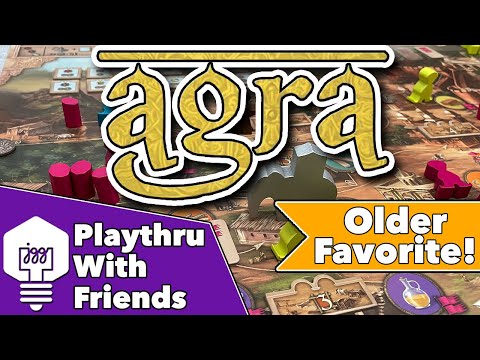
Agra is, by multiple accounts, a beautiful game. Michael Menzel's artwork creates a board that looks gorgeous when laid out, and the physical components contribute meaningfully to the experience. The distinctive display with its colored wooden cylinders transforms the table into a spectacle, making Agra one of the most visually impressive heavy euros in circulation. This aesthetic achievement elevates the experience beyond mere mechanics.
Sandbox-Like Depth Without Overwhelming Randomness
Despite its complexity, Agra offers something closer to a sandbox experience than a rigid ruleset. The abundance of resources, conversion chains, and strategic choices creates the sense that many different approaches can succeed, provided players execute them well. Yet reviewers emphasize that this is not chaotic or overwhelming; rather, it is a coherent system in which every element serves a purpose and connects to every other element.
Potential Drawbacks
Substantial Complexity and Table Presence
Agra demands serious engagement. It is a game that takes up meaningful table real estate and requires players to hold multiple strategic threads simultaneously. The sheer number of resources and conversion options means that turns can involve many decision points, and teaching the game demands patience and clarity. This is not a game for casual evenings; it is a heavyweight euro in the truest sense.
The Risk of Underestimation
Because Agra has not achieved the profile of other major euro titles, there is a risk that players might acquire it without fully appreciating the commitment it requires. Reviewers note that the game appears complex and is complex, making it important for potential buyers to be clear about their tolerance for heavy strategic games before bringing it to the table.
If You Enjoy Agra
If Agra captures your interest, you will likely find similar satisfaction in Agricola, which shares Agra's depth of resource management and worker placement, as well as its substantial box and table presence. Both games reward long-term planning and offer multiple viable paths to victory, and players who relish that kind of dense resource-conversion puzzle should also look at heavyweight euros like Le Havre.
What Reviewers Are Saying
"This is one of the grandest euro games you'll ever see. You take on the role of an ambitious landowner who uses basic resources such as wood and sandstone and trades them to create wares and acquire luxurious goods, which you'll use to woo the notables. This is a beautiful game called Agra, and I love it."
— Board Game Sanctuary
"This is another heavy worker-placement game, but I feel like it has flown under the radar a little bit. It's a typical heavy euro where you're managing resources, producing them, and converting them into other resources to get points. The twist is that there are just so many resources here, doing these long conversion chains."
— Totally Tabled
"It's not even so much that it's a heavy euro, there's plenty of those around, it's the fact that it just looks gorgeous when it's laid out. Michael Menzel does the artwork, and anytime he touches the board it looks beautiful. Then you see that weird display with all the wooden cylinder bits on it, all colored. It's a bit of a spectacle on the table, but it also looks complex as hell."
— The Broken Meeple