







Algae, Inc. Deep Dive
What the Community Thinks About Algae, Inc.
Reviewers and preview channels describe Algae, Inc. as a medium to heavy Euro game from Game Brewer in which each player runs one department of the same algae company. Coverage from Meeple University and Watch It Played centers on the production chain and the tile upgrades that drive it, while Let's Table It focuses on how closely the processes mirror real algae manufacturing. The praise mostly concerns how differently each department plays, and the caution mostly concerns how much there is to absorb before a table can plan with confidence.
Board Gaming Ramblings ranked the game among the top three titles it played in February and described it as a game that invites you to keep diving deeper. Getting Games was drawn to the title through its tile placement, income, and tech tree elements, and the host disclosed a likely sponsored tutorial, a point viewers should weigh alongside the preview. Several channels stressed that the components they handled were prototypes, so rules and artwork could still change before release.
Core Mechanics That Define Algae, Inc.
The Asymmetric Player Board Production Line
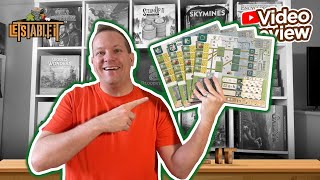
Each player controls one of four departments: Cosmetics, food, bioplastics, or biofuel. Brody at Let's Table It walked through how the Cosmetics board turns algae into hand soap, toothpaste, and skin cream, while the food board produces Burgers, drinks, Nori, and candy. Every board works like an assembly line of conveyor belts that push algae cubes through machines A, B, and C toward a finished product, and upgrade tiles change how that line runs. Stella at Meeple University pointed to the contrast between departments: the food department can make candy with a single machine, while Cosmetics requires running three machines but commands higher value, with the trade-off that its products cannot be mixed when delivering.
Resource Management Through Energy, Byproducts, and Science
Reviewers consistently describe the board as a juggling act of limited resources. Energy moves on its own track and determines whether a player receives weekly bonuses, byproducts such as biomass and bio oil can be burned for energy or sold for money, and science points unlock tiles that improve the line. Stella noted that a player can become stuck in an action with no efficient follow-up, such as a machine action without product to manufacture, and that wild tokens and exchange rates of 2:1 or 3:1 between tokens and money give the player room to recover. Matthew at Watch It Played summarized the design as Resource Management, Tableau building, and multi-processing in one package.
The Algae, Inc. Experience
An Economic Business Strategy
Commerce sits at the center of the experience. Players race to fill export demands in cities across Europe, and Stella explained that the first player to deliver to a city gains a bonus token while others can still deliver there without paying the same delivery cost. Milestones, export discs, and market demand tokens all push players to think about which markets to serve and when. Meeple University later described the scoring as objective-driven, where the tokens you place matter less than the combinations they complete, and the game escalates into a large final round. That business framing is the core of the appeal for players who like running a company rather than a battlefield.
Rewarding Mastery Across Four Departments
Replay value comes from the departments themselves. Brody at Let's Table It observed that once a player has mastered one department, three others remain to be explored. Stella added that the milestones, the player's private contract cards, and the meeple action parts are semi-random, so the setup changes from game to game. Several reviewers framed the game as one that teaches its systems gradually, with its depth opening up over repeated sessions.
What Makes Algae, Inc. Stand Out
Asymmetric Departments That Change How You Play
The most consistent praise targets the asymmetric boards. Johannes at Board Gaming Ramblings described the departments as having very different play styles, with each player working toward their own goals and driving production in a different direction. Brody noted that players focus on different parts of the company, so no two tables play the same way. Stella highlighted that each board carries its own strengths and constraints, which makes the choice of department a strategic decision in its own right.
A Theme Grounded in Real Processes
Reviewers also single out how faithfully the game depicts its subject. Brody argued that although real-world algae processing is more complex than what appears on the table, the game's processes are genuine processes of turning algae into products. Board Gaming Ramblings similarly described the game as "an asymmetric economic Euro game about using the algae in different processes to make different products," and the cosmetics, food, bioplastics, and biofuel departments give the theme concrete texture rather than an abstract coat of paint.
Potential Drawbacks
Setup Weight and a Steep Learning Curve
Brody acknowledged that the game has a lot of different parts and tiles, and that forming a strategy takes time. Stella also described many decisions about which upgrades to take, which combined with the four departments and the layered tile system, asks a lot of a first-time table. Players who want a light, quick Euro may find the early turns slow as they learn how each board's conveyor belts, storage tanks, and scoring tracks interact.
Stuck Actions and Prototype Uncertainty
Stella described moments when an action leaves a player with no efficient follow-up, which can lead to downtime or an inefficient turn. The wild and question mark tokens soften this, but reviewers still noted that the options can feel constrained in a bad position. Because the coverage was based on prototype copies, with Stella explicitly noting that rules and artwork were not final, readers should expect some details to change before the Kickstarter and retail release.
If You Enjoy Algae, Inc.
Algae, Inc. suits players who enjoy planning a production chain several turns ahead. Matthew at Watch It Played said that tile placement and tech tree elements were what made the game stand out to them, and the Getting Games host listed a similar mix of tile placement, income, and tech trees as the reason for interest. Stella described the game as asymmetric engine building where actions can only be taken in a specific order and the goal is to keep finding ways to trigger more actions. Those who like optimizing a line, managing a flexible economy, and replaying the same system through different roles are the audience this game is built for.
What Reviewers Are Saying
"The food manufacturer for example can make candy with a single machine easily but they love value and they do great between rounds while it's harder to manufacture all Cosmetics products operating three different machines but they have longer shelf life higher value but you can't mix and match when delivering. No one wants to brush their teeth with skin cream right."
— Meeple University
"Super good game, spoiler alert. I really really enjoyed it just like one of those games that gives me that feeling of oh this is fun and the there's so much upgrading things to do."
— Board Gaming Ramblings
"One of the best things I really like about this game is that even though in real life these processes might be more complex than you know what's shown on the table or on these boards, they are real processes of using algae to make products."
— Let's Table It