/pic4070329.jpg)
Altiplano is a bag-building game along the lines of Orléans, set in the South American highlands of the Andes (the "Altiplano"). The competition for limited resources is considerable, as it was in Orléans, but the greater focus in Altiplano is on building up your own production to be the best that it can be - or at least better than that of the other players!
The object of the game is for players to use their goods to produce more goods that will be worth points in the end. Each player starts with a unique role tile, giving them access to different goods and methods of production. Players have limited access to production at the start, but they can acquire additional production sites during the game that open up new options. The various types of goods — such as fish, alpaca, cacao, silver and corn — all have their own characteristics and places where they can be used. For example, silver can be sold for a high price at the market, fish can be exchanged for other goods at the harbor and alpaca can produce wool at the farm that can then be made into cloth.
Aside from building up an effective production, players must fulfill their orders at the right time, develop the road in good time and store their goods cleverly enough to fill their warehouses in the most valuable way. Often, a good warehouse keeper is more relevant in the end than the best producer.


Altiplano: Learn to Play

30 Hour Marathon: Hours 13-17
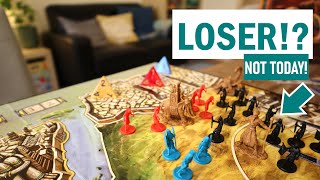
- Cool integrated grading mechanism that keeps things tight
- Gives falling behind players a chance to win
- Can seem to reward poor decision making initially, but serves to balance the game.
- Expanding a clan's kingdom by purchasing and selling tiles
- Carcassonne
Mechanics (from transcript analysis)
- catch-up mechanism — From round three onwards, players receive coins based on their position behind the leader on the victory point track.
- Resource Management — Coins are awarded as a catch-up mechanic, influencing economic decisions.
- Tile Placement — Players purchase and sell tiles to build their map and satisfy objectives.
Video topics + discussion points
Quotes (from this video)
- when it comes to playing board games I think I'm a pretty big loser in fact I think I lose about 75 of the games that I've played
- the feeling of winning is pretty good
- the competitive nature is what really makes games so exciting it's like watching a really tense action movie
- progress is a huge factor for determining whether you're winning or losing and how far you're losing behind the winning player
- hidden information about how far each player is progress throughout the game means that the tension and the suspense level throughout the game remains High until that very final reveal
- this little balancing mechanism as you can see as you get further and further up the victory Point track the red lines become more and more frequent
- the power to manipulate the turn order if you're losing the game really helps to keep things even
- what do you think about losing in board games are you someone who wins a lot loses a lot or you don't care either way I'd love to hear about your board game experiences in the comments section below
References (from this video)
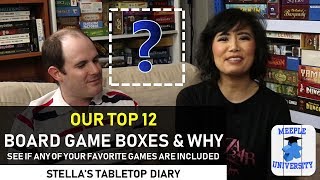
- Minimalist design with a central image
- Highlights a cute element (first player marker)
- Distinctive background pattern
- Garish background pattern
Mechanics (from transcript analysis)
Video topics + discussion points
Quotes (from this video)
- When a board game's sitting on the shop on the shelf sometime and get me interested to actually purchase it Oh on Kickstarter but more especially in boy game shop
- I almost pick a game based on pick a design based on the color on the spine and just liking the color palette and so you'll see that a bit through the first three that come up they're all guys or I really like the color palette on the spine and it transfers on to the front as well
- The reason is Tarrant started at pointing at board game covers originally and we sometimes think that you know when a board games sitting on the shop on the shelf sometime and get me interested to actually purchase it
- It's a book look the magnetic strip it's just the McCulloch I'm not gonna start saying the color plant pellet the color is good is golden with black keys it looks like an old just antique book
- This is a pizza box pizza box literally look but it is the what game food what game it's amazing
- it's excellent marketing it's yes taking the marketability to the next level
References (from this video)
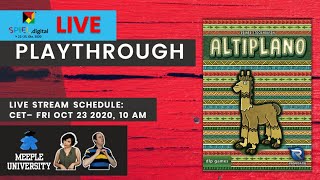
- Described as a classic and one of the hosts' favorites
- Flow is accessible after learning rounds
- Contract system provides engaging scoring opportunities
- Traveler expansion adds interesting passive abilities
- Can be solitary with limited interaction in two-player play
- Some players find it restrictive and repetitive
- Bag-draw randomness can be frustrating and punishing
- Resource management can be tricky and easy to mismanage
- trading and alpaca farming
- South American high country
- Orleans
Mechanics (from transcript analysis)
- Area Movement — Players move across seven areas of the board to collect materials.
- area_movement — Players move across seven areas of the board to collect materials.
- Bag Building — Tokens are drawn from a bag to form a hand; the bag is shuffled with tokens as the round progresses.
- bag_building — Tokens are drawn from a bag to form a hand; the bag is shuffled with tokens as the round progresses.
- Compound Scoring — Warehousing and end-of-round token management influence scoring potential.
- Contracts — Contracts provide points and have rules about open contracts and limits on how many can be taken.
- Deck Building — Described as essentially a deck-building game in token form; actions recycle tokens into a pool.
- deck_building_style — Described as essentially a deck-building game in token form; actions recycle tokens into a pool.
- market_and_purchases — Market row and purchasing actions drive game progression and resource conversion.
- missions_and_objectives — Starting families and two objective cards per game provide targets to pursue.
- Resource Management — Players collect resources (food, ore, wood, silver, coco, glass, cloth, etc.) and convert them into points.
- resource_management — Players collect resources (food, ore, wood, silver, coco, glass, cloth, etc.) and convert them into points.
- road_expansion — Advancing on the road increases effective hand size and unlocks actions.
- warehousing_and_storage — Warehousing and end-of-round token management influence scoring potential.
Video topics + discussion points
Quotes (from this video)
- it is essentially a deck builder but in the form of these tokens
- it's one of our classics
- the draw of the tiles feels more like drawing five cards in a deck builder and not getting the hand you want but it just feels more frustrating coming out of a bag
- we interacted even less because at least we both have war and fish
- two players is enough for this game
- Orleans has got just um specifically focus on it's a it's got a couple more specific things
References (from this video)

Mechanics (from transcript analysis)
- Bag-building / hand management — A bag-building engine with varied player actions to optimize scoring.
Video topics + discussion points
Quotes (from this video)
- This is a delightful small convention.
- The Rage Bucks program... it is fantastic.
- It's a huge huge game library.
- Every con should be using this Cardboard Events system.
References (from this video)
Mechanics (from transcript analysis)
Video topics + discussion points
Quotes (from this video)
- This game rips.
- I wish my wallet was full of fat stacks like this.
- So, we're going to be playing this game hypothetically.
- My filming assignment was to capture the essence of sadness, and I did.
- Tom, I will always travel with you and not with Eric Supper.
- I don't know if that man has had a single flight not get canceled.
References (from this video)
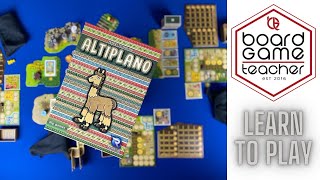
- Workers gathering resources, storing them, and fulfilling orders to become the most successful.
- South American highlands
Mechanics (from transcript analysis)
- action selection — Players take one action at a time in turn order until all players pass.
- Bag Building — Players draw tiles from a bag to their planning spaces and refill the bag from their container when it runs out.
- Resource Management — Players gather, store, and use various goods tiles (food, wood, stone, ore, cloth, wool, silver, fish, glass, alpaca, cacao, coins, carts) to fulfill orders and gain points.
- Set Collection — Players score points for collecting sets of goods, boats, houses, and fulfilled orders.
- Tile Placement — Location tiles are placed randomly in a circle, and players place tiles on their action spaces.
- Worker Placement — Players move their pawns to different location tiles to take actions.
Video topics + discussion points
Quotes (from this video)
- welcome today we're gonna be taking a look at alta plano
References (from this video)
- Really, really enjoy it.
- Love the gameplay.
- Artifacts provide variety.
- Deluxe wooden boards look very cool.
- The festival theme is the least favorite part.
- Uncertain about gameplay longevity compared to other systems.
- The current experience is with a prototype, not the final retail game.
- Festival
- Dune Imperium
- Endless Winter
- Last Ruins of Arnak
Mechanics (from transcript analysis)
- dice building — Players build and upgrade a pool of dice.
- Resource Management — Managing dice and artifacts to achieve goals.
- Set Collection — Collecting artifacts to work engines around.
- Worker Placement — Dice are used to place workers and gain benefits.
Video topics + discussion points
Quotes (from this video)
- If you've been around for a bit on the channel, then you know that I have the series Chewback or Not to Back, one of my most popular series, but one that I ultimately stopped doing for a variety of reasons.
- I'm not yet sure if it's a keeper for me. There's many things that I really enjoyed, and I do want more plays out of it for now, but it's one of those games that the biggest problem with Entropy, as far as I'm concerned, is that there are so many amazing Eurogames, and I have to be very particular which games actually get my time versus which games do I want to give more time to.
- I don't think games need to be forever.
- These are by far the best swappable dice faces I have ever played in any game.
- The testimonial they have of Blatro is like, 'These dice really work well.' Which is true. The dice do really work well, and I was concerned they wouldn't.
- For clarity, I love the game. I thought it was great.
References (from this video)
Mechanics (from transcript analysis)
Video topics + discussion points
Quotes (from this video)
- we are going to show you a one round playthrough for altiplano and describe what we're doing to give you a flavor of how this game flows
- I'm sort of in a fish heavy strategy I've picked up quite a lot of fish
- Stella has more of an alpaca heavy strategy starting character has the alpaca so that's very helpful there
- basically I'm putting food as bait and then an alpaca toss and then oh I capture it Wow alpaca trap
References (from this video)

Mechanics (from transcript analysis)
Video topics + discussion points
Quotes (from this video)
- fill your warehouse pro your resources and wealth in your little village
- designed by rainier sarcasm and published by gail b games
- players will have a pool building economy
- movement becomes a critical part of the actions phase
- you can never place food into your warehouse
- the player with the highest score wins in the event of a tie whoever has the most money left over wins and is still tired victory is she
- resources that are worth a lot of victory points are not very useful for performing actions and vice versa
- everything comes with a balance in the game
References (from this video)
Mechanics (from transcript analysis)
Video topics + discussion points
Quotes (from this video)
- Hi, it's Tarrant. And Stella from Meeple University bringing you a variety of quality board game videos.
- On this channel, we do a lot of how to play, play through, review, vlog, and other view just like this one.
- If you're new here, please consider subscribing and do hit the bell to be notified of when we post new videos.
- And that's what to expect from Altiplano.
- We hope that you enjoyed the video and we hope that it helps you.
- If you'd like to learn the full rules to the game, we have a how to play video, and you can check that out by clicking on the link in the description below.
- If you enjoyed this video, please let us know by hitting the like button.
- Write your comments, feedback, questions in the comment sections below.
- You can also join our Facebook group, Meeple University Community, to share your love of board games.
- And finally, if you'd like to be among the first notified of what's new from Meeple University, please consider subscribing to our channel.
References (from this video)
- Potential for efficient resource conversion.
- Strategic depth in planning actions.
- Engaging route-building element.
- Satisfying warehouse management and special token use (corn).
- Misplaying the warehouse can lead to suboptimal early game.
- Dependence on food for using carts effectively.
- Andean region
Mechanics (from transcript analysis)
- action selection — Players choose from a limited set of available actions during their turn.
- Bag Building — Drawing tokens from a bag, with the potential to acquire new tokens or improve the contents of the bag over time.
- Route Building — Moving a marker along a track or road, spending resources to advance and unlock new opportunities.
- Set Collection — Collecting specific sets of tokens or resources to fulfill orders or achieve objectives.
- Worker Placement — Placing tokens on action spaces to perform specific actions, such as gathering resources or interacting with locations.
Video topics + discussion points
Quotes (from this video)
- we are going to show you a one round playthrough for altiplano and describe what we're doing to give you a flavor of how this game flows
- I'm sort of in a fish heavy strategy I've picked up quite a lot of fish
- Stella has more of an alpaca heavy strategy starting character has the alpaca so that's very helpful there
- basically I'm putting food as bait and then an alpaca toss and then oh I capture it Wow alpaca trap
References (from this video)
- Multiple pathways to victory.
- Variable setup enhances replayability.
- Strategic depth in resource management and action planning.
- Engine building potential through carts and extensions.
- Movement rules can be tricky for new players.
- Some key resources are difficult to obtain through basic actions.
- Pool building economy, trading for and gaining various resources cards and building the road in order to build up wealth.
- Somewhere between the high mountain ranges of Bolivia and Peru
Mechanics (from transcript analysis)
- action selection — Players plan actions by moving tokens from planning spaces to action spaces on their player board and then execute these actions during the actions phase, provided their meeple is at the corresponding location.
- Bag Building — Players gather resource tokens into a bag, draw them blindly into planning spaces, use them for actions, and discard them. The discard container is recycled into the bag when it's empty.
- End game trigger — The game ends when the extension market cannot be refilled or when any one of the seven location tiles becomes completely empty of resource tokens or cards.
- Movement — Movement is restricted and based on planned food tokens and purchased carts. Players have one free movement (1-3 spaces) and subsequent moves require spending food. Carts allow for longer distance travel when food is spent.
- Set Collection — Players aim to collect sets of resources for orders or specific resources to complete rows in their warehouse for bonus points.
- Variable player powers — Players start with a unique roll tile that dictates starting resources and may influence which extensions they can purchase.
- Worker Placement — A player's meeple must be at the location tile that matches the action the player wishes to take.
Video topics + discussion points
Quotes (from this video)
- fill your warehouse pro your resources and wealth in your little village
- designed by rainier sarcasm and published by gail b games
- players will have a pool building economy
- movement becomes a critical part of the actions phase
- you can never place food into your warehouse
- the player with the highest score wins in the event of a tie whoever has the most money left over wins and is still tired victory is she
- resources that are worth a lot of victory points are not very useful for performing actions and vice versa
- everything comes with a balance in the game
References (from this video)
- Many paths players can take
- Resources useful for trading
- Resources worth more victory points
- Cash purchases enable buying new carts or extensions
- Extensions offer additional actions and bonuses
- Building houses grants bonus points
- Fulfilling orders can be worth good quantity of points
- Mission cards provide bonus points for completing objectives
- Warehouse system allows thinning resources from circulation while still scoring points
- Scoring additional points for filled warehouse rows
- Certain resources have limited or no engine-building capabilities
- Orders often require combinations of resources from different tactical paths
- Building a warehouse, growing resources and wealth in a village
- South American Highlands, somewhere between the high mountain ranges of Bolivia and Peru
- Orléans
Mechanics (from transcript analysis)
- action selection — Players plan their turns by placing tokens into specific action spaces, and then take actions one at a time.
- Bag Building — Tokens are drawn from a bag, and discarded tokens are returned to the bag once it's empty, creating a cycle.
- Order Fulfillment — Players can take and fulfill orders which require combinations of resources and grant points.
- pool building — Players draw tokens from a bag, place them into planning spaces, and then use them to take actions. Tokens are discarded and returned to the bag once empty, cycling through the player's entire pool.
- Resource Management — Players collect various resource tokens (e.g., alpacas, fish, cocoa, cloth, glass, silver) which have different uses for trading, scoring, or purchasing upgrades.
- Set Collection — Players can gain bonus points by filling rows in their warehouse with specific resource types or corn (wild).
- Variable player powers — Building houses grants bonus points for specific resource types gathered.
Video topics + discussion points
Quotes (from this video)
- Hi, it's Tarrant. And Stella from Meeple University bringing you a variety of quality board game videos.
- On this channel, we do a lot of how to play, play through, review, vlog, and other view just like this one.
- If you're new here, please consider subscribing and do hit the bell to be notified of when we post new videos.
- And that's what to expect from Altiplano.
- We hope that you enjoyed the video and we hope that it helps you.
- If you'd like to learn the full rules to the game, we have a how to play video, and you can check that out by clicking on the link in the description below.
- If you enjoyed this video, please let us know by hitting the like button.
- Write your comments, feedback, questions in the comment sections below.
- You can also join our Facebook group, Meeple University Community, to share your love of board games.
- And finally, if you'd like to be among the first notified of what's new from Meeple University, please consider subscribing to our channel.
References (from this video)

- The yellow track was perceived as too strong by playtesters.
Mechanics (from transcript analysis)
- Blue Track — The blue track in Altiplano was mentioned in the context of players not utilizing it, suggesting a potential strategic imbalance or player preference influencing its use.
- Yellow Track — The yellow track in Altiplano was mentioned as being too strong by playtesters, indicating a potential balance issue within a specific game mechanic.
Video topics + discussion points
Quotes (from this video)
- crowdfunding makes our games better.
- "Hey, the yellow track on Altiplano is really strong right now."
- "And so it it is a a process that without the hype of a Kickstarter it might or a game fund campaign, it might be hard pull those people to the playtesting table, and so it'll just be a different process."
References (from this video)

- Simultaneous planning reduces downtime
- Extensions allow crafting a personalized strategy
- Warehouse mechanic adds a lean bag strategy and meaningful decision space
- Good variability with roll tiles, extension stack, and optional mission module
- Two-player game scales reasonably to other player counts
- Length and pacing; about two hours regardless of player count
- Balance concerns among role tiles; some roles seem easier or harder for new players
- Optional mission module can clash with role dynamics and may not suit all groups
- Mostly solitaire engine-building with limited direct interaction
- resource management and planning
- South American Highlands
- Or Leone
Mechanics (from transcript analysis)
- Bag Building — Players pull resources from a bag at the start of each turn and place them into a planning area.
- bag-building — Players pull resources from a bag at the start of each turn and place them into a planning area.
- canoes and resource deck — A canoe deck provides immediate resource bonuses; canoes are worth points and are removed when taken.
- corn tokens and wild resources — Corn tokens act as wild resources and affect movement or abilities; can be used to progress and customize actions.
- End Game Bonuses — End-game scoring includes resources, canoes, houses, completed orders, and optional mission cards that add variability.
- end-game scoring and missions (optional) — End-game scoring includes resources, canoes, houses, completed orders, and optional mission cards that add variability.
- market, orders, and extensions — Players can buy extensions from a market and complete orders to generate victory points.
- Resource Management — Corn tokens act as wild resources and affect movement or abilities; can be used to progress and customize actions.
- Simultaneous Actions — All players plan their actions at the same time; each player takes a single action per turn.
- simultaneous planning and action selection — All players plan their actions at the same time; each player takes a single action per turn.
- warehouse and row-based scoring — Resources are stored in a warehouse in rows; finishing rows yields end-game points and encourages lean bag strategies.
- Worker Placement — A worker pawn is moved to locations to perform actions; there are seven locations and actions occur when your worker is on a location.
- worker placement with fixed slots — A worker pawn is moved to locations to perform actions; there are seven locations and actions occur when your worker is on a location.
Video topics + discussion points
Quotes (from this video)
- Altiplano is a bag builder which means it's similar to deck builders
- the warehouse is a wonderful mechanic tell facilitate keeping a nice lean bag
- I really enjoy asymmetry in games in general and I think that Altiplano is no exception here
- Simultaneous as you are you know figuring out all the hard parts of the game you're doing it at the same time
- I enjoy the process of trying to figure out which ones I want and then once I get them just trying to run them as often as I can
References (from this video)
- Engaging bag-building mechanic
- High resource diversity
- Strong thematic setting for a Euro game
- Can be heavy for new players
- Older edition may affect availability or access
- mercantile bag-building and resource management
- Andean high plateau with a focus on resource gathering and trade
- economic/abstract
- Clash of Cultures
- EPO
Mechanics (from transcript analysis)
- Bag Building — Players assemble bags of resource tokens and draw from them to perform actions.
- bag-building — Players assemble bags of resource tokens and draw from them to perform actions.
- economic_engineering — Optimizing resource conversion and ordering for scoring potential.
- Engine Building: Efficiency — Optimizing resource conversion and ordering for scoring potential.
- Resource Management — Managing a variety of resource types with different values and uses.
- resource_management — Managing a variety of resource types with different values and uses.
Video topics + discussion points
Quotes (from this video)
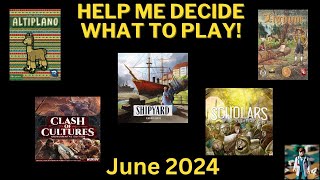
- I love the input from the community and I want to expand that input to the YouTube world as well
- five games that in this upcoming month of June most likely near near the end of June
- the first one is Altiplano
- I'll include the link or the poll… down in the description below for you to participate
References (from this video)
- deep engine-building with multiple viable endgame paths
- satisfying planning phase that rewards long-term planning and flexibility
- strong synergy between boats, buildings, and warehouse scoring
- rules can be dense and intimidating for new players
- late-game planning can feel punishing if mismanaged
- farming, trade, and artisan production in a small village
- Andean frontier village, resource management
- analytical playthrough with emphasis on resource flow and endgame scoring
- Orléans
Mechanics (from transcript analysis)
- bag_building — players draw and activate tokens from their own bag to perform actions.
- boat_and_endgame_scoring — building boats provides endgame points and access to new resources; endgame scoring emphasizes both buildings and orders.
- extension_market_and_orders — a market of extensions and orders that modify actions and scoring.
- planning_phase — a simultaneous planning phase where players place actions on a shared map using planning tiles.
- warehouse_and_buildings — resources are stored in a warehouse; buildings grant endgame points and unlock scoring opportunities.
Video topics + discussion points
Quotes (from this video)
- this is a bag-building game
- fish are worth zero points at the end of the game
- buildings give you quite a bit of victory points
- boats give us points and access to hard to grab resources
- the market is a place to pick up extensions and orders
References (from this video)

- Innovative bag-building flavor
- Engaging planning phase
- Rules can feel heavy
- Setup can be involved
- city planning, logistics
- High-altitude city/bag-building theme focusing on resource management.
- abstract
- Gizmos
- Reef
- Baron Park
Mechanics (from transcript analysis)
- Bag Building — Draw and place tiles from a bag to fulfill city plans and trigger bonuses.
- bag-building — Draw and place tiles from a bag to fulfill city plans and trigger bonuses.
- Resource conversion — Trade in resources to fit objectives and optimize scoring lines.
- Resource Management — Trade in resources to fit objectives and optimize scoring lines.
- Set Collection — Acquire resources to upgrade or complete objectives for points.
Video topics + discussion points
Quotes (from this video)
- Gizmos is one of my all-time favorites.
- Baron Park is all about efficiency.
- If you're not cheating, you're not trying.
- Baron Park is all about efficiency, and the bears are watching.