
































Anno 1800: The Board Game Deep Dive
What the Community Thinks About Anno 1800: The Board Game
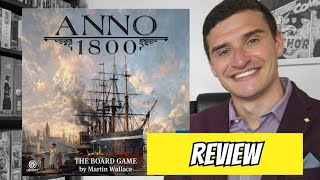
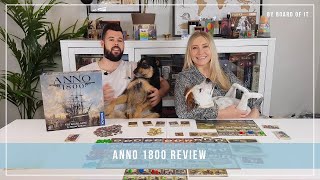
Anno 1800: The Board Game is a colonial engine builder for two to four players, with a listed playing time of 120 minutes. Martin Wallace designed it, Cosmos published it in 2020, and it draws on the Ubisoft city builder for PC. Reviewers agree that the game rewards players who enjoy a dense puzzle, but they split on whether that density is a strength or a burden. Most describe it as a game of options first and player conflict second.
Core Mechanics That Define Anno 1800: The Board Game
On a turn you take one action from a menu that includes building industries, adding workers, upgrading workers, building ships, exploring the Old and New Worlds, and playing population cards. Industries are built by activating the goods a tile requires, and each tile unlocks the next, so the engine grows out of simple beginnings. Trade tokens let you use goods you lack. The cost depends on worker colour, and the owner of the good receives a gold coin. Returning workers to the board costs gold, which turns recall timing into a planning decision. The game ends once one player empties their hand, and everyone gets one more full turn.
Resource Management
Goods flow through a chain of dependencies, and the central tension is deciding which worker to commit where. Reviewers describe the midgame as a steady search for the missing good, whether that is a light bulb, a sausage, or a cheap brick. Because recalling workers costs gold, efficient play means recalling as little as possible while still advancing your board.
Hand Management
Population cards provide most of the victory points and also create the main pressure. Your hand grows as you add workers, so it swells quickly. One reviewer noted that half of their hand was blocked by industries that did not yet exist. The real decision is whether to play cards early or hold them for end-game scoring. Some players enjoy this as a puzzle, while others find it stressful.
The Experience
The first session is mostly spent learning where everything sits on the board and what each reference icon means. Once players stop checking the reference sheet, turns speed up and the puzzle becomes the focus. Reviewers describe it as a game for people who find dense systems intriguing rather than daunting.
Crunchy and Satisfying Engine
For many players the appeal is watching a board grow from a handful of tiles into a web of linked industries. Each new tile opens options that were not available before, and players who build the right chains describe a strong sense of momentum. Several reviewers say the enjoyment comes from the crunch itself, with a meaningful decision almost every turn rather than downtime between them.
Rewarding Mastery
Players who return to the game tend to find efficiencies they missed earlier. Examples include building a second dock to make more than one ship in a turn, or timing trades so that they avoid paying gold for recalls. The learning curve is steep, but seeing a multi-step plan come together is the payoff that keeps players coming back.
What Makes It Stand Out
Several features set Anno 1800 apart from the usual euro engine builder. The board works like a tech tree, and the scoring cards tie the whole engine to a single end-game payoff. Reviewers consistently point to these elements as the reason the game is memorable, even when they are unsure whether they love it.
A Huge Decision Space
Nearly every turn offers a wide menu of legal moves, and reviewers say that breadth is the core draw. Players rarely feel that a turn is forced. Instead they weigh which industry to advance, which ship to build, and which card to play, and each choice shapes the next several turns.
A Distinctive Engine
Industries require simpler industries, ships are needed for trade and exploration, and the new world supplies goods that many buildings depend on. Reviewers highlight this layered dependency as the most distinctive part of the design. Some see it as a clever puzzle, while others see it as a lot of overhead to manage.
Potential Drawbacks
The most common criticisms concern how much the game asks of players and how little players interact. Reviewers who like the puzzle still acknowledge these trade-offs, and they tend to recommend the game with that caveat in mind.
Sparse Player Interaction
Interaction is mostly limited to asking who has a needed good and paying a trade token so that the other player gains a coin. Reviewers note that this makes the game feel more like parallel solitaire than a contest. Players who want direct confrontation will likely look elsewhere.
Long Games and Swelling Hands
Because the endgame is triggered by players emptying their hands, games can run long when people are not shedding cards and keeping their workforces trim. Hands grow fast, and recall costs add friction. One reviewer found that upgrading workers felt wasteful and was only worth doing when they were desperate for a specific colour. New world exploration also adds three cards each time, which some players find frustrating.
If You Enjoy
- Anno 1800 (PC game): The board game captures much of the PC version's population satisfaction and trade, though it simplifies money. See Meeple University for a direct comparison.
- Brass Birmingham: A more interactive engine builder from the same designer, recommended by 3 Minute Board Games for players who want more contact with opponents.
- Black Angel: A tighter puzzle, suggested by 3 Minute Board Games for players who want the same kind of planning with less sprawl.
- Civilization series: For players who enjoy building an empire through technology and expansion, the tech-tree pursuit and long-horizon planning will feel familiar.
What Reviewers Are Saying
"The best thing about this game is the many options you have each turn. It has a huge decision space."
— 3 Minute Board Games
"This is the thing that I think makes the game most distinctive about the game. I don't know whether it makes it good or bad. It's just the most distinctive."
— Meeple University
"You are not allowed to trade for other players' new world raw resources, so if you're not drawing into the raw resource that you need, then perhaps you'll have to change your plans."
— Getting Games