










Aquamarine Deep Dive
What the Community Thinks About Aquamarine
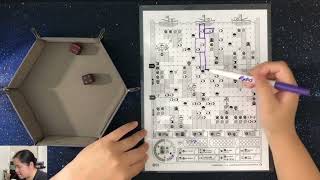
Reviewers broadly agree that Aquamarine is a well-built roll and write, and they single out the features that set it apart from a crowded genre. The Tabletop Tokki channel played a complete solo game across a single day of dives, finishing with 98 points. The reviewer described it as a new take on a small Tetris-style puzzle, one that blends spatial reasoning with route building in a way they had not seen much elsewhere.
Dylan at All You Can Board was more cautious. Dylan noted that roll and write releases arrive constantly and that a new entry needs something visibly different before Dylan will spend time on it. Dylan first noticed Aquamarine on BoardGameGeek, compared its sheet layout to Cartographers, and singled out the shared dice mechanism as the reason to try it. At the time of the preview, Dylan had not played it, so the interest rested on the design rather than on table experience.
The Board Game Garden channel, hosted by Jenna, approaches the game as a print and play title worth building into a personal collection. Jenna described Aquamarine and Voyages as two of the most talked about print and play roll and writes in the community. Robert at AzureDeath | Solo Board Gaming lists it among print and play games that need nothing more than a printed sheet and a few dice, which makes it a practical pick for travel. Tom Vasel at The Dice Tower recognized it as a 2022 print and play release and said the idea appealed to Vasel, though Vasel was not sure it had ever been played by Vasel.
The one full playthrough in this group was enthusiastic. The more reserved voices focused less on whether the game works and more on whether the roll and write genre has room for another entry without a strong hook.
Core Mechanics That Define Aquamarine
Flip/Roll and Write With Shared Dice
Each round, two dice are rolled and shared by every player, and each player chooses either the higher or the lower value. Tabletop Tokki explained that the chosen value sets the size of a straight line, rectangle, or square drawn from the diver's last shape. Every new shape must connect to the previous one without overlapping, crossing rock structures, or touching shapes from earlier dives, even at the corners. Selecting the higher die costs air equal to the difference between the two dice, while the lower die often narrows where a diver can go. Dylan singled out this shared pool as the detail that makes the game stand out, because every player works from the same two dice and must decide how much risk to accept with the higher value.
End Game Bonuses
Aquamarine rewards planning beyond the current dive. Tabletop Tokki chose one of the end game bonuses partway through the day, taking the flag bonus, and then tried to collect flags across the remaining dives. Other bonuses on the sheet reward extra points per coral, per cuttlefish, and per stingray, a payout for enclosed shipwrecks, and a payout for pairs of beacons. The shipwreck bonus shows the tension well: the reviewer's plan to enclose a shipwreck failed after a series of rolls that did not fit, yet the flags they had planned around still shaped their final score.
The Aquamarine Experience
Tense Air Budgeting
Playing Aquamarine feels like managing a shrinking resource. In the solo mode, each dive must reach below a set line or the game is lost, and the air runs out quickly whenever the higher die is used. Tabletop Tokki described moments of hurry, such as deciding that "we really need to book it" because half the day was already gone, and then wondering aloud whether the full 24 hour cycle would be finished at all. The reviewer praised how the diving variance keeps a solo game engaging without adding components that weigh it down. Players who enjoy push your luck will recognize the appeal, since each choice trades a little safety for a chance at a better shape.
Spatial Puzzle Satisfaction, Tempered by Self-Blocking
Reviewers compare the spatial side to Tetris and polyomino puzzles, with a route building twist. Satisfaction comes from wrapping a long shape around coral or bubbles, or from finding a stingray during the day, when it scores, rather than at night, when it would be crossed off. The flip side is frustration. Tabletop Tokki repeatedly boxed themselves in, with one shape closing off a planned shipwreck and another cutting off the route back. The reviewer's reaction, "that's so sad I didn't realize we were cutting ourselves off," captures how quickly a clever route can become a dead end.
What Makes Aquamarine Stand Out
A Print-at-Home Format With Expandable Maps
Reviewers consistently praise the way Aquamarine reaches players. Tabletop Tokki argued that a single sheet removes the shortages that come with small print runs and sold-out copies, and that the game can also be played digitally to save paper. The reviewer appreciated the expansion model as well: each release adds new maps, the publisher uploads the assets so players can mix and match them or design their own, and a single purchase unlocks the content that follows. Jenna at The Board Game Garden made a practical version of the same point, showing how a laminated sheet can be reused with dry erase markers so that one printout serves many sessions.
A Shared Dice Twist on a Familiar Genre
Dylan offered the clearest view of what makes the design distinctive. Dylan observed that many roll and writes simply ask players to roll dice and pick one, while Aquamarine asks every player to weigh risk against a shared pool, and Dylan argued that this twist keeps a new entry from feeling like another copy. Dylan also responded well to the sheet design and artwork, and saw a light, easy to teach game that fits the roughly 20 to 30 minute window that suits the genre best.
Potential Drawbacks
Dice Luck and Self-Blocking Routes
The most consistent criticism concerns the dice as a constraint. Tabletop Tokki found that the lower die often narrowed options in ways that were hard to recover from, leading to remarks such as "we really needed a one or a two" after a planned shipwreck enclosure fell apart. The rule that shapes may not touch earlier dives, even at corners, means a poor route can lock a diver out of nearby treasure. The reviewer still judged the game positively, but these moments show that Aquamarine asks players to accept real frustration when the shared dice do not cooperate.
Preparation Effort for Print and Play
The print-at-home model carries its own friction. Jenna described sizing the sheets, cutting margins, attempting to punch holes that would not line up across a stack of pages, and laminating each sheet, a process that took about two days. Jenna said laminating double-sided would have saved binder space, and one of the larger maps had to be printed across two separate pages. Jenna still considered the effort worth it, but players without a printer or laminator should expect more setup time than opening a boxed copy would require.
If You Enjoy Aquamarine
- Cartographers: Dylan saw a clear resemblance in the sheet layout, with the main play area above a scoring section. Players who like a map-drawing roll and write with a polished presentation will find a familiar structure here.
- Lost Cities: Rolling Right: Dylan used this title as a contrast point. Dylan found that it did not do enough that was unique to hold Dylan's interest, so Aquamarine's shared dice make a useful comparison for players who want a roll and write with a stronger hook.
- Voyages: Tabletop Tokki, Jenna, and Robert all tied Voyages to Aquamarine. Both come from Postmark Games, and Tokki noted that Voyages already had five maps with downloadable assets, which makes it a natural next step for a print and play fan.
- Palm Island: Robert calls it one of their biggest travel staples, a minimalist, in-hand card game with very light rules. It is a good option for players who want another portable game that needs no table.
What Reviewers Are Saying
"I really love the format of this game. I think it makes it very accessible to a lot of people even if you don't have access to a printer. If you have a device and play it that way, it also means that you'll never run into an issue of shortage where you can't get it in a certain location or they've sold out of copies."
— Tabletop Tokki
"As soon as you do something even remotely unique like this where hey we're all sharing the same two dice you roll them you have to pick whether you're using the higher the lower one."
— Dylan, All You Can Board
"Voyages and Aquamarine are two of the most like talked about print and play Roland rights I've heard a ton of good things about them."
— Jenna, The Board Game Garden