/pic3386263.jpg)
In a world unified by the Empire, it is forbidden to raise armies and make war. All major conflicts get solved in the ARENA, where the best fighters represent entire Nations. Such fighters, with good reason, are called HEROES.
In this turn-based tactical combat boardgame, players recruit teams of three or four from a wide pool of Heroes, all of them experts in a Combat Role, like Tactician, Healer and Bruiser. There are countless combos, counterpicks and strategies to explore in the attempt to build a powerful and synergistic team.
Each Hero is granted a Move and an Attack action per turn. Its governing rules are intuitive, meaning even beginners will find ARENA easy to learn; however, the game will forever remain challenging, as it is impossible to reproduce two equal matches, all attacks are unique, and there are optional 'advanced' features to implement in order to refresh and deepen the experience, such as Artifacts and Scrolls.
In Competitive mode (PvP), both teams fight each other until one eliminates all opposition and wins the battle. Matches begin by strategically positioning highly-detailed miniatures in an infinitely customizable battlefield featuring optional elements that change the dynamics of combat, such as walls, debris, altars and lava. You're required to plan ahead, consider your enemies' moves and work in harmony with your team in order to find the best possible action when your turn comes.
In Cooperative mode (PvE), the Player(s) build a team of 4 Heroes to travel the fantastic world of Tanares in order to solve an ancient mystery, facing Missions with different problems, hazards, and goals. Campaign Cards present players with challenging events, requiring tough decisions that shape the course - and outcome - of an adventure that find its climaxes in the difficult Dragon Boss Fights.
The Campaign is meant to be conducted through the course of several sessions, in which Heroes gain experience according to the number - and quality - of accomplished Mission objectives. Experience Points can be spent to Level UP and acquire minor permanent boosts, or to purchase Items that grant major - but provisory - boosts to any Hero.
Players are free to tweak and adjust their experience according to their personal preferences, making Arena a highly diverse and replayable game. Players can make tournament tables and play simultaneous Matches on different boards; add or subtract different advanced rules and strategical features at will; try the game on custom boards or design their own missions. Players that enjoy immersion and storytelling can maximize adventure in PvE-Campaign Mode, while players adverse to that can even play the Quests individually, in any sequence, with minimum reading required.
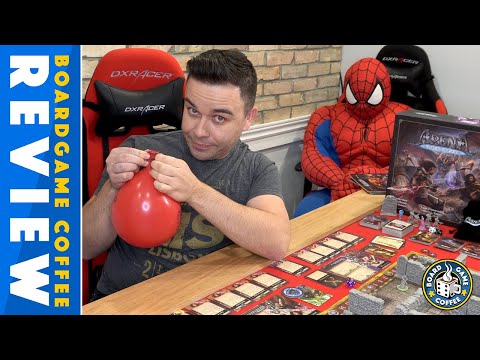

- campaigns with puzzles and branching endings
- variety of characters and play styles
- narrative-driven co-op with puzzles and multiple endings
- campaign-driven arena-style adventures with branching paths
- branching narrative outcomes based on choices
Mechanics (from transcript analysis)
- campaign with branching endings — puzzles and decisions alter the road ahead and possible conclusions
- simplified card play with varied abilities — mix of cards providing different actions and synergy
Video topics + discussion points
Quotes (from this video)
- this is a list that is purely subjective and what i mean by that is this is purely the games that i like to play the most
- the numbers 5 through 10 or maybe even 4 through 10 might change on any given day
- one and two are really really close
- it's light-hearted it has a strong story
- the dice are fun
- the real joy of gloomhaven is just the card play
- i love exploding dice
- the artwork and minis look really good
References (from this video)

- strong narrative integration with combat improvements
- deeper character development and more card options
- fast, readable city phase providing a breather
- increased variety and strategic choices
- large physical footprint and storage needs
- learning curve and book-navigation complexity
- potential overwhelm from many characters and options
- D20 system feels swingy at times
- Heroic fantasy, tactical combat layered with narrative progression
- Fantasy arena-based campaign world where heroes gather to fight, explore, and develop a settlement
- Campaign-driven, branching weekly adventures with city and world phases
- Arena the Contest
Mechanics (from transcript analysis)
- adventure selection — choose among multiple adventures with consequences for future weeks
- Character dashboards — skills and abilities tracked per character with limited-turn interactions
- City phase — short deck-building phase to manage town, recruit, and prepare for adventures
- D20 Combat — roll a D20 against target numbers to resolve fights with damage and effects
- Deck Building — draw and play character cards to recruit and upgrade your town and party
- deck-building — draw and play character cards to recruit and upgrade your town and party
- Variable Phase Order — global map phase where invasions occur and progress unlocks new quests
- World phase — global map phase where invasions occur and progress unlocks new quests
Video topics + discussion points
Quotes (from this video)
- it's taken everything that I liked about the combat and Arena the contest
- space is at a premium
- I think across the board for the solo Co-op player tonight's Adventures is an improvement on Arena the contest
- the story is pretty good
- it's not a top tier story right it's not Madara it's not oh sworn or familiar Tales level story
- it's a D20 system
References (from this video)
- tight tactical play with a lot of combo potential
- solid pacing for a 1-4 player game
- learning curve for new players
- some players may want more varied factions
- combat tournament style with national representation
- world unified by a single empire; conflicts resolved in arena
- tactical, gladiatorial flavor with UN-esque politics
- Tortuga
- Foundations of Rome
- Bees
- War of Whispers
- Isle of Cats
- Return to Dark Tower
- Clash of Cultures Monumental Edition
Mechanics (from transcript analysis)
- team-building — select and assemble a squad from a pool of specialists
- turn-based tactical combat — recruit teams of heroes with defined combat roles
Video topics + discussion points
Quotes (from this video)
- these scores are of course completely subjective and quite possibly completely made up
- this new series is going to list new old and newsworthy games that caught our attention within the last month
- for one reason or another these are the top ten games that recently stood out from the crowd to us and are now on our radar
- the kickstarter campaign for the game ended just last week raising over a million dollars in pledges
- we'll be shipping to backers a year from now because that's how Kickstarter works
- you'll feel like a queen bee while playing the Isle of Cats
- not a single butterfly ever makes the round-trip
- this is a sequel of sorts to the 1981 classic game Return to Dark Tower
References (from this video)
- Con-exclusive promos and freebies
- Good for quick, social play
- Demo pressure can affect experience
- Limited availability of promos
- tournament-style card/mini game
- arena-themed competition
- light, party-ish competition
Mechanics (from transcript analysis)
- demo-driven acquisition — demo signups and optional purchases during the con
Video topics + discussion points
Quotes (from this video)
- you can mix these guys you can take Robin Hood against King Arthur
- detective club was really interesting; it's kind of like a party game
- Black Angel seems great and the board is really bold
- Court of the Dead looks really pretty and the minis are fantastic
- we backed Arena the Contest, we got a con-exclusive promo
References (from this video)
- impressive map presentation
- upgraded components in some editions
- noted heavy reading and long levels; pacing can be slow
- Tournament-style monster battles
- Arena combat with fantasy figures
- Scenario-based arena skirmishes
Mechanics (from transcript analysis)
- arena combat — Big maps with 3D walls and modular layout
- Scenario / Mission / Campaign Game — Multiple scenarios with escalating difficulty
- Story/monster scenarios — Multiple scenarios with escalating difficulty
Video topics + discussion points
Quotes (from this video)
- Sleeping Gods is so good it's so good
- it's like playing a Choose Your Own Adventure storybook
- The Minis on this are huge
- this box is so much heavier than I thought it was
- it's the slowest game ever
- it's a worldwide contest
- have fun keep gaming be social
References (from this video)
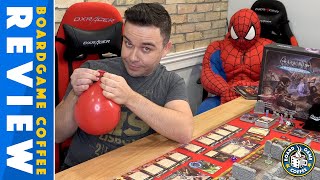
- Versatile play styles (cooperative dungeon crawl or PvP arena)
- Great art direction and a strong campaign concept with moral choices
- Character customization and XP-driven progression feel rewarding
- 3D walls/doors add substantial immersion and tactical depth
- Campaign deck with puzzles and branching decisions is a standout feature
- Fiddly tracking and management can slow games and cause cognitive load
- Rulebook setup is complex and spread across multiple books, hindering quick learning
- Pacing can drag, especially in longer campaigns; stories can feel lengthy for some groups
- 2D components and some minis quality criticized; 3D minis later iteration addressed via Kickstarter
- Epic fantasy adventure, dungeon exploration, hero progression
- Fantasy dungeon arena with episodic campaign
- Campaign-driven storytelling with branching decisions and puzzles
- Hero Quest
- Zombicide
Mechanics (from transcript analysis)
- Campaign deck and puzzles — Campaign deck provides moral decisions and puzzles between missions, with multiple-choice outcomes and QR puzzle verification
- Character progression — XP, level-ups, scrolls and artifacts to upgrade characters between missions
- Cooperative and competitive play — Can be played as a cooperative dungeon crawl or as a PvP arena battle (2 teams or individuals)
- Cooperative Game — Can be played as a cooperative dungeon crawl or as a PvP arena battle (2 teams or individuals)
- Modular Board — 3D walls and doors add depth and immersion, affecting movement and tactics
- Modular environment — 3D walls and doors add depth and immersion, affecting movement and tactics
- Narrative Choice — Puzzles and moral choices influence story paths and unlocks
- Puzzle-based decision points — Puzzles and moral choices influence story paths and unlocks
- Reading-driven play — Story and quest content requires significant reading between missions, including long passages
- Rulebook and reading integration — Campaign requires using multiple books (rulebook, quest guide, campaign tome) to manage levels and story
- Track Advancement — XP, level-ups, scrolls and artifacts to upgrade characters between missions
Video topics + discussion points
Quotes (from this video)
- arena the contest is a 2 to 8 player versus player combat arena game
- it's an arena game with schizophrenic tendencies that tend to lead towards Dungeons & Dragons
- the three dimensionality that the walls and doors bring to the environment has a profound effect on my enjoyment of the game
- the campaign deck with its moral decisions and fun little puzzles is absolutely awesome
- spending your XP to upgrade your characters your way is very rewarding
- this is too much for a new group but with the right group it could be amazing