/pic6279084.jpg)
March 18, 1990, Boston: You enter the art museum, and an hour-and-a-half later you come out unnoticed with your pockets full — but now comes the hardest part...
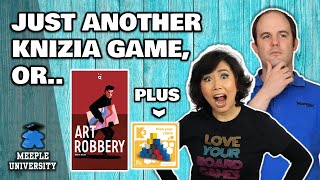
In Art Robbery, you slip into the role of art thieves. You have successfully put the robbery behind you, and you have many drawings, paintings, sculptures, and antiques in your possession, yet the treasure is not infinite and you are now facing your greatest challenge: distributing the loot.
Over several rounds, you confront the other players and try to get a share of the four collections. In the end, the thief who is able to snatch most of the loot wins...maybe. After all, the FBI is not giving up and is looking for you, so during the game, you need to collect enough alibis to avoid being caught.


- Simple
- Playable
- Fun
- Plays 2-5 players
- Can get long with more than 5 players
- art thieves
- Sushi Go!
Mechanics (from transcript analysis)
- Hand Management — You have cards in your hand, you play a card, you take the token of that number.
- Set Collection — Whoever has the most money wins, but unless a lot of the lower value ones have alibis on them and if you don't have enough alibis you lose instantly.
- Take That — You can take it either from the middle or take it from the player who has it.
Video topics + discussion points
Quotes (from this video)
- It has deck building, the mechanic of deck building that I wish I have in some others that makes my life easier in deck building.
- It all fits together very cleverly.
- This is the first sort of ultra heavy, above 4 on BGG type of game that I've liked this much for quite a while.
- It makes for really interesting decisions.
- The components are really great in here as well, they've got lots of little buildings and metal coins and all sorts of fun stuff.
- It's really a three-dimensional puzzle.
- The limited amount of actions you can do makes it like it's so tight that you have to think ahead.
- It's just a really simple, really elegant, thinky, you know two player push and pull back and forth sort of game.
- The theme is so fun, it's like the puns in the shop and everything else.
- It is also a lot more interactive than your typical one.
- It's really a deep strategy game.
- It's been really close every time, with high scores around about 100.
References (from this video)
- Very simple and accessible.
- Fun party/game with direct interaction and take-that elements.
- Fast rounds make it a good filler for groups.
- art heist/robbery caper
- Ziggurat
- DOS
Mechanics (from transcript analysis)
- Alibi cards and zeros — Zero cards are alibis with no points; alibis are represented by dots on cards.
- Boss and dog cards — Special boss card allows taking a boss token; the dog token can guard or force card transfer when targeted.
- Boss Battler — Special boss card allows taking a boss token; the dog token can guard or force card transfer when targeted.
- Card-based turn and draw — Players hold five cards; on your turn you play a card and draw a card.
- Compound Scoring — After four rounds, players tally alibis and tokens; lowest alibis loses (with a special adjustment for two-player rules); overall highest score wins.
- End of round and boss scoring — End of each round, boss status is resolved; boss is worth five points unless discarded; several round cycle ends with next round reveal.
- Greedy thief — Greedy thief card lets you take any token from the middle, not from another player.
- Round-based scoring and end-of-game — After four rounds, players tally alibis and tokens; lowest alibis loses (with a special adjustment for two-player rules); overall highest score wins.
- Token-picking via card play — Playing a card lets you take the matching token from the middle or from another player.
Video topics + discussion points
Quotes (from this video)
- it's a very simple game but there's a couple of things in there which make it really nice
- drive your opponent into being the one who can't take a turn
- I would recommend both of these
- it's a good family game
- it's incredibly simple game
References (from this video)

- simple game with clever decision point
Mechanics (from transcript analysis)
- card play vs item take — Noted as a simple loop: play card, take item, repeat with a clever decision within a simple framework.
Video topics + discussion points
Quotes (from this video)
- it's about playing not about winning
- it's fast and furious
- it's extremely simple
References (from this video)

- streamlined, thematic card-driven heist
- well-regarded designer with a track record
- as with many Knizia titles, could be heavy on calculation for new players
- art theft and alibi-based scoring
- urban, art heist theme
- lighthearted heist
- High Society
Mechanics (from transcript analysis)
- card deck with alibi mechanic — low-value tokens have alibi icons; player with the fewest alibis at round end loses
- multi-round token drafting — four rounds, tokens are drafted and taken from the table depending on cards played
- Token-based end-game scoring — tokens gathered during play contribute to end-game points
Video topics + discussion points
Quotes (from this video)
- the theme of this one says it's a science themed work replacement game set in the 17th century
- this is enough for me to be interested
- it's a really strange game it's called first rat and thematically it's about a bunch of rats in a junkyard trying to make a spaceship
- the cover is stunning and the game looks gorgeous