






























Astra Deep Dive
What the Community Thinks About Astra
Astra has earned a devoted following among board gamers who appreciate lighter, more accessible games from Mind Clash Games' new family-weight line. Reviewers consistently praise the game's gorgeous constellation theme and elegant core mechanics, though reactions to the overall experience reveal a game that excels in specific moments rather than sustaining engagement throughout. The game finds admirers among those seeking beautiful, strategic alternatives to heavier titles, yet some feel the experience lacks the emotional resonance that typically keeps players returning to the table.
Core Mechanics That Define Astra
Stardust Resource Management
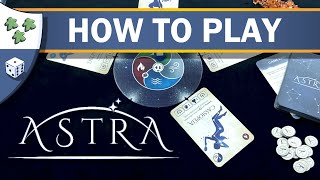
The heart of Astra revolves around a simple yet elegant resource: Stardust. Players accumulate Stardust by resting, then spend it strategically to observe constellations by marking individual stars on shared cards. This push-your-luck element defines the tension of each turn. You must decide whether to spend precious resources now to mark stars and potentially complete a constellation, or rest to replenish your supply and risk giving opponents the chance to claim cards you've contributed to. The Stardust economy creates natural rhythms of action and recovery, forcing meaningful trade-offs between immediate progress and long-term positioning.
Area Majority with Shared Rewards
Rather than simple first-come-first-served scoring, Astra implements a sophisticated majority system where completing a constellation benefits all contributors. The player who marks the final star claims the card itself, but others who helped mark stars receive bonus choices based on their contribution count. This design prevents runaway leaders and keeps all players invested in ongoing constellations, even when they lack the resources to complete them alone. The bonus system rewards both commitment and strategic timing, making early contributions to high-value cards worth more than grabbing everything at once.
The Astra Experience
Quiet Contemplation
Astra creates a meditative, puzzle-like atmosphere where players focus intently on optimizing their positions. The game encourages deep personal strategy rather than table talk, with each turn becoming a careful calculation of resources and positioning. Reviewers note this quiet nature distinctly, describing sessions where players sink into their own boards, managing their wisdom limits and planning which set completions to pursue. The dry quality comes not from poor design but from the game's structural emphasis on individual optimization over dynamic interaction.
Strategic Tension Without Combat
Despite the tranquil pace, Astra delivers meaningful player interaction through pure strategy. Players can block opponents by placing single stars in inconvenient positions, forcing others to spend additional turns completing constellations. The timing element created by the rotating season marker adds another layer, as players choose when to rest based not just on their needs but on preventing opponents from refreshing powerful ability cards. This creates moments of genuine tension where every action carries weight, even if the overall tone remains contemplative.
What Makes Astra Stand Out
Constellation Theme as More Than Flavor
The stargazing theme deeply integrates with the mechanics rather than sitting as window dressing. Players literally chart constellations by connecting dots in linear patterns, with each card's shape dictating possible connections. Dry erase markers and the tactile experience of filling in stars make the theme tangible. The constellation cards themselves become beautiful focal points on the table, with reviewers particularly noting how the visual presentation of connected stars creates a satisfying sense of discovery and completion when a constellation is finally revealed.
Set Collection Depth with Hidden Goals
Behind each player's asymmetric mat lies a secret scoring grid tracking elemental collection. This hidden set collection layer operates beneath the main action, rewarding players who quietly build specific combinations while others chase visible constellation cards. The mismatch between public and private scoring systems creates interesting decision moments where completing a constellation might matter less than the type of card you claim, based on your individual collection track. This dual-victory-condition approach adds strategic breadth without overwhelming the game's accessible entry point.
Potential Drawbacks
Length and Pacing Issues at Higher Player Counts
With four or five players, Astra struggles to maintain momentum. Each turn cycle involves rounds of sequential star-marking across multiple cards, and with multiple players considering their options, turn order can stretch significantly. Reviewers note that a five-player game may struggle to finish within an hour, with the game becoming more mechanical toward the end. The core loop of observing, resting, and managing resources feels best suited to two or three players where the pace remains brisk and unpredictability stays high.
Ability Card Power Imbalance
Not all discovered constellation cards carry equal weight. Some ability powers prove significantly more valuable than others, with certain free actions substantially outpacing alternative benefits. Reviewers noted cases where specific cards essentially broke conventional strategy, allowing players who secured them to operate with vastly more efficiency than opponents without equivalent abilities. While this variance can create interesting asymmetric play, it occasionally tilts outcomes toward luck rather than pure strategy, particularly when high-value cards appear early in the game.
If You Enjoy Astra
Players drawn to Astra's constellation theme and set-collection core should explore Cascadia, which shares a beautiful naturalistic aesthetic and pattern-building satisfaction. Those who appreciate the area-majority mechanic without conflict might enjoy Acrony or Trickerion, Mind Clash Games' heavier siblings that offer similar strategic depth with more aggressive direct conflict. For the contemplative pace and multiple scoring layers, Geisha's Road and similar two-player focused games deliver comparable thoughtfulness with stronger player interaction.
What Reviewers Are Saying
"The theme was really cute that's the thing that kind of intrigued me with the game in the first place I really enjoyed the idea of stargazing and constellations and such but yeah just a little bit dry."
— Before You Play
"I really enjoy the implementation of area majority in this one where basically you're drawing on stars on different constellations in your color and you're using your little Star Bits in order to do that that's like your currency and I absolutely love it."
— The Board Game Garden
"It has a little bit of like area majority which is interesting that I love it so much but it's the kind of area majority and honestly I think I do enjoy area majority it's more so area control and conflict that I don't prefer in games but I really enjoy the implementation of area majority in this one."
— The Board Game Garden