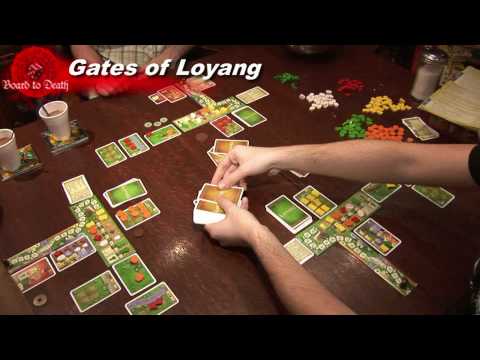







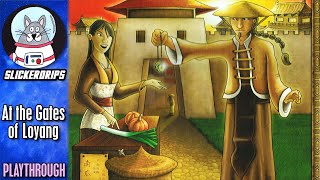



















At the Gates of Loyang is a trading game in which you are able to produce goods by planting them and later selling them to customers. You can use the abilities of some helpers to increase your income or production.
Fields, customers, helpers, and miscellaneous objects are represented by cards. Each player receives two of these cards per round distributed by a bidding/drawing mechanism in which you end up with one of the cards you draw and one of the cards of a public offer filled by all players. Additionally, to these cards you always receive one field for free each round.
Placing one good on a field fills the complete field with goods of this type. Each round, one unit per field is harvested. After planting, harvesting, and distributing cards, each player can use as many actions as he wants, only limited by the number of his cards or the number of goods he owns. At the end of his turn, he can invest the earned money on a scoring track, where early money is worth more than late money. The game ends after a certain number of rounds, and the player who is first on the scoring track wins.
Online Play
Yucata (turn-based)
- farming, resource optimization
- agricultural town planning and card-driven resource management
- strategic puzzle
Mechanics (from transcript analysis)
- Deck building — drafting cards to optimize actions and resources
- deck-building — drafting cards to optimize actions and resources
Video topics + discussion points
Quotes (from this video)
- I think this game really shines with its thematic integration and the way that its mechanisms work
- it's not perhaps the most replayable but it does or at least the most variable
- the solo mode is very interesting and yeah just a very solid game by Rosenberg
- I love the the depth that this game provides and I still enjoy playing this game over 50 times now
- the player interaction is very awesome I love the simpleness of this game yet it's very reactive and hard to master
- Age of Innovation I feel not as daunting to me for someone who hasn't put in the time
References (from this video)
- Very free-form action economy feels fresh and rewarding
- Elegant scoring system where costs rise as points are earned
- Fresh despite its age; still feels current
- Potential for AP due to vast action choices
- Learning curve can be steep for new players
- Agriculture, market interaction, and resource planning
- Farming and trading in Loyang, a classic farming locale.
- Strategic, modular setup with flowing turns
Mechanics (from transcript analysis)
- action optimization and AP — A wide action set can lead to analysis paralysis as players optimize turns.
- commodity trading and markets — Players buy, sell, and trade crops with market stalls to maximize income and points.
- End-round scoring — At the end of each round, you purchase victory points with earned money, with scaling costs.
- free-flowing turns — Turns are highly flexible: players can perform many actions in any order and repeat them as needed.
Video topics + discussion points
Quotes (from this video)
- this is the fourth in a series of videos where I'm separating my favorite solo games into five different complexity levels
- it's my favorite as well
- no Universal scale exists so a mediumweight game to you might be a heavy game to me and vice versa
- I particularly like its clever bag building system
- this war of mine is the most profound board game I've ever played
- the solo opponent is super quick and easy to manage
References (from this video)
- very quick setup for a medium-weight Euro
- colorful and vibrant components
- playful, soothing solo experience
- some may find the pacing too relaxed compared to heavier Euros
- market-based farming economy and trade
- vegetable trading in Loyang
- colorful, bustling, uplifting
Mechanics (from transcript analysis)
- economic/farming engine with fast setup — Very quick setup for a medium-weight Euro; buy/sell, trade, and fulfill contracts to maximize money and points.
Video topics + discussion points
Quotes (from this video)
- these games tend to fly off the shelf because they just work so well they have few components so setup is super easy
- I love the coziness of this design and how quickly it can spiral completely out of control
- The Twist here is that police meeples are being randomly placed in locations as well and at the end of the round your workers need to be able to trace a clear path back to your hideout
- Cascadia feels super casual and when you're feeling bad a nature theme is exactly what the doctor ordered
- it's my ultimate comfort food game for so many reasons
- everything about this game is quirky from its theme to its artwork to the gameplay which is really unlike anything I've played before
References (from this video)
- Engaging engine-building with a strong card-drafting core
- Rich solo-mode that creates meaningful choices without other players
- Lively economy with Trader/Shopper interactions that enable clever exchanges
- Thematic flavor feels integrated with the farming and market setup
- Clear progression via the prosperity track and fulfillment requirements
- Lots of micro-optimization and planning opportunities for long-term scoring
- Steep learning curve and potential for early confusion with market setup
- Cluttered market board can be overwhelming during planning
- End-game pressure can feel punishing if cash flow is mismanaged
- Draft luck can influence the pace and feasibility of big rounds
- agriculture, trade, and market-driven resource management
- China, ~2,000 years ago at the gates of Loyang
- economic farming engine with marketplace interactions
Mechanics (from transcript analysis)
- Action economy — Performing multiple actions per turn in any order according to a provided action list
- card drafting — Drafting from a 3x4 grid to select market and helper cards
- end-of-round and round-tracking — Harvest, continue cycles (nine rounds), and manage field exhaustion
- helper cards with one-time abilities — Employing helpers whose abilities resolve once per use
- loan risk mechanic — Loans provide cash with penalties on the prosperity track accumulation
- Loans — Loans provide cash with penalties on the prosperity track accumulation
- market stalls and trading — Filling and using Market stalls to buy/sell and trade vegetables
- orders fulfillment (regular vs casual customers) — Fulfill customer orders with varying rewards and penalties
- prosperity track — Progressing on a prosperity track that drives end-game and scoring possibilities
- storehouse management — Storing vegetables between turns and upgrading capacity to store more
- Track advancement — Progressing on a prosperity track that drives end-game and scoring possibilities
- two-pack draft mechanic — Each round you may take two cards from the top and decide how many to keep
Video topics + discussion points
Quotes (from this video)
- amazing absolutely amazing turn
- I'm really liking this con man
- it's the Thematic thing to do that
- This is an amazing solo experience
- The market interactions feel incredibly dynamic
References (from this video)
- one of the best solitary Rosenberg designs
- solo redraft changes improve pacing and tension
- tight economy and card flow create meaningful choices
- solo mode requires significant rule interpretation
- not the same experience as multiplayer
- production planning with long-term customers
- farming and selling produce
- calm, strategic farming economy
Mechanics (from transcript analysis)
- card drafting — In solo, you draft on a 3x4 grid, selecting up to two cards per round and managing money tightly.
- dreaded drafting optimization — Discarded cash cards slide down, forcing choices under scarcity.
- solo card drafting — In solo, you draft on a 3x4 grid, selecting up to two cards per round and managing money tightly.
Video topics + discussion points
Quotes (from this video)
- Voidfall is one of my favorite games of all time.
- I love that he brought completely new mechanisms to solitare voidfall that aren't used in the competitive multiplayer mode.
- Ultimately, Voidfall shows that even highly interactive games can make for great solo experiences as long as you have a designer dedicated to the art form.
- Solo tricktaking. Actually, is tricktaking one word? Maybe I only need two words.
- Heat not only exposes how ridiculous that opinion is, but I think it shows how much the genre has suffered by not including solo play.
References (from this video)
- very relaxing yet meatier than typical light games
- strong solos historically
- older title; may be harder to find
- agrarian economy with market dynamics
- farming and trading in a blossoming market
- free-flowing, relaxing yet strategic
Mechanics (from transcript analysis)
- farming and trading — farm goods, trade, and fulfill contracts
- free-flow turns — actions can be taken in flexible order with multiple repeats
- market dynamics — end-of-round VP track with increasing costs
- Market Pricing/Manipulation — end-of-round VP track with increasing costs
- Simultaneous Actions — actions can be taken in flexible order with multiple repeats
Video topics + discussion points
Quotes (from this video)
- these are the games that have stood the test of time for me each one I've played every year for a decade or more
- Robinson Crusoe for me it came out in 2012 I got it immediately
- it's the ultimate forever game
References (from this video)
- rich theme
- tight design
- strong production value
- learning curve could be steep
- civilization-building and political strategy
- Ancient China; Luoyang as a center of power
- historical civ-building with thematic flavor
- Agricola
- Chaos in the Old World
Mechanics (from transcript analysis)
- Area Control — control of key regions to gain power or points
- card drafting — players draft cards to influence actions
- tile placement — placing tiles to structure city development
Video topics + discussion points
Quotes (from this video)
- Eric Lang is the rock star of board-gaming
- artwork and production matters; artwork and production matters; it's not just putting a game out
- Jamie Stegmaier... Kickstarter guru
- it's not just putting a game out, artwork and production matters
References (from this video)
- card drafting adds engaging decision points
- less interaction than Agricola, allowing efficient solo engine development
- open pool variant and cards that shift rules keep the experience fresh
- least interactive among the trio, which can reduce direct player competition
- some phrasing about card effects can feel cryptic or fiddly
- card drafting and market fulfillment with production and delivery decisions
- produce business in transforming market landscape
- strategy driven by card-based choices that influence several turns ahead
- La Havre
- Agricola
Mechanics (from transcript analysis)
- card drafting — players draft cards that modify their options and potentially alter rules or timings.
- card_drafting — players draft cards that modify their options and potentially alter rules or timings.
- helper_and_rule_modification — cards can modify how certain actions work, sometimes altering standard expectations.
- Pick-up and deliver — players sew fields and harvest to meet customer demand, delivering goods for points.
- resource_delivery_and_market_fulfillment — players sew fields and harvest to meet customer demand, delivering goods for points.
Video topics + discussion points
Quotes (from this video)
- It's the thing that I like more about La Havre than something like Agricola is that Agricola feels again like you're always trying to avert disaster.
- You have to feed your people or you're going to have to create more food every time, but you never feel like there's a panic.
- It's a constant struggle against time because it gets you have to feed them more and more and more often.
References (from this video)
- clever drafting system
- compact and elegant
- some players may find drafting system unusual
- agriculture, production
- Farming and card drafting in Loyang
- light thematic
- Patchwork
- Fields of ARLE
- The Gates of Loyang multiplayer variants
Mechanics (from transcript analysis)
- card drafting — players draft action and product cards to optimize scoring.
- card_drafting — players draft action and product cards to optimize scoring.
Video topics + discussion points
Quotes (from this video)
- Two-player only games tend to lend themselves to deduction games
- I could play deduction games like Mr Jack all day
- plenty of scope for new stuff
References (from this video)
- Solid economic engine
- Elegant production values
- Older design may feel dated to some
- Can be heavy in later rounds
- Settlement development with spice trade
- Orient-inspired farming and resource management
- Agrarian, resource-driven with market pressures
- Five Tribes
- Five Tribes (sequel/variant)
Mechanics (from transcript analysis)
- farming / resource management — players manage crops and goods to fulfill constraints
Video topics + discussion points
Quotes (from this video)
- my default would probably be innovation by carl chadwick
- you're my soul mate
- pre-meeple built he performed as a comedian and a magician
- meepleville board game cafe in las vegas
- it's a huge upgrade
- the board game quiz show by going analog
References (from this video)
- Engaging combination of resource management and card-driven actions
- Mechanics align well with the farming and market theme
- Downtime is effectively reduced in 4-player games via partner rule
- Clear player aid and well-structured phases make rules approachable with practice
- Lengthy playtime, especially with 4 players
- Rules complexity can be challenging for newcomers
- Loans create end-game penalties that can skew scoring if mismanaged
- Farming, market economy, vegetable trade
- Ancient China farming town of Loyang
- Educational tutorial with practical gameplay demonstration
Mechanics (from transcript analysis)
- Action drafting using hand and courtyard — Players select two cards: one from their hand and one from the central courtyard, then resolve plays.
- Card cycling and discipline — Action cards are discarded and reshuffled, maintaining deck balance and variety.
- Cooperative interaction variant (4 players) — In 4-player games, a partnership mechanic restricts interactions to partners, reducing downtime.
- Field farming and harvesting — Players plant vegetables on private fields and harvest them into storage when collecting points.
- Loans and risk management — Loans provide immediate coins but impose negative end-game scoring penalties.
- Market stalls and customer fulfillment — Stalls provide vegetable exchanges; customers demand goods and provide coins or satisfaction tokens.
- Private field decks and home cards — Each player uses a personal deck of home/field cards guiding available crops and scoring opportunities.
- Satisfaction tracking and penalties — Unmet customer demands trigger penalties and storage limits adjust over rounds.
- Scoring track advancement — Cash and actions allow advancing on a scoring track with increasing costs.
Video topics + discussion points
Quotes (from this video)
- to decrease downtime significantly, Uve rosenberg has made some alterations that apply only in a four players game
- there is a rule that no more than two players can select the same vegetable type
- the game is played over nine rounds
References (from this video)
- Second edition coming
- Well regarded
- ancient history
- civilization
Mechanics (from transcript analysis)
Video topics + discussion points
Quotes (from this video)
References (from this video)
- tight resource management with meaningful decisions
- strong interaction via market stalls and helpers
- clear core loop with nine rounds; keeps tension high
- elegant design and accessible setup
- can be punishing and long, especially at higher player counts
- considerable luck in card draws affecting outcomes
- early investment and loans can be costly
- endgame can be difficult to reach 20 on the prosperity track
- publisher (TMG) is no longer actively producing games, impacting availability
- agriculture and commerce in a pre-modern market setting
- Two players operate personal fields and market stalls in an ancient Chinese frontier, exchanging vegetables to fulfill customer orders over nine rounds.
- informative
- Agricola
- Lahav
- Mercator
Mechanics (from transcript analysis)
- action card drafting and courtyard placement — Each round, pick action cards by selecting from hand and courtyard into positions to perform round actions.
- customer orders and satisfaction tokens — Regular and casual customers require sets of vegetables; fulfilling orders yields money and bonuses; satisfaction tokens influence round outcomes.
- end-of-round scoring and deck cycling — End-of-round steps include flipping tokens, discarding/distributing cards, and shuffling decks for the next round.
- field planting and harvest — Plant vegetables into fields and harvest them over rounds to supply carts and fulfill orders.
- market stalls and trading — Trade vegetables via market stall cards with varying exchange rates to acquire required produce.
- prosperity track and loans — Progress on prosperity track to determine end-game scoring; loans provide cash at cost.
- storage and upgrade mechanics — Store surplus vegetables and potentially upgrade storage capacity.
- Trading — Trade vegetables via market stall cards with varying exchange rates to acquire required produce.
Video topics + discussion points
Quotes (from this video)
- it's pretty impressive that he is able to put out these many designs back to back to back
- this is going to be semi-a continuation of the farming theme
- nine rounds, prosperity track determines the winner
- it's extremely hard
- the market stalls are what glue the game together
- this game is very elegant and accessible
References (from this video)
- satisfying optimization loop
- pleasing components (veggie meeples)
- thematic lightness for some
- older rules require careful setup
- optimization and resource management
- vegetable field production and customers
- classic Euro with vegetable meeples
Mechanics (from transcript analysis)
- Resource management — produce and fulfill orders to maximize profits
- Resource optimization — produce and fulfill orders to maximize profits
- worker placement — placing actions strategically on a grid
- worker placement-like planning — placing actions strategically on a grid
Video topics + discussion points
Quotes (from this video)
- this game is so good at literally you get a storybook and it'll be like go here do this when this happens this is what it means and read this page and it just teaches you as you go in such like a beautiful way
- I really liked it I'm not sure how you felt I don't know how I feel yet we've only played two or three
References (from this video)
- tactile, strategic, and highly replayable
- multiplayer downtime can increase
- vegetable farming, trading, and growth
- China, 2000 years ago
- economic strategy with card drafting
- Agricola
- Ora et Labora
Mechanics (from transcript analysis)
- card-drafting — draft traders, helpers, and customers to build your economy
- set-collection & trading — sell vegetables and fulfill customer demand for prosperity
Video topics + discussion points
Quotes (from this video)
- I love the game Patchwork, a brilliant tile-laying game
- if Cottage Garden becomes something like that, then that's fantastic news for all of us
- the main Crux of the game is serving customers
- I love the artwork, it's a totally new style again
- Rattus is coming back after a while, out of print with all the expansions and a new expansion
- this big tin here I've been looking forward to this one for a long time because Sushi Go is just a magnificent game
- Skull King, a trick-taking dice game
- adults version of Code Names Not Safe for Work
- Evolution Junior, it's called Evolution the Beginning is only going to be available at Target for its first year