
Retell the incredible origin myth of the Inca in this dramatic mid-weight eurogame.
In the beginning, Viracocha the creator brought forth Inti, the sun god, and Mama Quilla, the moon god. From the union of these two gods sprang four sons and four daughters: the Ayar. These siblings were tasked with guiding the first clans and teaching them the skills needed to build a civilization. As they traveled the land in search of fertile ground, the Ayar one by one met their fates until only two remained to found Tawantinsuyu – the Inca Empire.
In Ayar: Children of the Sun, players take control of one of the first clans, journeying with the Ayar across the Andes. Follow their teaching and improve your skills at farming, pottery, weaving, and reed bundling. As well as advancing your own clan, you must influence the progress of the Ayar, ensuring the survival of those who reward your most developed skills. Seek the approval of Mama Quilla through long-term strategy, and please Inti with tactical play. Be careful not to earn the ire of one of these jealous gods because at the end of the game, whichever one favors you least will determine your final score.
The future of your clan – and the Inca civilization – is in your hands.
—description from the publisher


Images

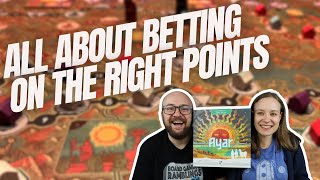
- Very unique game
- Interactive
- Tactical decisions
- Tight game with four players
- Appreciated for doing something completely different
- Enjoyable puzzle element reminiscent of 'Marv'
- Don't see who's winning until the very end
- Not recommended for two players; better with three or four
- Actions themselves are not very interesting; it's the interaction that matters
- Variability is not super high
- Appeasing two different gods: the night god and the sun god/moon god.
- Sankor
- Sou
- Wingspan
- Rhonk
Mechanics (from transcript analysis)
- action selection — After moving on a track, players place a 'house' to select an action.
- End-game scoring — Points are awarded based on what players have the least of, similar to 'Rhonk' (likely a reference to a game mechanic like Rondo or a specific scoring mechanism), but in a denser way.
- Scoring tracks — Two types of points are tracked: sun points (scored every round) and moon points (instant points/end-game scoring). Scoring is influenced by player actions and track removal.
- Set Collection — Players collect different colored pots for sun points and same-colored pots for moon points. They also collect temples for moon points.
- tile laying — Described as a 'simple tile laying puzzle' where players place tiles to score night points and match distances.
- track movement — Players move on tracks that are not their own, placing a piece to move the track and then taking an action.
- Variable Player Powers/Abilities — Players can unlock special abilities by collecting mask tokens, which can be instant or provide ongoing benefits.
Video topics + discussion points
Quotes (from this video)
- This is a very unique game in many ways.
- Without interaction, this game is kind of nothing.
- The interaction is the game.
- It makes it the tightest. It makes it the most interesting and also makes like the everything you do make more sense than if you play with less players.
- I will say that the variability of this game is not super high, but it's one of those games where the interaction is what makes the game.
- I don't love it, but I do enjoy it and I I I really appreciate it for doing something this completely different.
- I'm going to land on a 7.5. I think it's a good game. I am happy to keep it because it's doing things as I already said very differently and that I appreciate it for and would love to play it more for that reason.
References (from this video)

- visually nice and colorful
- artwork looks nice
- designer's previous games have been 'meh' or disliked by the host
- potential for dry mechanics
- game may be dry due to lack of theme
- description suggests generic Euro mechanics
- time estimate may be shorter than actual playtime
- Calimala
- Merv
- Zapotec
- Autobahn
- Free Reign Circus
- Sankoré
- Shackleton Base
- Newton
- Darwin's Journey
- Lorenzo il Magnifico
Mechanics (from transcript analysis)
- Area Majority — Mentioned as a mechanic found on Tabletop Together.
- point-to-point movement — Mentioned as a mechanic found on Tabletop Together.
- Set Collection — Mentioned as a mechanic found on Tabletop Together.
- Tile Placement — Mentioned as a mechanic found on Tabletop Together.
- Worker Placement — Implied by the Euro game context and the mention of 'Euro mechanics'.
Video topics + discussion points
Quotes (from this video)
- The artwork is very pretty.
- it's an aggressive area control game.
- This expansion is fixing a fundamental flaw of the original game.
- I am salivating at the mouth for this one.
- This game is the theme done justice in tabletop form.
- I do have to temper my expectations because I think Valheim's going to be a little bit trickier to bring to tabletop.
- There's not a lot of innovation in games anymore.
- But when I played it, it's like, 'Okay, that mechanism I like. Let's find out.'
- This is a very long podcast.
- But remember, it's only a game.
References (from this video)

- Interesting action power progression system
- Unique strategic influence on scoring
- Thematic tie-in to Inca history
- Advancing your clan and seeking the favor of the gods
- Dawn of the Inca civilization
Mechanics (from transcript analysis)
- action selection — As you're taking an action, you have a bunch of these houses on your board and as you're taking an action, you are removing a house from your board.
- area influence — You also must influence the progress of the IR. There are four different colors. And so as you remove things from your board and take various actions, you're going to need to uh move the corresponding um you basically you have these little like uh meeples and they respond to their they're different colors. And so as you take an action with one of those, you're going to move that eye forward.
- Grid Movement — There is a grid column and row system to this. And when you remove a action, I mean, when you remove a house in the same column that you did before, now you're going to get that at the power of two. And if you remove another one, now you're going to get that at a power of three. And if you do a row that already has one of the columns full, then you're going to do it a power you so and so you are increasing the power of your actions as you're removing stuff from your grid.
- Player Progression — You are also, as well as sort of advancing your own clan, you're going to be doing a bunch of stuff on your own player board and advancing your own clan.
Video topics + discussion points
Quotes (from this video)
- October is always an interesting month for retail releases because the largest board game convention in the world happens in October.
- This video focuses on North American releases.
- I've got my next dates for my next one Sunday se uh Sunday, November 2nd.
- This is uh thematically you are advancing your clan and seeking the favor of the gods at the dawn of the Inca civilization.
- This is the League of Legends trading card game.
- It is mostly a dice game.
- This is a trick-taking card game with a lot more theme.
- This is a uh, you know, and write game. It's not a roll and write.
References (from this video)

- The player boards are well-liked.
- The strategy around the player boards is good.
- The momentum of the game speeds up each round.
- The game doesn't drag towards the end because each round goes quicker.
- Easier to learn than MV and Sori.
- The art and production from Osprey Games are really good.
- The weight of 3.0 is considered too high.
- The game mechanics have components that are not favorites of the reviewer, specifically the big swingy points at the end.
- The rulebook is not very good, leading to confusion about victory point tracking and marker placement.
- The game can be too long.
- The 'crab in the pot' situation can occur.
- The need for mandatory collection actions can feel forced.
- The strategy involving early sun scoring is essential and can be missed by players.
- The weaving action is complicated.
- The 'slingshot' or 'rubber banding' scoring mechanics are disliked.
- Birth of the Incan Empire with moon and sun gods, and the IR trying to bring about the clans of the area.
- Incan Empire
- MV
- Sori
- Kalamala
Mechanics (from transcript analysis)
- action selection — Players choose from four unique actions: pottery, weaving, terrace farming, and reed collecting. The strength of the action is influenced by the number of houses removed from a column/row.
- Area Control — The game involves controlling areas on the board to gain victory points.
- Card Drafting — Players draft cards from other players to gain clues and take actions.
- End game scoring — The final score is determined by the lowest of the sun or moon points, with llamas used to adjust scores.
- Set Collection — The pottery action involves collecting pottery tiles to score moon points, and accumulating pottery increments sun points.
- Tile Placement — Weaving involves placing tiles on a player board to form a rug, aiming to score points based on filled columns and the farthest filled column.
- track movement — IRs move along tracks on the main board, influencing available actions and triggering scoring.
- Variable player powers — Each faction has a unique ability, and players choose one of three rulers at the start of the game for a special ability.
- Worker Placement — Players place 'houses' (tambos) onto action spots on their player board, which are associated with the movement of IRs on the main board.
Video topics + discussion points
Quotes (from this video)
- It's the most wonderful time of the year.
- I hate leaves.
- Hey, his time's money.
- The preventative care is 100% covered because that's kind of a well care visit.
- You know what's not wonderful either is uh going to the doctor and getting blindsided by a charge that you think is absolutely ridiculous.
- Oh, Tony. So tease this holiday creamy vanilla. I don't know that I associate creamy vanilla with the holidays.
- It tastes like cream soda plus.
- I hate to tell you this. Uh Tony Andy Williams died a long time ago.
- It's like, yeah. [gasps] Hey, true capitalism, right?
- I will say after listening to those other two, I think this is an easier game to play and understand.
- So, that's why I think I like them in that order. I think IR is good, but I will personally say try before you buy.
- I love mastermind as a kid.
- This game doesn't do a lot different, except maybe the fact that you can only take two actions per round.
- The rulebook is not very good.
- You got dudes on a map, you got other dudes on the map, you got a bunch of dudes on the map, and they're going to be fighting for some land.
- So, the math laid out brilliantly with the numbers of the dice and having to find that stuff. That was so cool.
- It's like I just got to do one more run. Just one more run. Oh, I just need five more wheat.
- This is so brilliant. Comes out December 3rd. Just kind of dropped out of nowhere.
- It is so much fun. You again, it looks like Breakout except the things that are coming down are like monsters and they're moving down towards you and you shoot these balls towards them to deal enough damage to break them.
References (from this video)

- Unique themes based on world myths
- Easiest to teach in its series
- Visually appealing art
- Engaging euro mechanics
- Can look cluttered on the table
- Retelling a myth about the creation of the world and the populate of the Andes, focusing on sun and moon gods and their offspring.
- South America (Andes Mountains)
- Merv
- Sor
Mechanics (from transcript analysis)
- Area Control — Incorporates some area control elements.
- Resource Management — Players manage resources to advance their clan.
- Set Collection — Implied through collecting resources and influencing tracks.
- Track Advancement — Players influence the IRs who move up and down tracks.
- Worker Placement — Players control a clan and perform actions like farming and building.
Video topics + discussion points
Quotes (from this video)
- Grim Coven is an absolute amazing boss battler.
- This is a genre that I just absolutely love. It is so good.
- the stories that they tell are like nothing that we've seen, you know, and just just knowing that
- that's Bonkers the for foresight and thought that had to go into designing this.
- This just brings it into the into the Elder Scrolls universe.
- it makes it a much more in my mind deeper experience than like a Too Many Bones cuz it's got a it's like a campaign game.
- This game is a masterpiece in its design.
- This is the epitome of where exploration RPG and campaign games really need to be.
- It was a no-brainer at this case. I knew what my number one and number two were, you know, pretty pretty easily.
References (from this video)
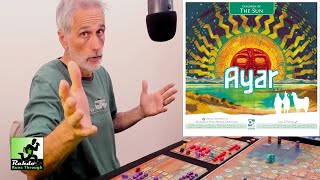
- Elegant and simple design
- Culturally evocative theme and art
- Interesting blend of mechanics
- Beautiful tension between sun and moon scoring
- Unique concept
- Potential for strategic depth
- Predictable and chesslike at two players
- Can feel less exciting at lower player counts
- Origin story of the Incan Empire, where four brothers travel the land teaching people how to live, with only one surviving to lead the civilization.
- Incan Empire
- MV
- Sanori
- Power Grid
- Concordia
Mechanics (from transcript analysis)
- Action Point Allowance — Players decide how many steps an 'AR' figure will move, which determines the level of the action they can perform.
- Area Majority — The farming activity is described as an area majority game where players compete for the most planted crops.
- Dice Drafting — Players choose which 'AR' to move and how far, influencing available actions and scoring opportunities.
- Press Your Luck — Players must balance immediate point scoring (moon devotion) with long-term investments (sun devotion).
- Race — The game has a 'horse race' feel, where the movement of 'AR' figures opens up opportunities and triggers scoring.
- Set Collection — The pottery activity is described as a set collection game where players aim to gather sets of the same color.
- tile laying — The weaving activity is described as a tile-laying game.
- Worker Placement — Players place markers to activate actions, and the available action spots are created by the movement of the 'AR' figures.
Video topics + discussion points
Quotes (from this video)
- Please please publishers put pronunciation guides in your rule book.
- This is the most unusual of the games.
- It's such a beautiful tension between these two different things that pull you towards you know this is one of the ultimate bird in the hand two in the bush situations I have ever seen.
- It's not necessarily a great thing. For you, it might be because with only one other player, and you can see exactly what they've got, exactly who they can move, how far they can move them, you can make much more informed decisions that are designed to, all right, you really want that to cross the line. I need to make sure that one dies because it benefits you and it doesn't benefit me.
References (from this video)
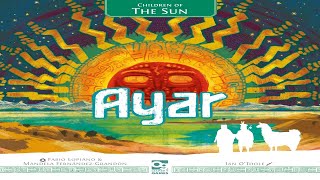
- Interesting and unique mechanisms not seen in many other games.
- Thematic integration with historical notes and lore.
- Clean and efficient gameplay flow.
- Visually appealing art and graphic design.
- Good jumping-off point for Eurogame players.
- Straightforward yet interesting action selection system.
- The way 'IR' move on the track and the retiring of workers.
- The Veroka tokens provide cool bonuses.
- Player boards are cool as taking cubes off unlocks new things.
- The farming action can feel forced in a two-player game, requiring players to follow suit to compete for Veroka tokens.
- Lack of recessed boards for tokens and cubes can lead to them scattering if the table is bumped.
- The game might feel too simple for some experienced Eurogamers, not offering enough challenge or forcing difficult decisions.
- Pottery action felt less touched upon by some players and is reliant on luck with the stack.
- The placement of the step markers could be an issue if players forget where they were after moving them.
- Incan civilization
- Incan civilization
- MV
- Sor
- Shackleton Bay
- Three Ring Circus
- To Want Sue
- Ark Nova
- Rogers of the Ganges
- Two Cities
- Beer and Bread
- Teotihuacan
- Tend
- Unconscious Mind
- Brass
Mechanics (from transcript analysis)
- action selection — A core mechanic is the action selection, which is described as "great" and "interesting," tied to the movement of 'IR' figures on a track.
- Area Majority — The farming action involves an area majority mechanism where players compete for 'Veroka' tokens based on who farms the most.
- Bonus/Wild Action — A gold 'IR' token acts as a wild, providing flexibility when players are 'hosed on something' or need to use a specific color again.
- dual scoring tracks — The game features managing two scoring tracks, Sun and Moon, where the lower of the two is the final score.
- Resource Management — Players manage resources, like cubes for farming, to gain benefits and potentially score 'Veroka' tokens.
- Set Collection — Players collect 'textiles' and 'pottery' which can lead to combos and score points based on different strategies.
- Variable player powers — As cubes are taken off player boards for actions like farming, players unlock points or reveal new abilities, encouraging a bit of everything.
- Worker Placement — The game uses a worker placement system where placing workers moves 'IR' up a track, influences action strength, and one worker retires each round.
Video topics + discussion points
Quotes (from this video)
- Just to add a little bit more flavor into a relatively dry Euro.
- The action selection is great.
- It's a very interesting system, but I also found it to be straightforward.
- I really, really like this game.
- This one was definitely the easiest to pick up.
- It's just a lot of different mechanisms that flow really well together.
- It this is clean and I didn't think the game lasted that long.
- It's like, okay, this is like terraforming Mars all over again.
- This is pretty unique from what I've seen, but it's still kind of hits that Euro feel.
- But I'd much rather play this, which is a seven, over brass, which is also a seven, because funny enough, brass just that's that's the kind of cutthro nature that pisses me off.
References (from this video)

- Beautiful table presence and well-organized components
- Engaging theme with strong integration into mechanics
- Replayability via different paths and upgrades
- High complexity and learning curve
- Longer play sessions may require multiple sittings
- Temple-based scoring; timing matters; city-building
- Vienna with sun and moon temples; mythic/dynastic city
- Thematic, drumbeat of timing and expansion through progression
Mechanics (from transcript analysis)
- city-building — Placing buildings and managing temples to gain points
- Compound Scoring — Temple-based scoring with sun and moon tokens
- Engine Building — Upgradeable player boards that improve actions over time
- engine-building — Upgradeable player boards that improve actions over time
- variable scoring — Temple-based scoring with sun and moon tokens
Video topics + discussion points
Quotes (from this video)
- Salt Fjord is a fantastic game with great table presence.
- The timing matters so much in Children of the Sun; it's brilliant.
- Emberleaf has a unique card-dueling engine with sliding cards.
- Kinfire Council hits every target—it's a great experience.
- Unconscious Mind is a beautiful thematic experience, with Freud and the talking cure.
References (from this video)
- Streamlined rules with strong depth for a medium-weight Euro
- Tight action-selection and blocking mechanics that fit thematically
- High player interaction for a Euro game
- Solid production and art direction (illustration and production noted in video)
- Two-player early game may push sun-point strategy and reduce variety
- Solo mode viability may need longer-term validation
- Potential dynamic shift in four-player games
- Mythic journey and founding a new home for the IR siblings
- Origin myth of the Inca Empire
- mythic, legend-inspired
- Conbon
- Conbon EV
- Sori
Mechanics (from transcript analysis)
- Action selection with step markers and blocking — Players place step markers on their boards and stand them up to block locations until moved, adding a personal puzzle layer.
- Competitive space for actions and resource gathering — Block competition and shared resource gathering creates meaningful player interaction.
- Dual-point scoring (sun and moon) with minimum scoring rule — Players aim to maximize sun and moon points, but final score is the lesser of the two.
- Persistent blocking of locations — Blockers stay active across rounds, shaping player options and forcing planning.
- Solo mode with a simple AI opponent — A solo opponent is available and designed to be easy to run.
Video topics + discussion points
Quotes (from this video)
- I love the entire action selection mechanism on your playerboard. The way you place the step markers and stand them up to block locations until you move them off.
- This is a game where the other players really matter and affect your decision at every turn.
- I'm very impressed with the design.
- This is a mediumweight game with a strong depth to the complexity ratio.
- The rules were streamlined, especially compared to Sori before it.
- The solo opponent is also extremely easy to run.
- I’d like to try IR at three and four players.
References (from this video)
- Engaging sun/moon scoring with early Sun-point emphasis
- Solid solo-mode with predictable AI behavior based on rhyme tiles
- Temples and llamas add end-game strategic depth
- Clear visual feedback from the board and tokens
- Occasional setup inconsistencies and host mistakes in the video
- Rules can be dense; solo rules require careful reading
- AI behavior occasionally punishes players for suboptimal moves
- Resource management and ritual scoring via sun and moon cycles
- Origin myth of the Inca Empire; pre-Columbian Andes
- Myth-informed historical fantasy with procedural storytelling
- Conbon EV
Mechanics (from transcript analysis)
- End Game Bonuses — Llamas awarded for achieving certain conditions and converted to points.
- llama tokens as end-game bonuses — Llamas awarded for achieving certain conditions and converted to points.
- Set collection and scoring — Sun and moon point scoring via rhymed tiles and pottery/weaving sets.
- Solo vs AI opposition — Automated opponent uses rhyme-based decision making and hard-coded priorities.
- temple/board advancement — Completing temples grants bonuses and advances scoring track.
- tile/action row selection — Players choose actions using Tambos and IR lines, with power/action costs determined by available tiles.
- Track Advancement — Completing temples grants bonuses and advances scoring track.
Video topics + discussion points
Quotes (from this video)
- Getting sun points early is key to winning, and llamas amplify end-game scoring.
- Watching the AI chase pottery or weaving and react to rhyme tiles is entertaining.
- Sun points as early as possible—that's the strategy that seemed to work here.
References (from this video)

- Tactical and dynamic scoring
- Mythic theming with strategic depth
- Some suggestions that timing scoring feels counterintuitive
- Divine powers, scoring areas that shift over time
- Incan Empire mythology and gods
- Mythic, tactical with dynamic scoring
- Glory of the Sun-themed titles
- Other area-scoring euro games
Mechanics (from transcript analysis)
- Area scoring that shifts — Score areas, but some areas score early and then fade, requiring flexibility.
- Compound Scoring — Score areas, but some areas score early and then fade, requiring flexibility.
Video topics + discussion points
Quotes (from this video)
- Vanish is a perfect 10 game.
- It's a dead language. Who knows? Children of the Sun.
- This is Metal Gear Solid, and it finally came out, and oh my gosh, it's so good.
- Pergola is a beautiful little game where you're making a little pergola, a garden, right?
References (from this video)

- cooperative feel with meaningful path progression
- varied micro-games tied to progression
- co-op-lite may not appeal to all
- learning curve for new players
- paths, cooperation, and progression on a shared map
- cooperative-semi, with a path-based worker/house system
- story-driven progression through modules
Mechanics (from transcript analysis)
- colorful worker placement with paths — Colored workers activate actions behind a path, moving along cooperative routes.
- house placement and path unlocking — Take off a built house to unlock actions; cooperation to advance along paths.
- Worker Placement — Colored workers activate actions behind a path, moving along cooperative routes.
Video topics + discussion points
Quotes (from this video)
- I love this game so much.
- Cozy Stickerville is releasing at retail.
- Maple Valley Solo is the best solo game that I played in January.
- I am obsessed with this game.
- This game absolutely broke my brain.
- F honestly broke my brain.
References (from this video)
- Unique multi-layered puzzle with four micro-goals (corn weaving, reed bundling, island placement, pottery sets) feeding into a cohesive whole
- High replayability due to randomization of scoring tiles and multiple pathways to victory
- Four-player games shine; direct interaction around the main board creates tense timing decisions
- Strong components, art style, and color palette with a tactile, visually appealing presentation
- Solid solo mode and organized setup, with a high player-count sweet spot
- Long teaching and setup time; the organizer helps but it still takes effort to set everything up and teach
- Steep learning curve and unforgiving nature of strategic mistakes
- Color naming can be confusing for some players (color descriptors varied among players)
- Setup and storage can be cumbersome without proper organization
- Resource management, weaving, temple placement, and island development in a mythic-educational framing
- Origins of the Incan Empire in pre-Columbian Andes
- Abstract puzzle with thematic flavor and nicknamed terms for teaching
- MV
- Sankur
Mechanics (from transcript analysis)
- Grid Building — Players build a weaving layout to create suns and fill columns, earning rewards for successful patterns.
- Island placement via reed bundles — Reeds are bundled to place island tiles on the board, unlocking rewards and point opportunities.
- multi-track action economy — Actions are purchased on a per-row basis, with increasing power as you commit more tempo in a row.
- Night phase scoring and retirement — At the end of each round, one IR retires, removing future scoring opportunities and forcing timing decisions.
- Randomized scoring tiles and solo mode — Scoring tiles are randomized to boost replayability; there is a solo mode included for single-player play.
- Sun and Moon scoring with the lower score counting — Players accumulate sun and moon points; only the lower of the two contributes to final score, creating balance tension between pathways.
- Temple and pottering cycles — Temples provide moon point opportunities; pottery sets of different colors grant additional scoring.
- Weaving puzzle on the player board — Players build a weaving layout to create suns and fill columns, earning rewards for successful patterns.
- Worker Placement — Players move IR figures along tracks using a movement budget to perform actions that upgrade abilities on their personal boards.
- Worker placement on four tracks — Players move IR figures along tracks using a movement budget to perform actions that upgrade abilities on their personal boards.
Video topics + discussion points
Quotes (from this video)
- This is another game from Osprey Games, and I haven't played anything by them that I didn't really like.
- Four players, this thing sings.
- We love this game.
References (from this video)

- cooperative teamwork under time pressure
- evolving rules keep the puzzle dynamic
- poetic illustrations (as described)
- unknowns about long-term replay implications
- Time pressure and silent collaboration
- Abstract/cooperative with time-based challenges
- Poetic/abstract
Mechanics (from transcript analysis)
- Cooperative Game — Players discuss and decide together under time constraints, often with silent communication.
- cooperative play — Players discuss and decide together under time constraints, often with silent communication.
- Real-Time — Each clock introduces a new rule or twist that changes how the group must respond.
- time-based rule evolution — Each clock introduces a new rule or twist that changes how the group must respond.
Video topics + discussion points
Quotes (from this video)
- Time itself is testing you.
- Player aids are a must.
- Board game people are the best.
References (from this video)

- Beautiful production and artwork
- Deep, strategic action selection with clear thematic ties
- Tension between sun and moon scoring provides meaningful choices
- Heavy for new players; complex rules and dual rulebooks
- Keywords and components may require extra time to grok
- Mythic strategy with resource management
- Incan civilization with sun and moon gods
- Heavy, deeply thematic action selection
- Kalisto 2200
- Undaunted
Mechanics (from transcript analysis)
- Action selection with space movement — Move one legendary brother a number of spaces, then pick a follow-up action.
- Deterministic planning with high decision impact — Plan turns carefully; player decisions heavily shape outcomes.
- Resource gathering (pottery, read, weave) — Choose actions to collect different resources.
- Two-track scoring (sun god and moon god) — Score is determined by the lower of the two metrics.
Video topics + discussion points
Quotes (from this video)
- It's a banger for me.
- This is a really fun game.
- The production is amazing for such a small price.
- It's a solid game.
- This is the AR Children of the Sun; the game of the month.
References (from this video)

- Deep, thinker-friendly design with gorgeous production
- Player-driven scoring timing creates tension and planning
- Beautiful art and clean UI with strong UX
- Complex for beginners, but rewarding with experience
- Ancient empire building with cultural exchange
- Incan civilization themed setting
- Strategic, multi-path scoring and player-driven timing
- Galarist
- Ironwood
Mechanics (from transcript analysis)
- action selection with worker placement flavor — Players bid/hire to trigger actions and score varied objectives
- multi-faceted scoring and tile interactions — Players influence scoring timing and public scoring data
Video topics + discussion points
Quotes (from this video)
- This is our top games to go and buy at Spiel and there are so many.
- We’re putting our money on the hot stuff.
- This is going to be really big just like yes exactly.
- It’s a Christmas for ball games.
- Dragons. Ember. Training my own dragon to be the best dragon.
- AR Children of the Sun... it’s deep, it’s fascinating, it’s brilliant.
References (from this video)

- Euro-style gameplay
- Interesting optimization puzzle with dual tracks
- By designer of favorite game Kalya
- Creates internal tension and decision-making
- Bright art style
- Managing sun and moon forces
- Celestial/religious
- Dual-track optimization puzzle
Mechanics (from transcript analysis)
- dual scoring tracks — Sun track and moon track, final score is the lower of the two
- Optimization — Balancing resources between two competing objectives
Video topics + discussion points
Quotes (from this video)
- October. We are going to be talking about our top 10 most anticipated games at Essen Spiel
- This is the world's largest board game convention held in Essen Germany
- We are expecting a baby any day now
- They're all clever. Clever in their own way, one way or another
- It just sounds very euroy. something that goes right up our alley
- I like these kind of games where you're trying to always bring up the rear. I feel like it kind of creates this internal tension and decision-making
- It's a little funky, but it works really well
- Pretty much if there's a David Turxy Euro game that's coming out, my board and dice, we would love to play it
- I am absolutely judging this board game by its cover and by its looks
- The looks alone and the fact that it's like a heavy euro has us both really, really intrigued in this one
- So anyh who, really looking forward to playing this one. That is our number one, Sanctuary
- There are a lot of publishers that you see there that you don't see anywhere else and they're from all over the world
References (from this video)

- Stunning production and artwork
- Engaging, thinky puzzle with strong replayability
- Interesting action-selection mechanism
- Complex onboarding for newcomers
- Rules density can be intimidating
- Cultural development, societal planning
- Mythic city-state with deterministic elements
- Brainteaser-like derivations from action selection
- Memoir '44
- The Mind (for pacing and puzzle feel)
Mechanics (from transcript analysis)
- Action selection with high variability — Players pick actions that interact with a deterministic engine, creating unique runs
- Deterministic strategy — Game outcomes feel fixed by the chosen actions rather than purely random
Video topics + discussion points
Quotes (from this video)
- This year was brutal for making a top 10; the quality was that high.
- This game will stay in the collection for the foreseeable future.
- It's a banger, mate. Absolutely a standout.
References (from this video)
- deep interlocking systems with high thematic integration
- compelling two-player head-to-head potential; tight puzzle
- two-player mode can be cutthroat and unforgiving
- some players may miss typical modern designer elements like unique powers
- demigods, temples, and horse-race style progress
- Incan myth-inspired setting
- mythic race with multiple activity tracks
- Power Grid
Mechanics (from transcript analysis)
- four disparate mini-games — domino-like, set-collection, area-majority, and travel/building mechanics.
- multi-action horse-race style worker placement — four demigods race along paths; each move triggers different mini-games.
- temple scoring and dynasty choices — build temples to influence diegetic outcomes and shifting scoring.
Video topics + discussion points
Quotes (from this video)
- Damn, this game is mean.
- This is the best trick-taking game we've ever played.
- Entwined drafting is excellent; the arithmetic can be heavy but rewarding.
- Peak Team is the best cooperative game of 2025 so far, by far.
References (from this video)
- dual sun/moon scoring system creates interesting tradeoffs
- strong personal-board strategy and tension around marker placement
- rule-book clarity issues and occasional confusion about scoring transfers
- endgame scoring can feel swingy
- Sun and Moon scoring, weaving, terrace farming
- Ancient Incan Empire
- Thematic abstraction around sun/moon scoring and weaving tiles as a core payoff
- MV
- Sori
Mechanics (from transcript analysis)
- dual-score tracking — sun and moon tracks provide endgame scoring with interactions via tokens and temples
- sailing / read collecting — a river-based route where you place huts to uncover suns and advance along tracks
- Set Collection — pottery tiles and sun/moon tokens are gathered to enable actions and scoring
- tile placement / weaving — place weaving tiles on a personal board to build rug patterns that unlock sun/moon scoring
Video topics + discussion points
Quotes (from this video)
- Everything looks great. You have one little skin tag on your face. You just want me to zap that real quick?
- This app uses an adaptive audio engine and an ever growing sound library that is 100% human-made audio.
- We stayed true to ourselves. Stay true to our friends, no matter the cost.