











Batman: The Dark Knight Returns – The Game Deep Dive
What the Community Thinks About Batman: The Dark Knight Returns – The Game
Reviewers agree on the game's central appeal: it is a faithful, tightly themed solo adaptation of Frank Miller's graphic novel, published by Cryptozoic Entertainment. Board Game Hangover calls it a love letter to the comic, noting that the villains, the allies, and even the reasons characters act as they do all track the source material. The Discriminating Gamer ranks it second on a list of non-war solitaire games and praises the great dice, the artwork, and the way the book's four chapters become four linked games.
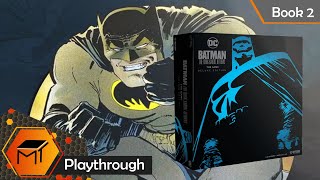
Opinion divides mainly on accessibility. Several commentators argue that the game rewards readers of the comic. Board Game Hangover says a player who has not read it will struggle to follow what is happening, since the rulebook offers little explanation of characters like Two-Face or the mutants. Meet Me at the Table, by contrast, plays through book two with obvious enthusiasm and focuses on the mechanics and board state rather than the story.
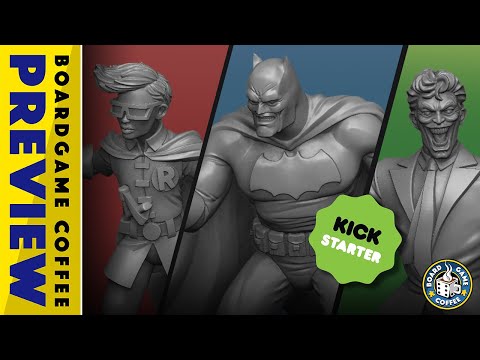
Those who finish the campaign describe a strong, demanding solo experience that is occasionally grindy, with complaints about the save system and the physical footprint. Mark Maya of Board Game Coffee introduced the game in preview form, describing four books played in order, each with its own mission and turn limit, and a city that keeps deteriorating whether or not the player is paying attention.
Core Mechanics That Define Batman: The Dark Knight Returns – The Game
Resource Management
Reviewers describe the game's core tension as a constant choice about what to give up. Board Game Coffee explains the event deck: every card has an effect if you keep it and a different effect if you do not, and you cannot keep them all. The cards you discard return later as threats, so the drafting decision is both tactical and personal. Board Game Hangover describes it as a draft in which you pick three cards, keep one for the event deck, and use the rest in combat or as a later event.
Grit, health, and sanity act as shared fuel, and running out of any of them ends the game. The Doomsday Clock and the riot tracks represent the other side of the ledger. Colin of Meet Me at the Table shows this in play, refusing an event that would advance the clock from six and accepting small losses to grit and sanity to keep options open. Board Game Coffee notes the broader lesson: letting districts fall into disorder buys time for the main objective, but those same mutants and cops follow the player into the next book.
Combat: Dice
Fights are resolved with custom Batman dice, which reviewers treat as one of the game's strongest systems. Board Game Hangover praises the dice management as smooth and well made. At the start of a fight the player takes three dice, some better at blocking, some better at hitting, and some that let Batman ram an opponent at a cost to himself. Upgrades add better faces to the pool over time.
Colin's playthrough shows the rhythm of the system: rerolling, deciding which results to flip, and returning spent dice to the utility belt on a cool-down cycle, so that every reroll carries a real decision. The dice are not without critics, but the system itself is widely admired as a source of swingy, cinematic fights.
The Batman: The Dark Knight Returns – The Game Experience
Pandemic-Style Pressure
Many reviewers describe the feeling of managing a city that is always on the edge of collapse. Board Game Hangover says the game carries pandemic principles, with threats spreading across the map that the player must move through and clear, and that it handles those principles more effectively than similar titles. Colin says the game delivers "the pandemic feel of trying to make sure locations don't overflow," describing the satisfaction of keeping a district from tipping into a riot.
Board Game Coffee frames the design goal clearly: the player cannot solve all of Gotham's crime, so every turn is a decision about which battles to ignore. That acceptance of partial failure gives the experience its tension and keeps each action feeling consequential.
Gritty, Aging Batman
Reviewers repeatedly describe the mood as weary rather than heroic. Board Game Hangover asked what made the reviewer feel like Batman, and the answer was the aching body, the sense that every trip across town costs something, and the feeling that bad things are happening everywhere at once. Board Game Coffee presents the premise bluntly: Gotham is a bad place to live, and there is no utopia on the horizon. The goal is to endure and reach the end of the story.
That tone is what makes the campaign feel like the comic. The player is an older Batman coming back from retirement, and the game's pacing, its resource losses, and its cost-benefit decisions reinforce that he is no longer the man he was.
What Makes Batman: The Dark Knight Returns – The Game Stand Out
Faithfulness to the Graphic Novel
Reviewers consistently praise how closely the game follows Frank Miller's story. Mike of Board Games for One notes that the three scenarios follow the comic's storyline, with its allies, its villains, and its vehicles. The Discriminating Gamer describes the campaign as an escalating ladder of opponents, with the Joker, a street gang, and Two-Face giving way to Superman, the Man of Steel himself, at the end. Board Game Hangover argues that the theme is the main reason to buy the game, since the visuals, the mechanics, and the feel all reinforce the source.
The Dry-Erase Gotham Map
The wipe-clean map is praised as a central part of the experience rather than a gimmick. Board Game Coffee notes that the city map is coated with dry-erase material so players can draw on it and wipe it away. Board Game Hangover says the player draws new paths that connect regions and marks bonus locations, so the player's own choices create the campaign rather than a scripted sequence of paragraphs. Mike of Board Games for One describes the changing board as a kind of pseudo-Legacy effect that does not carry permanent changes between plays, so the map can be reset and replayed.
Potential Drawbacks
Bulk, Price, and Save Friction
Board Game Hangover describes the box and rulebook as huge, with a footprint that makes the game hard to fit into a normal table setup. The reviewer also notes that the deluxe edition, which swaps plastic miniatures for standees, costs at least a hundred dollars and suggests borrowing the game before committing. Mike of Board Games for One places the standard version near sixty dollars and says the game is adored, but also calls the save system unintuitive, a point Board Game Hangover echoes. Each scenario can run up to two hours, and keeping track of tokens between sessions is a hassle that the reviewer says makes the game harder to leave on the table.
Batarang Dice and a Comic-Dependent Flavor
The batarang-shaped dice are a polarizing element. Mike of Board Games for One notes that some players dislike them because they cannot be rolled like standard dice, though Mike found that rolling them sideways works well and called them thematic. Board Game Hangover's concern runs deeper. The reviewer says the game asks the player to bring the comic's knowledge to the table, and the lack of flavor text leaves newcomers without context. In a related ranking discussion, Board Game Hangover describes the game as niche for anyone who does not like Batman or has not read the comic.
If You Enjoy Batman: The Dark Knight Returns – The Game
Players who enjoy the game's pandemic-style management of spreading threats will find similar satisfaction in Arkham Horror Third Edition. Board Game Hangover notes that Arkham Horror Third Edition shares the feeling of moving through a city, clearing threats, and dealing with monsters, while adding more flavor text and choice-driven story moments.
Board Game Hangover was asked directly about alternatives and answered that there is no close equivalent for a Batman board game, but it drew comparisons to Arkham Asylum on the question of atmosphere. Players who want the Gotham setting and its gritty tone in another format may find Arkham Asylum a natural next step after this game's comic-faithful campaign.
What Reviewers Are Saying
"If you have read that comic you will see that everything is here from that comic, the bad guys, why some allies do the things that they do is because that's what happens in the comic. It is a love letter to the comic book and it's super true to the source material."
— Board Game Hangover
"As you're playing through this game, you're up against the Joker, and you're up against this street gang and Two-Face, and ultimately you're up against Superman, the man of steel himself."
— The Discriminating Gamer
"I really wish more games would come out with a dry erase board. What a great idea. You can change the board, but then you can erase it and then reuse it again and again."
— Meet Me at the Table