








Battle Masters Deep Dive
What the Community Thinks About Battle Masters
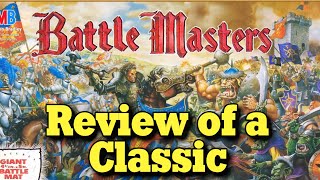
Battle Masters is a 1992 fantasy miniatures battle game from Milton Bradley and Games Workshop, designed by Steven Baker. Reviewers remember it as a big, bold box that looks impressive on the table. In their Dungeon Dive review, Daniel places it beside HeroQuest, calling it the family focused introduction to Warhammer Fantasy Battle, and they say the table presence is "totally off the charts, especially when everything is painted."
Opinions split over the card deck that runs the game. Daniel regards that deck as the best part of the design, while The Dice Tower reviewer is far less enthusiastic about the result. Both agree the game is light, and both agree the spectacle is a large part of its appeal. Designers from Restoration Games, speaking in a Rolling Dice & Taking Names interview, treat the original as a reference point for their own project, describing it as an early 1990s game of two armies on a very large board.
Core Mechanics That Define Battle Masters
Card-Driven Activation
Each turn a battle card is drawn, and the units illustrated on it are the ones that can act. Daniel explains that the players never choose when their units move, and that each drawn card lets the owner activate the units shown, with activation consisting of a move and an attack. Because the deck is shuffled at the start, the order of play is effectively set in advance, which Daniel describes as an almost pre-programmed tactical game. They are clear that this costs the game some strategic planning, but they see the trade as a gain in narrative.
Damage-Based Dice Combat
Combat uses plastic dice marked with symbols for hits, misses and defense. The attacking unit rolls dice equal to its combat value, which is usually between two and five dice, and the defender rolls to block. Any hits left over cause damage, and most units can absorb three hits before they are wiped out. Fights therefore play out across several exchanges rather than in a single roll. Daniel notes that movement is simple and turns are fast, since most units move one hex and a few move two.
The Battle Masters Experience
Dramatic Swings That Feel Like a Story
The shuffled deck produces narrative moments that the players did not plan. In one of Daniel's games, their Imperial Mountain Knights stood far from the fighting for most of the battle, because their activation cards sat clumped near the bottom of the deck. Then for six or so turns in a row those cards came up, and the knights galloped in to save the day. They say, "I love how the randomness of unit activation added to and bolstered this dramatic event." Players who prize control may find that frustrating, but Daniel calls the same randomness a huge win.
Nostalgic, Approachable Fun
Many reviewers arrive through childhood memories. The Dice Tower reviewer remembers playing it as a kid and imagines a giant ogre or troll facing a cannon across a large play mat. Daniel came to the game as an adult, after many years of never hearing of it, and found that its focus is on simple, approachable fun. They say they "had an absolute blast playing it," and they suggest that the game is best appreciated for what it is, not measured against deeper tactical wargames.
What Makes Battle Masters Stand Out
The Ogre Champion and the Mighty Cannon
Each army has one special unit governed by its own mini-game. The Chaos ogre champion draws from a six-card deck, three moves and three attacks, so it can flail away without a target or charge in for a heroic double action. The Imperial cannon works differently. The player places a target disc, then reveals a stack of face-down discs along the flight path to learn whether the shot hits, bounces with splash damage, or stops short and misfires. Daniel says both units add a ton of flavor and drama to the game, and they wish the design had been expanded with more units of the same kind.
Table Presence and Production
The physical production earns consistent praise. Daniel describes a box holding roughly 100 quality plastic miniatures, a chunky plastic fortress tower, and a huge vinyl battle mat, with great sculpts and illustrations. The Restoration Games designers recall that the original was "often had to be played on the floor," on a board about the size of a twister mat, and they cite that large-board format as the starting point for their own reboot.
Potential Drawbacks
Limited Tactical Control
The most common concern is that the card deck takes decisions away from the players. Daniel acknowledges the argument of hardcore tactical players, and they accept that the mechanism severely limits tactical and strategic planning. They still say Battle Masters might lack the planning some gamers crave, but its focus is clearly on one thing: approachable fun. Readers who need meaningful choices each turn should weigh that trade before buying.
Thin Depth and Unrealized Potential
The Dice Tower reviewer calls it a light miniatures game and says it is not a great game, although they are looking forward to the Godzilla version from Restoration Games. Daniel wishes the game had received more official support, and they imagine battle mages and chaos sorcerers drawing random spell cards in the same way the ogre draws its activation cards. The included five scenario campaign is modest. Surviving units gain an elite status that lets them roll one extra die in combat, and that is the only real progression between scenarios.
If You Enjoy Battle Masters
Players who enjoy the big-battle feel of Battle Masters will find a close relative in Battle Monsters, the Restoration Games reboot that its designers describe as a combination and reboot of the 1990s game. Players who enjoy Battle Masters' family-friendly fantasy introduction will find a similar satisfaction in HeroQuest, which Daniel names as its companion from the same era. Players who enjoy the miniature play and the nostalgia of Battle Masters will also find an easy home in Space Crusade and Advanced Space Crusade, two titles Daniel mentions alongside it from their own years of gaming. Players drawn to the tension of a shuffled deck deciding the pace of play can also look at Talisman, which Daniel groups with the same childhood favorites.
What Reviewers Are Saying
"The most interesting thing about Battle Masters is also the most contentious and that is the deck of battle cards that controls the entire flow and rhythm of the game. In Battle Masters, there is no initiative and the players don't even get to choose when their units move and attack."
— Daniel, Dungeon Dive
"It's a really, really light miniatures game, but it's not great. It's not a great game."
— The Dice Tower
"Battle Masters was something that was sort of on our short list for a while and the scale just made a lot of sense."
— Rolling Dice & Taking Names