/pic7064178.jpg)




















Beer & Bread Deep Dive
What the Community Thinks About Beer & Bread
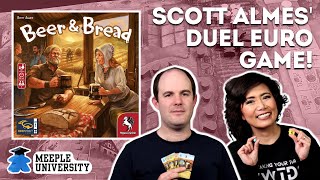
Beer & Bread arrived in 2022 as an essential two-player release that immediately caught the attention of the board game community. Reviewers and players consistently praise its elegant balance between accessibility and strategic depth. The game feels like a peaceful farming simulation on the surface, but its scoring system and resource management create genuine tension and memorable moments of conflict. Unlike many two-player games that rely on direct antagonism, Beer & Bread forces players into economic cooperation disguised as competition, where the most painful defeats come not from direct blocking but from being forced to gift your opponent the exact resources they need.
Core Mechanics That Define Beer & Bread
Multi-Use Cards
Each of the game's 60 cards serves three distinct purposes, and this flexibility defines the strategic puzzle. During a turn, you can play a card to harvest resources stacked in a column that grows as the round progresses, with later plays granting more resources. Alternatively, you can spend the resources shown on that same card to bake bread or brew beer directly into your tableau. Or you can use it as an upgrade, tucking it under your board to gain bonuses like extra storage or passive income. This tri-purpose design means you can never craft a dominant strategy that focuses on one scoring path. Instead, you find yourself constantly deciding whether you need resources now, points now, or engine-building power for the future. The cards are sophisticated enough to matter without being confusing; no exotic combos emerge, which keeps the decision space clean at two players.
The Forced Gift Mechanism
When your storage, limited to nine resource slots, overflows from a harvest action, you must offer the excess to your opponent. This rule generates the most memorable moments of the game. One reviewer described a specific turn where they played a card to gain water for their brewery, receiving three water tokens but only having room for two. The forced gift of that third token went directly to their opponent, who smiled, took it, and immediately used it to complete a high-scoring beer card that had been blocked for 20 minutes. This mechanic creates what players call a unique kind of pain: you are not outplayed, you are made complicit in your own defeat. The rule forces careful management of your storage, creating moments where you avoid certain harvest cards because you know they'll give your opponent valuable resources.
The Beer & Bread Experience
Intimate and Non-Confrontational
Beer & Bread occupies a rare space for two-player games. It has genuine interaction and meaningful decisions without the push-your-pull directness of games like Watergate or the hidden information of games like Fog of Love. One reviewer noted they prefer two-player games with euro-building interaction rather than pure push-and-pull mechanics, and Beer & Bread delivers exactly that. You can hate-draft cards you see your opponent needs, knowing exactly what you're denying them because you watched the hand exchange during the fruitful year draft phase. But you can also collaborate through card gifting. This creates what players describe as a more forgiving feel than Seven Wonders Duel or Carcassonne, even as the scoring margins remain razor-thin.
Surprising Depth in a Light Package
Despite playing in 30 to 45 minutes with straightforward actions, Beer & Bread demands real planning. The alternating fruitful and dry years force you to think ahead: which harvest cards do you want to pick up now for use in the dry year when resources shrink? Can you plan your cards properly, or will you end up stuck with cards you cannot fulfill? The timing of when you clear your brewery and bakery with upgrades becomes critical because you lose action space if either fills up. Reviewers consistently note that the game feels far more thinky than its weight suggests, especially once you understand the rhythm of alternating seasons and how to work the multi-use cards. It is genuinely easy to learn but truly difficult to master.
What Makes Beer & Bread Stand Out
The Lowest-Score-Wins Victory Condition
Your final score is the lower of your two totals, bread or beer. If you score 40 points in beer but only 5 in bread, your final score is 5. This forces a brutally tight balance that runs counter to natural player inclination. You cannot obsess over brewing beer because sooner or later you must focus on baking bread and vice versa. Reviewers love this mechanism because it creates a structural puzzle within every game: you know exactly what you need to do, you just cannot quite find the resources or time to do it perfectly. Games end with scores like 23 to 24, and knowing you lost because you gave your opponent one wheat token three rounds ago sticks with you. This scoring design elevates the game from a pleasant resource puzzle into something with real teeth.
Meaningful Variability Through Cards and Drafting
With 60 unique cards and a deck that does not always get fully revealed, each game feels distinct. The fruitful year draft is bluffed and strategic; the dry year hand management is about planning for the future and recovering from bad draws. You never feel completely locked out of options because multiple action spaces offer similar effects at different efficiency levels. If the best training action is unavailable, an alternative exists that lets you still progress. This design philosophy keeps all players engaged rather than watching someone pull ahead while others struggle to find a path forward. The cards themselves, while simple in effect, create enough variation that you find yourself discovering new synergies and engine-building lines every few plays.
Potential Drawbacks
Card Design Clarity
One reviewer noted that the card design itself does not help readability. Despite the cards being mechanically simple, they visually wash over the eyes; it is easy not to notice there are different types of bread on the cards until your second or third play. This is a teaching and first-play issue more than a design problem, but it worth noting if you are introducing the game to someone unfamiliar with board games. Once players understand that each card has three zones and how those interact with the engine, the visual simplicity becomes an asset rather than a liability.
Tight Margins and the Weight of Small Decisions
Because the scoring is so tight and every resource matters, the game can feel punishing in ways that some players may not enjoy. If you are not careful about your storage, you will gift your opponent a critical resource. If you do not plan your cards correctly, you will find yourself unable to complete contracts when you need them most. This is not random punishment; it is the consequence of imperfect planning in an information-light environment (especially in the closed draft of fruitful years). Some players find this frustrating rather than satisfying, particularly if they struggle with the memory burden of recalling which cards their opponent received during hand exchanges.
If You Enjoy Beer & Bread
Players who love Beer & Bread often gravitate toward similar two-player experiences. Seven Wonders Duel offers comparable card play and drafting but with a less forgiving structure. Village provides a different mechanical approach to similar themes. Those who enjoy lighter Rosenberg games like Agricola or Caverna in their essence but want something faster find Beer & Bread to be an excellent alternative. If you appreciate games where you can see all of your opponent's moves and resources but still feel genuine surprise at their outcomes, Beer & Bread will reward you repeatedly.
What Reviewers Are Saying
"It has everything I really like in a two-player game. I like a two-player game where you're interacting and euro building stuff, and this really has that. The key is if your storage overflows you have to offer to your opponent, which is such an interesting decision."
— Meeple University
"You're not just outplayed, you're forced to be complicit in your own defeat. That mechanic creates a unique kind of pain. Knowing that I lost because I gave you one wheat token three rounds ago. That sticks with you."
— Board Game Critique
"The best thing about this game is the final scoring. I like games where you have to balance your efforts well to win. It's passive aggressive warfare disguised as a bakery."
— 3 Minute Board Games