

















Beyond the Horizon Deep Dive
What the Community Thinks About Beyond the Horizon
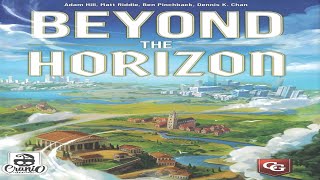
Beyond the Horizon arrived in 2024 as a spiritual successor to Beyond the Sun, the beloved tech-tree civilization game that ranks among the highest-rated designs in the hobby. The new game carries forward designer Dennis K. Chan's love of engine building and progressive technology advancement, but charts its own course by shifting emphasis away from pure tech optimization. Community response has been mixed: channels like Meeple University appreciate many of the new design choices, while Quackalope feels the game trades away some of what made Beyond the Sun so compelling.
Core Mechanics That Define Beyond the Horizon
The Tech Tree as Engine
At the heart of Beyond the Horizon lies a shared technology tree where players race to research cards that unlock more powerful worker-placement spaces. As you research technologies, you gain both immediate bonuses and access to new action options, though opponents must still work their way through the tech dependencies to use them. This creates a satisfying progression where early movers choose which technologies to develop and benefit from them faster. The system rewards forward planning, since you can see the entire tree ahead of time and trace which technologies lead to which end-game bonuses. Published by Rio Grande Games, it keeps that racing tension front and center.
Income and Worker Placement
What makes Beyond the Horizon distinct is how it solves the income problem that plagues many civilization games. Your workers sit in separate columns on your player board, and as you deploy them into technologies, you generate income, but only one income per column regardless of how many workers occupy it. This forces a compelling puzzle, since you must constantly unlock new income sources as your workers get permanently tied up. You choose each turn whether to gain influence, money, or activate trade powers, knowing that keeping your income growing is essential to funding future actions. The game does not escalate costs in the traditional sense, so the tension comes entirely from managing permanent worker placement.
The Beyond the Horizon Experience
A Gentler Take on Conquest
Beyond the Horizon removes the contentious area control that defined Beyond the Sun's map phase. Instead of fighting for regions that change hands based on military strength, it makes map expansion a race for permanent bonuses. When you claim a tile as a settler or soldier, you lock in that income forever. Every tile comes with two claim options: one worth fewer points but giving an immediate effect, and another worth more points. This encourages players to range across the entire board rather than fortifying a corner, though clever play can still yield a focused strategy.
Timing and Hard Choices
The game ends when players complete shared objectives, which means you rarely have time to do everything you want. This creates urgency that sharpens endgame decision-making. You must keep close watch on whether opponents are close to triggering victory conditions, forcing hard choices about whether to push your strategy or pivot to complete objectives quickly. The interaction between players shines through technology racing, where reaching a new technology first lets you set which specific tech card becomes available for everyone else.
What Makes Beyond the Horizon Stand Out
Elegant Management of Personal Resources
The income system deserves particular praise. Rather than the typical trap where costs escalate as the game progresses, Beyond the Horizon lets you take the same actions for the same cost throughout: one influence piece to research a tech, one to explore the map. The constraint is purely on how many influence pieces you can generate, which keeps the pacing clean and avoids the mid-to-late-game slowdown that plagues many euros. You are always managing competing income tracks: influence, money, and upgrades to your asymmetric player power.
Replayability Through Asymmetric Powers
Each player has a unique power card that unlocks and upgrades throughout the game. These powers create meaningful strategic forks, because pursuing certain paths can dramatically shift your approach. Unlike random powers that feel tacked on, they integrate into the resource-management puzzle and give each player a distinct economic identity.
Potential Drawbacks
Component Fiddliness
The worker-strength tokens, small counters balanced on top of goblet-shaped pieces, are prone to falling off during play. Players have reported repeatedly dropping these pieces and having to remember what strength they were tracking. The design intent is clever, but in practice the tokens need a recess to stay stable. It is a minor but persistent friction point that surfaces during regular play.
A Different Game Than Expected
Beyond the Sun devotees should go in with eyes open: this is not Beyond the Sun 2. The tech tree feels less dominant to the overall strategy. Some players feel the shift toward map exploration and gentler competitive tech selection diminishes what made Beyond the Sun special. The peaceful-coexistence approach, while thematically appealing, means fewer moments where a new technology fundamentally changes everyone's options. If you came seeking the same crunchy tech-tree optimization, Beyond the Horizon addresses a slightly different puzzle.
If You Enjoy Beyond the Horizon
You likely have an appetite for civilization-building euros with meaningful engines. Beyond the Sun remains the most direct comparison, though Beyond the Horizon branches into different territory. Lords of Waterdeep shares the worker-placement DNA and the satisfaction of watching new action spaces become available. Anno 1800 has similar shared-progress tracks where one player advancing opens opportunities for everyone. For those drawn to the exploration side, Wingspan delivers that sense of building a personal engine while quietly competing through asymmetric powers.
What Reviewers Are Saying
"It's a very clever mechanism where you have to manage that, and ultimately the end of the game is triggered by racing to complete these objectives. You get points by completing objectives and by researching a whole lot of technologies, because every technology is worth points."
— Meeple University
"The tech tree feels debuffed in an unsatisfying way. The thing that makes Beyond the Sun so wonderful is this tech-tree building game where you're slowly expanding into the galaxy trying to get to these level-four technologies, and it's a worker placement game and a resource management game with asymmetric player powers."
— Quackalope
"Researching technology is a way of getting points, a way of getting immediate bonuses, and a way of getting more actions. It gives you very many dimensions to how this plays, which can be very interesting."
— Meeple University