











Blank Slate Deep Dive
What the Community Thinks About Blank Slate
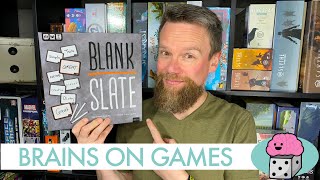
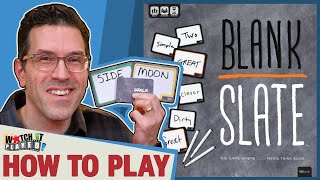
Reviewers generally treat Blank Slate as a light, social word game that rewards a good read on the people around the table. The game, designed by Robert A. Camp, supports three to eight players and typically runs 20 to 35 minutes. Across the videos, the consensus is that it works best as a party or family game. Brains On Games, hosted by Dr. Brian McDonald, describes it as simple to explain and easy to start, and notes that it can even be played over Zoom with paper and a marker. Watch It Played, through Rodney Smith's rules tutorial, frames the game as a test of prediction: how well you can guess what the group will write, or what one specific person will write.
Disagreement is mostly about how much skill separates players. Some reviewers see the game as a contest of vocabulary and memory, while others emphasize that the real skill is social. Rolling Dice & Taking Names reports that a married couple kept matching each other because they shared the same household habits, which suggests that familiarity can outweigh general word knowledge. FPG Voices describes a large Thanksgiving session in which many first-time players enjoyed the game, and Going Analog is the most measured voice, focusing its criticism on the team-based spin-off rather than the original.
Core Mechanics That Define Blank Slate
Written Answer
Each round, the selector draws a cue card with a blank and reads it aloud. Every player, the selector included, writes a private answer on a personal wipe-off slate. The answers are then revealed one at a time, starting with the player to the left of the selector, and dropped into the center of the table. This simultaneity matters: nobody can copy an answer they have not yet seen, so the game becomes a cross-table read of intentions rather than a race to recall facts.
The scoring is what turns the written answers into a guessing game. A player who matches exactly one other player earns three points, a player who matches two or more earns one point each, and a player with no match earns nothing. Reviewers stress that the target is a single match, not the most popular answer. Players have to predict what a specific group of friends is likely to write and then aim for a word that just one of them will share. Brains On Games notes that this is what makes the scoring demanding, because the winning move depends on knowing the people you are playing with.
Word Building
The answer must complete the printed phrase, and the rules define what counts as a valid completion. Rodney Smith of Watch It Played explains that a single-letter addition is not allowed, so a player cannot turn "start" into a word by adding only a "t". A player must add at least two letters, though a compound word, a short syllable that preserves the root word, or a proper noun all qualify as long as the response is one word. Brains On Games describes the same flexibility, noting that a syllable is acceptable as long as the original word can still be heard. The result is an open vocabulary space where the same cue card can generate many different answers, which is part of why the game holds up across repeated sessions.
The Blank Slate Experience
Easy to Learn and Easy to Welcome Newcomers
Reviewers consistently describe the first few minutes as the point where the game wins people over. Brains On Games emphasizes that the rules are simple enough to teach and learn quickly, and that the components, a box of double-sided cards, a set of slates, and markers, are minimal. Rolling Dice & Taking Names describes the game as one that a group of friends could absorb after a short explanation, and FPG Voices reports that the game was new to many relatives at a holiday gathering and was enjoyed by them. The feeling is one of low barriers: no one needs to be a seasoned gamer to take part, and the cards are forgiving because almost any reasonable word can score.
Relaxing Social Play
Blank Slate feels calm and conversational rather than tense. Reviewers describe the rounds as opportunities for laughter, especially when answers collide in unexpected ways. The game is fast enough that a loss does not linger, and the tension comes from the playful question of what your friends will write rather than from any punishing mechanic. Rolling Dice & Taking Names describes the game as a source of genuine enjoyment for the group, and the reviewers consistently treat the social matching as the source of the fun rather than the score itself.
What Makes Blank Slate Stand Out
Scoring That Rewards Being Understood
The most praised feature is the matching system, which turns a simple word prompt into a test of social insight. Reviewers highlight that the three-point reward for a single match, combined with the penalty for being too unusual, forces players to model how others think. Brains On Games describes this as a combination of verbal memory and social judgment, and Going Analog explains the original's core loop as trying to match other people while avoiding answers that are too unique to score. This is what separates Blank Slate from a straightforward word association game.
Compact Components and Endless Replay
Reviewers repeatedly point to the physical design as a strength. The cards are double-sided, so a single box holds a large supply of prompts, and Watch It Played notes that when a draw repeats, the box can simply be flipped to reveal an entirely new set of words. Brains On Games stresses that the box and slates are enough to start a session, and that the game can be carried to a Zoom call without special equipment. Together these details make the game easy to bring out at a gathering and easy to store afterward.
Potential Drawbacks
Results Depend on Knowing Your Table
The same social dependence that reviewers praise can also limit the game. Brains On Games notes that you have to know the people you are playing with to predict what they might write, which means that a group of strangers or a mixed group of casual and experienced players may see scores that feel uneven. Players who write a clever or unusual answer can be penalized for it, so the game can reward a shared frame of reference more than wit. Reviewers do not present this as a flaw in the design, but it is a real consideration for groups that do not share a common background.
Limits of the Team Spin-Off
Going Analog reviewed Blank Slate Challenge, a team-based variant from the same publisher, and was positive about the cooperative pairing, which turns each answer into a shared decision between teammates. The reviewers were critical of player count, however, noting that the variant is limited to two players or four players in teams, which makes it harder to bring a larger group together. Going Analog suggested that the teaming idea could work at a larger scale, and that the spin-off is best understood as a smaller, more focused companion rather than a replacement for the original.
If You Enjoy Blank Slate
Players who enjoy Blank Slate's written-answer matching will find a similar satisfaction in Just One, which Rolling Dice & Taking Names compared to Blank Slate for its single-word answers and social prediction. Both games reward players who can anticipate what others will think, and both thrive in groups that already know each other. Players who value the word-association side of the experience and the way a shared clue can produce a surprising match should also consider Codenames, where teams build understanding around a common set of cues. For players drawn to the guessing and interpretation aspect, Dixit offers a related challenge: reading how others will respond to an ambiguous image, much as Blank Slate asks players to read how others will complete a phrase.
What Reviewers Are Saying
"To me, any game like that where there's some sort of words relate to somebody else, something like that, you're more likely to relate to really good friends or spouses because you get in that same mindset."
— Rolling Dice & Taking Names
"The added complication is that idea of trying to match, hopefully a single player, maybe more than one, but you're trying to really hopefully match only one player. You have to know the people that you're playing with to try and figure out what they might guess."
— Dr. Brian McDonald, Brains On Games
"Basically you're trying to match other people and then you'll score points if you do some matches, if you don't match anyone because your answer is too unique, you don't get any points."
— Going Analog