














Block and Key Deep Dive
What the Community Thinks About Block and Key
Block and Key, published by Inside Up Games, has drawn attention from several board game channels, and the reviews share a common thread: the game looks great, teaches quickly, and asks players to see the same board in very different ways. Reviewers tend to describe it as a tactile, visually striking abstract puzzle rather than a heavy strategy game.
Meeple Mountain's board game brody reviewed a prototype copy and framed the game around its central idea, calling it a 3D abstract strategy puzzle in which each player plays in their own 2D space. Tabletoptiktok's Jamie included it in a list of underrated games and singled out the scoring, which depends on each player's own angle on the structure. All You Can Board's Carlo praised it as a visually stunning game with clay blocks and a dual structure, and Rolling Dice & Taking Names said it had great table presence and suggested it deserved a wider retail audience.
Not every reviewer is enthusiastic. Board Games UnLocked gave it a critical look, arguing that some of its tension feels like multiplayer solitaire and that the card-driven goals can leave a player without the colors they need. Taken together, the community view is positive on presentation and concept, with more mixed feelings about how the game plays out over a full session.
Core Mechanics That Define Block and Key
Tile Placement With a Height Rule
Each turn, a player takes one action. They can either draw blocks from a chosen row or column of the grid, or place a block on top of the structure. Placement is where the game lives. A new block can always sit diagonally against an existing block, which makes positioning easy. A block can also sit flush against a face, but only if the new block is taller than the face it touches. Players can flip or turn a block before placing it, so the same piece can serve very different purposes.
The key detail is that a placed block only completes a key card if it contributes to the pattern on that card. Because one block can complete more than one card at once, a strong placement can produce a large scoring swing. Reviewers consistently describe the placement rules as simple to learn but rich in consequence, since a block that helps one player can also set up a pattern for an opponent.
Card Drafting for Key Cards
Each player begins with four key cards at different difficulty levels, and the game uses a drafting-like rhythm to keep those goals moving. When a player completes a key card, they set it aside and draw a replacement from one of the decks. That choice is a real decision: a harder card offers more points, while a medium card is the safer path. The game ends when the trigger condition is met, and final scoring adds the points from completed cards to a bonus from an Enigma card.
The Enigma bonus awards a point for every three squares of a particular color visible from the player's own perspective. Several reviewers found this end-game layer less satisfying than the rest of the game, which is an important caveat for players who value clean endings.
The Block and Key Experience
A Shared Table With Separate Perspectives
The defining experience is that everyone sits around the same structure and sees something different. Because each side of the board presents a different 2D view, a block that looks like a gift from one seat can look like a trap from another. Reviewers describe this as the game's most interesting feature. It makes the table feel like a single puzzle with several simultaneous solvers, and it rewards players who pay attention to what others are building as well as to their own pattern hunt.
Tactile Blocks and Table Presence
The physical game is a major part of its appeal. The blocks are described as weighty and pleasant to handle, and the overall setup creates a strong visual presence on the table. Reviewers repeatedly mention how good the game looks in play. That presence also raises expectations, and some commentators argued that a design this attractive deserves broader distribution.
What Makes Block and Key Stand Out
Abstraction Built on Perspective
Many abstract games ask every player to look at the same thing in the same way. Block and Key changes that assumption. Because scoring depends on each player's own sightline, the abstraction feels less like arithmetic and more like a conversation about who can see what. Reviewers who enjoy spatial puzzles tend to find this layer the most memorable part of the design.
Easy to Teach, Easy to Enjoy
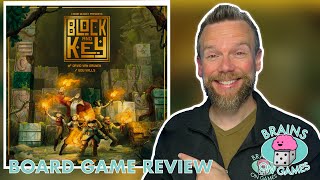
Despite the depth, reviewers say the rules are compact and quick to explain. Brains On Games called the game super easy to teach, and Rolling Dice & Taking Names noted that placement rules can be taught by example. The result is a game that works well as a first abstract for newer players, while still giving experienced players a planning challenge.
Potential Drawbacks
Cardboard Towers and Long-Term Durability
The most consistent physical concern is the cardboard towers that hold the play space together. Reviewers worry that the corners fold and must fit tightly, and that repeated setup and teardown may cause wear over time. Several commentators said they would prefer plastic for these parts, while acknowledging that cost control is a reasonable reason for the choice. Players who plan to take the game out often should keep this in mind.
Card Luck and a Multiplayer Solitaire Feel
Critics argue that the card-driven goals can make a session feel like parallel solitaire, where each player works toward their own patterns with limited interaction. A player who draws the wrong colors or difficulty can be stuck, and reviewers who prefer direct confrontation may find the game too self-contained. The Enigma end-game bonus also drew criticism for feeling overblown relative to the rest of the scoring.
If You Enjoy Block and Key
Players who like the spatial thinking in Block and Key may also enjoy Carpe Diem, which rewards careful planning around shared tile resources, or Sagrada, which pairs placement constraints with a satisfying sense of building a pattern over several rounds. Fans of colorful, tactile abstracts may find Cat Lady, Earth, Festival of Color, and Holy Festival of Colors worth exploring for their emphasis on arrangement and visual appeal. For a closer match to the blocky, height-aware feel reviewers mention, look for Tetris-inspired abstract titles, which share the same fascination with fitting irregular pieces into a growing structure.
What Reviewers Are Saying
"it is a real tactile experience the pieces have a great weight to them and they're they're fun to handle"
— Brains On Games
"the abstractness of this game is off the charts now"
— Meeple Mountain
"everything that you score is based on how you see it from your perspective"
— Tabletoptiktok