/pic3110249.jpg)
Bolt Action Deep Dive
What the Community Thinks About Bolt Action
Bolt Action stands as one of the most accessible gateways into historical wargaming. Tabletop Minions celebrate it as a game that defies the doom-and-gloom predictions about traditional historical wargaming's decline, while Black Country Wargaming showcase the painting and army-building hobby it inspires. The game has carved out a passionate community precisely because it lowers barriers to entry compared to larger historical projects, making it genuinely approachable for both newcomers and veterans who want tactical play without the overwhelming army requirements of bigger systems.
Core Mechanics That Define Bolt Action
The Order Dice Activation System
Bolt Action's signature mechanic is its order dice system, which reviewers recognize as the mechanical heart of the experience. At the start of each turn, both players place color-coded dice into a bag equal to their remaining unit count. As dice are drawn one at a time, the matching player activates one unit in response. Tabletop Minions explain that this simple but elegant design directly simulates the fog of war inherent to World War II combat, where commanders cannot perfectly choreograph their forces amid smoke and chaos. Yet because the total number of dice is known, the system remains strategically sound rather than purely random, since a lucky string of activations will inevitably give way to the opponent's turn.
Squad-Level Tactical Combat
The game revolves around building and commanding squads of infantry supported by vehicles and weapon teams. Reviewers describe armies built from dozens of individual models, including riflemen, submachine gunners, machine gunners, tank crews, and support gunners, each playing a defined role. The versatility appeals to painters and collectors who enjoy theming armies, from German units with intricate camouflage to American airborne with specific equipment. Combat itself uses dice pools to resolve fire, rewarding smart positioning and use of cover rather than simple attrition.
The Bolt Action Experience
Approachable Narrative Play
Reviewers emphasize that Bolt Action shines when played through scenarios with specific objectives, such as holding a town square, controlling bridges, or defending a village. This scenario-driven approach turns individual games into memorable tactical problems rather than abstract skirmishes. The game also supports campaign play where soldiers gain experience, acquire injuries, and develop personalities across multiple battles, creating investment in individual miniatures that pure competitive play does not.
A Playground for Army Building and Painting
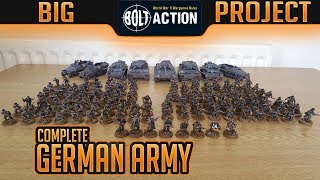
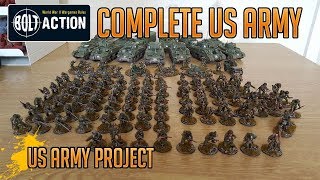
The reviewers devote extensive attention to building full armies with many painted miniatures over months of work. Black Country Wargaming showcase German forces and themed squads, discussing camo patterns, basing techniques, and historical accuracy. For many hobbyists, the craftsmanship and hobby investment rival the actual gaming, turning army completion into a major milestone and a source of pride before a single die is rolled.
What Makes Bolt Action Stand Out
Genuine Accessibility Within Historicals
Reviewers note that Bolt Action occupies a sweet spot in the historical wargaming ecosystem. Unlike traditional Napoleonics or Ancients, which can demand comprehensive collections and dense rulebooks, Bolt Action supports building a playable army with relatively few core infantry models. The game works at small scales but also scales up to larger games. This accessibility has attracted new players who might not have survived the commitment curve of older systems, contributing to observable growth in the historical wargaming space.
Flexible List-Building and Army Composition
Reviewers appreciate that Bolt Action allows substantial customization within squads. Units can swap weapons, take upgrade options, or shift from inexperienced levies to hardened veterans or elite troops. This flexibility means two armies can look and play very differently despite similar points totals, rewarding player knowledge and tactical thinking while avoiding rigid net-list dominance.
Potential Drawbacks
Miniature Kit Quality Variance
Reviewers note that some Warlord Games kits present assembly challenges or casting issues that frustrate hobbyists. Certain models, such as the Nebelwerfer rocket launcher, are described as among the hardest kits to build, with assembly difficulties that test patience. Some older resin vehicle kits suffer from inconsistent scale and fit, requiring significant cleanup. Newer releases have improved markedly, but this inconsistency occasionally surprises longtime hobbyists.
Army Commitment and Painting Workload
Building a tournament or showcase army demands substantial painting time. Reviewers describe multi-month projects to complete a single large force, emphasizing the upfront hobby investment before any games are played. For players uninterested in painting or assembly, this requirement creates real friction, and terrain setup can consume as much time as play itself when hobbyists prioritize visual authenticity.
If You Enjoy Bolt Action
Reviewers who praise Bolt Action often mention related titles. Flames of War offers a smaller-scale historical system with heavier vehicle emphasis, and Konflikt '47 is Bolt Action's alternate-history sister game that adds weird-war units to the World War II setting. Team Yankee shifts the era to Cold War armor, while SAGA brings skirmish-level historical combat to earlier periods. For non-historical players drawn to the accessibility and scenario focus, Warcry offers fast, skirmish-scale fantasy battles with a comparable low model count.
What Reviewers Are Saying
"Games like Flames of War, Team Yankee, Bolt Action and that kind of stuff, Saga and whatnot, even some historicals are growing. These smaller, more traditional historical wargaming games are doing really well right now."
— Tabletop Minions
"I really like the Volks rules. I've never used them before, but I'm gonna use all three of these squads and see how they do, see if they become veteran or just stay inexperienced. I actually really do like this winter Grenadier kit, especially because it's one of the newer ones."
— Black Country Wargaming
"In Bolt Action, you and your opponent each put a number of color-coded dice into the same dice bag at the beginning of each turn equal to the number of units you still have in the game. Then one of you reaches in and pulls out a die. If it's your color, you activate any one of your units. What this does is it simulates the fog of war."
— Tabletop Minions