/pic93883.jpg)
From the rulebook:
The year is 632 AD. The Byzantine Empire is all that remains of what once was the mighty Roman empire. She herself has only just survived a mighty war against Persia. Both empires now lay exhausted from their long years of struggle. Meanwhile, further south in the deserts of Arabia, the prophet Mohamed has given new meaning to an old religion and sets the peoples of that land on a course of action which will echo down the ages. Under the leadership of a succession of caliphs the Islamic Arabs are about to descend on the prostrate bodies of the Persian and Byzantine empires.
From the box:
The game 'Byzantium' deals with the rise of the Muslim Caliphate and its war with the Byzantine Empire. Your role as a player is to take a stake in each side and outwit your opponents to secure your own personal victory.


Mechanics (from transcript analysis)
Video topics + discussion points
Quotes (from this video)
- It looks visually amazing. I personally like the color palette of the game, and I think it does look really good.
- The game is a heavy game. It's a Some people will call it a medium game, right? It's a 45-minute teach.
- Agemonia, still fantastic, still really good.
- It's all three of our number one games of all time.
- Does it fit with the Marvel theme? Absolutely. It it really does.
- I
- Magnate: The First City designed by James Naylor and I'm going to be doing a giveaway for it.
- So, good luck for that and I'll announce the winner next month.
- all of my advertising revenue from all of my videos every month goes to charity.
- So yeah, Solar Titans is going to get three play throughs on the channel in December.
- It's going to be January and February. In fact, February's looking like a good month for me at the moment.
- Talisman Nemesis is the latest expansion for fifth edition that turns the game into a one versus many game.
- And me and Rick on a Tuesday night we're starting playing the Arnak cooperative campaign. So that is another series of play throughs, Lost Ruins of Arnak the cooperative campaign.
References (from this video)

- A little heavier than I would enjoy.
Mechanics (from transcript analysis)
- Euro Game — sort of a Euro game.
- war game — Sort of a war game
Video topics + discussion points
Quotes (from this video)
- I know it has its own little like um uh you know sub cult of people who enjoy it.
- I don't particularly like it because I think it has a very strong rich get richer.
- If you start winning an Outpost you were going to continue winning because if your engine gets going faster than mine there's not much I can do about it.
- But yeah this one does not This one is one I wanted to like a lot more than I did.
- it's a good back and forth two-player game.
- I like the theme of it a lot. Seems like most music games I play aren't very good.
- I I find this one amusing.
- It almost feels like you could play it randomly and have the same amount of fun, but it's a nice way to pass some time.
- It's a great little filler.
- I don't think a lot of people have played this one.
- It was replaced by Nobody is Perfect, too, because they didn't get it right the first time.
- This is what a lot of people were talking about.
- It was one of those games that I saw a little bit of buzz and I was like, "Ooh, I'll have to play that sometime." and then never heard anything else about it.
- I think that's just a really solid two-player game from Catalia.
References (from this video)
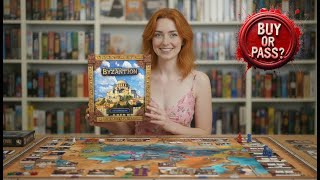
- Innovative dual-layer bidding and event manipulation create tense table dynamics
- Engine-building depth with cascading combos via abandon cards
- Strong thematic integration with Byzantine history and politics
- Emergent narratives from hidden quest cards and player interactions
- High production value (miniatures, neoprene mat, companion history books)
- Rulebook is work in progress and may require updates after pledge
- Long playtimes not aligning with campaign estimates (3 hours for a six-round variant)
- High production cost at low unit volumes (101 miniatures, ink wash) and potential delays
- Pricing structure with follow-based differences (FOMO) and post-campaign costs
- Limited to four players in demonstrated footage; solo/2-player not verified
- political intrigue, empire building, hidden objectives
- 6th century Byzantine Empire during Emperor Justinian's reign
- Array
- emergent political narratives driven by hidden quests and event outcomes
- Battlestar Galactica
- Dune Imperium
- Pax Premiera
- Cyclades
Mechanics (from transcript analysis)
- event resolution (prisoner's dilemma) — players contribute resources toward event fulfillment with penalties if under-contributed
- hidden objectives — private quest cards reward specific unit types or map placements
- Hidden Roles — private quest cards reward specific unit types or map placements
- initiative bidding — choose initiative position to determine turn order and bonuses
- market mechanics — buy/sell resources in a dynamic market, with the option to reset
- Market Pricing/Manipulation — buy/sell resources in a dynamic market, with the option to reset
- resource engine — collect, activate and chain abandon cards to generate resources
Video topics + discussion points
Quotes (from this video)
- The core mechanics are genuinely clever once you understand the overall flow and rhythm of a round.
- The dual layer bidding war happening on top of the actual strategic event manipulation creates immediate visible table tension.
- From the gameplay footage we watched, there was this absolutely brutal moment where one player deliberately and strategically declared their wild resources as the wrong type to fail the event on purpose, preventing everyone from scoring the success bonus while simultaneously forcing another player to eat a massive six-point penalty for contributing the least.
- The prisoners dilemma territory that creates the real social drama and memorable moments of the experience.
- The historical theme integration actually feels earned.
- There are real concerns with this campaign: unfinished rulebook, production risks, aggressive timeline, punitive pricing.
- The production value is genuinely solid with the inkwash minis and the neoprene map, which elevates the theme.
- The campaign pushes a lot of ambitious features; if the rules tighten and production catches up, the core loop could be transformative.
- If you followed before launch for the 109 tier, primarily play at four players, watched footage, and you're comfortable with crowdfunding risk, backing is reasonable but conditional.
- Wait for rulebook finalization and more complete solo/2-player demonstrations before fully committing.
References (from this video)
- High player interaction with bidding and counterplay
- Strong thematic flavor through leaders and intrigue cards
- Varied strategic options via multiple leader effects and market decisions
- Dynamic endgame scoring with several potential paths to victory
- Prototype components and balance noted during play
- Rule complexity and depth may be intimidating for new players
- Some players pointed to potential balance/timing issues in later rounds
- intrigue, corruption, diplomacy, and power struggles
- Byzantine/late Roman Empire political landscape in the Eastern Mediterranean
- historical fiction flavor with humorous banter
- Catan
- Monopoly
Mechanics (from transcript analysis)
- Action Interruption — Intrigue cards provide disruptive effects and can be countered or canceled by other players using dedicated mechanics.
- Action Points — Players spend action tokens to perform actions (market, cards, activate, etc.), with bonuses for initiative and board effects.
- action_tokens — Players spend action tokens to perform actions (market, cards, activate, etc.), with bonuses for initiative and board effects.
- draft_and_deploy_cards — Card drafting and simultaneous or sequential plays create opportunities for combos and strategic planning.
- endgame_scoring_and_quests — Final scoring combines empire resources, quest-like objectives, and control of zones/units, with tie-breakers influencing the outcome.
- event_bid_and_reward — At the end of a round, players bid resources to influence events; the highest bidder earns rewards while failures incur penalties.
- intrigue_cards_and_counterplay — Intrigue cards provide disruptive effects and can be countered or canceled by other players using dedicated mechanics.
- leader_cards_and_discounts — Leader cards grant permanent or temporary bonuses, notably discounts on purchases and special abilities when buying/selling.
- market_and_resource_management — A market where players buy and sell goods, manage scarce resources, and manipulate prices through round actions.
Video topics + discussion points
Quotes (from this video)
- It's a veritable mausoleium of choices there.
- It's like playing the katan monopoly card.
- The Pope is out.
- The market price on faith is a little high these days.