/pic2379288.jpg)
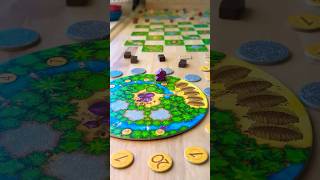
Cacao is a tile-placement game that immerses players in the exotic world of the "fruit of the Gods". As the chief of your tribe, you must lead your people to prosperity through the cultivation and trade of cacao — and to do that, you'll need to put them to work in the best way possible.
In the game, each player has an individual deck of square worker tiles, with the number of workers on each side of the tile varying from tile to tile. The playing area starts with only a couple of jungle tiles in play: a cacao field and a small market; two jungle tiles are laid face up, and the remaining jungle tiles stacked as a draw pile.
On a player's turn, he places one of her worker tiles on the board adjacent to one or more jungle tiles already in play, then (if two worker tiles are next to an empty space) adds one of the jungle tiles to the playing area in this space. Her workers then get busy and deliver the results of their effort: If you placed workers next to a cacao field, you receive one or two cacao markers per worker; if they're next to a market, you can choose to sell one cacao marker per worker at the listed price; if next to a well, you receive water; if next to a temple, they stand and look good until the end of the game; and so on. He then refills her hand from her personal deck to three worker tiles.
Once all players have used all of their worker tiles, the game ends. Players score (or lose) points based on their water supply, and each temple rewards whichever players sent the most workers to it. In the end, whoever has collected the most gold wins.
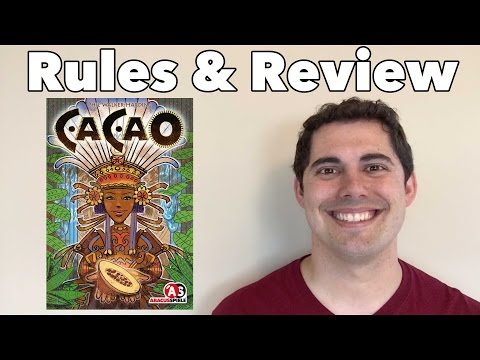
Cacao Review


Drafting the BEST Game Day for a New Gamer


- gorgeous beautiful cover work
- tiles themselves are pretty
- light gameplay
- tiles not as stunning as the cover
- tile-laying / resource management
- tile-laying / meeple-based action system
Mechanics (from transcript analysis)
- action system / worker placement — mechanics driven by placing and using actions on tiles
- Tile Placement — TI L style game with meeples and tile placement
- tile-laying / meeple placement — TI L style game with meeples and tile placement
Video topics + discussion points
Quotes (from this video)
- I am super duper excited about it
- it's almost one of the greatest gaming experiences I've ever had in my life
- it's kind of like a civilization themed card game
- this is a party game and I don't normally get party games but this one just looked too fascinating to pass up
- there's a timer on it we had a lot of fun playing with it
- got this stunning artwork on the cards
- it's a very quick little game where you are essentially trying to hide potions on a 4x4 board and then reveal them to make a set of three of a color before all of your opponents first person do that three times wins
References (from this video)
Mechanics (from transcript analysis)
Video topics + discussion points
Quotes (from this video)
- I feel like my biggest achieve the thing I feel most kind of happy about having done is I think it would probably be when I see pictures or hear about online people playing sushi go like all over the world and say that the game has like yes so many different types of people in so many different age groups so many different ashin a letís yeah are enjoying sushi go around more that I think is the thing that gives me the most fulfillment
- A lofty aim is to you know create a new classic you know a game that people are playing in 50 years
- I think the middle part where you're just churning through like that tests and trying to get it to work and it really just feels like work you know and you've just got a repeat and repeat and change and repeat that process is where you can get stuck
- I find that if I have multiple games stuck in that same period being able to jump between them helps keep my brain operating
- Often you designers start with something that's quite complex and I kind of my advice often why not try to make a card game just with one deck of cards first
References (from this video)

- Fun for kids
- Teaches educational concepts
Mechanics (from transcript analysis)
- dexterity — Involves fishing out a rubber ball from a contraption.
- Educational — Teaches spelling, math, and letters.
Video topics + discussion points
Quotes (from this video)
- I always like to start with theme I know some people say start with the objective I like to get you kind of invested in the setting and what we're going to be doing a little bit first
- rules turn all this lifeless junk effectively into possibly an incredibly fun experience that we're gonna have
- the success of an IP based game I think is a good thing for our hobby overall
- The more people I meet in life the more I realize that the way I see things it's you know it's so clear to me the way things are but to somebody else it's something else entirely different
- You know what I was gonna say I was gonna say mechs vs. minions but I completed that game and if I remember correctly I gave that away to someone in my game group so that means now I'm not gonna bring it out but my biggest game box is the reckoners
- The challenge with table talks is I like to pick topics that I feel feel personally invested in some way that I have like what I think is some kind of perspective to share
- So sorry we're late it was yeah well look we're here now right
- Let us know in the comments are you seeing and hearing me
- Write question in all caps and then put a colon and then after that you will write your question
- Ian and Kathy who maybe are watching tonight are having their 31st wedding anniversary
- It's a nice, relaxing little game, I think that's how I'd describe it.
- It's so satisfying to play.
- It has a constant underlying tension.
- The deduction is great.
References (from this video)

Mechanics (from transcript analysis)
Video topics + discussion points
Quotes (from this video)
- If my score is higher than their cumulative score, then the studio, the channel, and the Murfs themselves belong to me.
- How well do these brothers know each other? If they don't, their souls are mine.
- I chose I play I chose my least favorite game on the planet, which is London.
- The point is I want Squishy Fruits. But we all had the right idea.
- I would say that he thinks C is the best letter for board games. The letter C.
- It's between C and T. T.
- Your souls belong to me.
References (from this video)

- Simple and accessible
- Focused mechanics with replay value
- Clever tile-laying and action triggering
- Engaging shared map interaction
- Enjoyable chocolate expansion
- Harvesting and selling cacao
- Carason
Mechanics (from transcript analysis)
- action tile drafting — New action tiles are added and triggered in a checkerboard pattern.
- Action Triggering — Meeples bordering placed tiles activate the effects of those tiles.
- area influence — Players compete for dominance in certain areas of the map.
- Resource Management — Players harvest cacao and other resources to sell at the market.
- Tile Placement — Players place village tiles onto a shared map, triggering effects based on adjacent meeples.
Video topics + discussion points
Quotes (from this video)
- The top 10 games are going to come from my own board game collection, and they're games I already own.
- I think this is a video where I want to dedicate my top 10 list to games that just need a little bit more love.
- And if you love Stefan Feld games, they're all point salad games.
- It creates this really tense tug and pull and it makes players really feel like there's a sense of competition there.
- The fact that you can configure your koi pond to your artistic design, that's just something that I really really enjoy in a game.
- The other thing I really like about this game is that you can unlock these little herbs from your player board. And those herbs, you have to choose one of the bonuses and sacrifice the other.
References (from this video)
- Very neat tile placement game.
- Almost a classic.
- Works really well.
- Very decent game.
- Very good B game, likely at the top of the B tier.
- Unsure if it can be given an A.
- Ranked as a B.
Mechanics (from transcript analysis)
- Tile Placement — A very neat tile placement game.
Video topics + discussion points
Quotes (from this video)
- As soon as I finish playing Ark Nova, I'm thinking about Ark Nova again.
- This is the game that made me want to try and figure out how to play card drafting games, how to play action selection games.
- It's a classic engine builder, and it still holds up today.
- The scale of the game is huge and it feels like you're really accomplishing something.
- Each faction plays completely differently, offering huge replayability.
- It's a challenging game with a lot of moving parts.
References (from this video)
Mechanics (from transcript analysis)
Video topics + discussion points
Quotes (from this video)
- Hey everybody, I'm Tom Bassel.
- Thanks for watching the most boring unboxings on the planet Earth.
- I'm Tom Bassel. Thanks for watching another video on the Dice Tower.
References (from this video)

- So so so so good
- Great tile-laying
- Unique elements
- Pretty light but with depth
- Potentially Phil Walker Harding's best work
Mechanics (from transcript analysis)
- Set Collection — Collecting resources or completing objectives.
- tile laying — A great tile-laying game.
- Worker Placement — Implied by placing tiles and gaining benefits from areas.
Video topics + discussion points
Quotes (from this video)
- You can add and take away uh the amount of rules that you use on the cards and stuff to make it a little bit easier. So, I feel like you can kind of scale this as well.
- And it's just super fun. And uh I think the fact that it's just purely a puzzle game is also going to be easier to get into than like a lot of theme.
- Turnip is a uh a little card game that is all about like bluffing.
- It's also got weird like Renaissance art, but with carrots and bunnies. It's very cute.
- This one you just have a tile in the center of the table and you start building out the map as you go. That's really unique.
- And because you're working together, you get the satisfaction of like building out tiles so the landscape makes sense and adding some strategy, but the ability to talk about what you think is best uh in a cooperative way.
- So, if I'm thinking for a new W gamer, um, man, I think I'm gonna pick it. This might be a little too heavy, but I'm gonna go for it.
- We each have a couple of co-op options I think is always useful.
- Like you said, which of these lists do you prefer as a way to, you know, bring someone deeper into the hobby and show them some new stuff that maybe they've never seen before?
- Let us know who won in the comments below. And also, give yourself eight games. Look at your own collection. What are the eight games from your collection you would use for a similar type purpose?
- Make sure you subscribe while you're here. Just no matter what you do, just show games to people because we need more people in this hobby.
References (from this video)
- Fun family game
- Benefits from the chocolate expansion
- Leading your people to prosperity and glory through the cultivation and trade of cacao
- Exotic world of the fruit of the gods
- Carcassone
Mechanics (from transcript analysis)
- Area Majority — And there are even temples where you want to have the most number of workers around it.
- Overbuilding — If you acquire a sun token, you'll be able to overbuild on a pre-existing village space that you've placed out.
- Resource Generation — The number of workers on the edge of the tiles that touches the jungle tiles will trigger that particular action or resource generation multiple times.
- Set Collection — It might be getting two cacao. It might be getting gold or movement up the water track around your board.
- tile laying — This is a tile laying game with a twist.
- Trading — You can even trade your cacao at different markets for different prices.
- Worker Placement — Each player in the game is going to have a set of worker tiles that depict different numbers of meeples on the four edges.
Video topics + discussion points
Quotes (from this video)
- It's cacao and I love
References (from this video)
- Interactive tile placement with multiple interaction effects
- Classic euro-style decisions
- Concordia
- Dwellings of Everdale
Mechanics (from transcript analysis)
- Tile Placement — Common tile placement with interaction between tiles.
- Worker Placement — Workers on tiles enabling actions and interactions.
Video topics + discussion points
Quotes (from this video)
- it's very difficult to come up with a top 100 board games over a long period of time
- it's an icebreaker
- two players can play up to four players
- this is a trick taking game which came out late in 2024
- the tile placement is what is different
- wake up order as I'll call it
- pandemic style cooperative game
References (from this video)

- Gaining gold at the end of the game.
- Overbuilding tiles can be valuable.
- It is better to use sun worship tokens because you are more likely to get more than one gold out of overbuilding a tile.
- Excess cacao plants are lost if they exceed five.
- If a player comes to a market space with no fruits, the action is lost.
- workers gaining access to action spaces to buy and sell cacao fruits, go gold mining, gain access to water, and worship at temples.
- jungle
Mechanics (from transcript analysis)
- Action Drafting — Players choose from available jungle tiles to place.
- Action Point Allowance System — Players take actions for adjacent workers to jungle tiles. Players may take actions in any order, but must complete all actions in a pair before taking another.
- Area Majority — Players gain gold at the end of the game based on having the most or second most workers next to temples.
- End-game scoring — The game ends when all players have placed all worker tiles. Scoring includes temple majority bonuses, water track position, and leftover sun tokens.
- Hand Management — Players maintain a hand of three worker tiles and draw back up to three at the end of their turn.
- Resource Management — Players can buy and sell cacao fruits for gold. Cacao fruits have a limited storage space.
- Route Building — Players advance a water marker on a track, gaining or losing gold based on position. Further actions on the water space have no effect if the end of the track is reached.
- Set Collection — Players gain cacao plants which are placed on their player board, limited to five. Excess cacao plants are lost.
- Take That — Players can 'overbuild' their own existing worker tiles by placing a new worker tile on top, using a sun worship token. The underlying worker no longer counts for temple evaluation.
- tile drafting — Players draw worker tiles for their hand and choose from face-up jungle tiles in a display.
- tile laying — Players place jungle tiles into gaps between worker tiles, drawing from a face-up display or the top of the deck if more than two spaces are created.
- Tile Placement — Players place worker tiles representing their workers throughout the jungle. Worker tiles can only go next to jungle tiles and jungle tiles can only go next to worker tiles, creating a checkerboard pattern.
- Variable turn order — Turn order does not matter for taking actions as all players' actions are independent and can be taken simultaneously.
- Worker Placement — Players place worker tiles onto the board to gain access to action spaces. Actions are taken for any worker icons placed adjacent to a jungle tile.
Video topics + discussion points
Quotes (from this video)
- cacao is a tile placement game and in the game players will be placing these tiles representing their workers throughout the jungle to gain access to the various action spaces through the game players can buy and sell cacao fruits go gold mining gain access to water and worship at various temples
- the game ends when all players have placed all of their worker tiles and the player with the most gold at the end of the game is the winner
- players take actions for any worker icons who have just been placed adjacent to a jungle like on whether that's because the worker was placed or because the jungle was placed
- turn order does not matter when taking these actions because all players actions are independent of each other so players can take the action simultaneously
- note that for the purposes of evaluating temples only the maples on the top counts this one underneath who has been over built no longer counts towards this temple
- in the event of a tie most remaining cacao fruits breaks the tie and if still tied victory is shared and that's how to play cacao
References (from this video)

- Unique and clever tile placement.
- Intuitive yet strategic gameplay.
- Feels different from other Phil Walker Harding games.
- Limited storage can be a constraint.
Mechanics (from transcript analysis)
- Resource Management — Limited storage for cacao beans requires balancing gathering and spending actions.
- Tile Placement — Making a checkerboard pattern of tiles with worker tiles and scoring tiles.
- Worker Placement — Workers are placed on the edges of tiles and activate adjacent scoring tiles based on the number of workers.
Video topics + discussion points
Quotes (from this video)
- This is a top five designer series where we pick a designer that we favor.
- He's got a very large catalog and he plays very much in the gateway to Gateway plus space.
- He has a Gateway version of almost every mechanism on the market with some smarts built into it.
- For me Cacao is his finest game on the market.
- One of the greatest if it's not the greatest engine building of all and the time.
- Please do play if you like engine building and it if you like tactile games this is it.
References (from this video)

- Sun tokens add strategic depth for late-game decisions
- Easy to teach and understand for players new to the genre
- Gateway game that introduces Tiltang mechanics without overly complex illegal placements
- Balanced considerations across three main action types and temple scoring
- Tangible, visually appealing components and fast overall playtime
- Replayability is perceived as low by the reviewer
- Many turns feel like simple arithmetic rather than meaningful decisions
- Endgame sun-token overbuild decisions can be interesting but feel limited for the reviewer
- Occasional downtime in higher player counts due to math-heavy scoring
- Some players may not find the core decisions engaging or varied
- cacao beans, forest growth, temple influence
- board with forest tiles, temples, water track, and sun tokens
- area-majority and resource placement with endgame temple scoring
Mechanics (from transcript analysis)
- forest growth — Forest tiles grow when there is an empty spot adjacent to two different player tiles; players choose from face-up forest tiles to fill spots
- Increase Value of Unchosen Resources — Sun tokens allow overbuilding on existing placements to gain additional actions and endgame benefits
- market sale — One of the actions on a tile is to sell a cacao bean at the market for money (points)
- mines and water holes — Mines provide money equal to the number of adjacent workers; Water holes advance workers on the track and contribute points
- sun tokens / overbuild — Sun tokens allow overbuilding on existing placements to gain additional actions and endgame benefits
- temple scoring — Endgame scoring based on majority of workers adjacent to temples; temples award points to top positions
- Tile Placement — Players select a tile from their hand and place it on the board, must be adjacent to forest tiles
- worker activation — Each tile has four sides with workers; when adjacent to a forest tile, workers activate to grant cacao beans or trigger other actions
- Worker Placement — Each tile has four sides with workers; when adjacent to a forest tile, workers activate to grant cacao beans or trigger other actions
Video topics + discussion points
Quotes (from this video)
- Sun tokens that you gather throughout the game and then allow you to overbuild on top of your previous tiles
- This is a great Gateway game I think it teaches tailang very well
- how easy this game is to teach and to understand for people who are not necessarily as familiar with board gaming in general I think it's a great introduction into tailang as a mechanic
- that replayability of this game is pretty low for me
- most turns just feel like simple math problems
- I can't recommend it but that does not mean that it's bad
- it's easy to get out on the table and teach to people
References (from this video)

- fun tile-layer with thematic cohesion
- reminded of Apple Jack in mechanism feel
- some randomness from top-deck tile draw
- not exactly the farming game the reviewer expected
- tile-laying and hive/resource management
- tropical cacao production with markets and temples
- thematic integration with real-world farming
Mechanics (from transcript analysis)
- hive matching — match hive types and numbers to maximize honey production and income
- Speed Matching — match hive types and numbers to maximize honey production and income
- Tile Placement — place hex tiles to activate workers and access markets/temples
- Tile-laying — place hex tiles to activate workers and access markets/temples
Video topics + discussion points
Quotes (from this video)
- I really enjoyed it
- the plane of the game might be a little fiddly
- the board game arena implementation on the mobile is glitchy and downright unplayable
- Daybreak has QR codes that link to real-world solutions
- it's a great primer to teach people how to think about race for the Galaxy
- I think Teal will find some success on board game arena
References (from this video)

- Modular board setup creates varied, replayable layouts
- Diverse actions via jungle tiles and worker activations
- Strong thematic tie between cacao production, markets, and temple scoring
- Clear endgame scoring with token and temple mechanics
- Rules can be dense and require careful study
- Tile placement space can become tight on the table
- Jungle tile interactions demand good planning to optimize activations
- Cacao cultivation, trading, and temple-based endgame scoring.
- A tropical cacao plantation with a modular board formed by worker tiles and jungle tiles, including temples and market interactions.
- mechanics-driven, tile-placement and resource management embedded in thematic farming/trade
Mechanics (from transcript analysis)
- Market selling — Sell cacao fruits from markets for coins at varying prices.
- penalty/track bonuses — Water track penalties/bonuses influence end-game scoring and token gains.
- Resource Management — Manage cacao fruits, coins, sun tokens, sand tokens, and other markers.
- temple scoring — Endgame scoring based on workers attached to temples; tie-breaks based on cacao fruits.
- tile placement and modular board — Players place worker and jungle tiles to create a changing playing area each turn.
- Work replacement — Players place worker tiles to activate actions; tiles determine available actions and future placements.
Video topics + discussion points
Quotes (from this video)
- hi and welcome back to Peaky Boardgamer this is Ektorakos and today i will explain the game
- a game for 2-4 players placed in under hour and it's a game that features
- a simple but interesting work replacement mechanism let's see how the game is played
- the game ends immediately after all players have played all of their worker tiles at this point
- the player with the most coins wins the game
References (from this video)

- agriculture
- colonial
- Carcassonne
Mechanics (from transcript analysis)
Video topics + discussion points
Quotes (from this video)
- Your cards are ordered, you must never change the order of your cards
- If nobody guesses my card I get zero points and if everybody guesses my card I get zero points
- I've got to come up with a clue that's just obscure enough that some people around the table will get it
- Evolution is my absolute favorite game
- It's like a jigsaw but you build it all together - a game can be this
- Social deduction games can get quite loud and aggressive
- I really don't like games which require you as a player to be funny
- I find it so awkward and cringy, to be honest I won't play these games anymore
- There are billions and billions of possible combinations that we could make
- Hand management is a really satisfying part of many many card games