/pic5410171.jpg)
During the reign of King John V, Portugal was a major European power. From Brazil, the king ordered Sergeant Melo Palheta to travel to French Guiana to formally establish the Utrecht Treaty of 1713 and to secretly bring coffee seeds to Brazil. The Sergeant was successful and by 1800 Brazil was one of the largest coffee producers in the world.
In the early 20th century, coffee from Brazil, São Tomé and Príncipe, Angola and Timor is largely appreciated in Portugal and inspires the appearance of prestige coffee shops in emblematic locations that attract the elite. Through dedication, hard work and skill, the Portuguese 20th century witnesses the birth of one of the biggest coffee industries in the world.
In Café, 1 to 4 players represent coffee companies that from plantation, drying, roasting and distribution try to create and control the best supply chain of coffee.
—description from the publisher



- Portuguese coffee in 1800s
Mechanics (from transcript analysis)
Video topics + discussion points
Quotes (from this video)
References (from this video)
Mechanics (from transcript analysis)
Video topics + discussion points
Quotes (from this video)
- i've never actually written a rubric before
- a board game is just a pile of bits and uh cards without rules so that's a very important part of this
- i am super excited to actually own a copy of this
- i spent a decent amount of money to get this copy because i wanted to cover it for the channel
References (from this video)

- Lots of good things have been said about it.
- Good food.
- The game itself is small.
Mechanics (from transcript analysis)
Video topics + discussion points
Quotes (from this video)
- We are in Bali. Hello Joy. Good morning, our friend Joy.
- The show must our camera is sitting on a stack of plastic chairs.
- It's kind of the one that we bring to holiday, like old times.
- I don't reckon this version of Codenames gets the hype it deserves.
- Our record, we look at the mission map, I know it is embarrassing, but five wins and 23 losses.
- It doesn't matter how compatible two people are, they may not laterally think the same way. Indeed, and that is our problem.
- It is such a thinking game, it's part of why we played it here.
- We often talk about how bad we are with Codenames Duet. Now we're going to show how bad we are.
- It's like the way me and Terence thinks, it's different.
- I can't even see the bottom one there.
- I don't know what the next one is, to be honest. It's going to be tough.
- This is why this was always gonna be a tough game too.
- The best clues come from personal knowledge.
- Oh my gosh, I'm horrible at it.
- Bell. It's like how do I, how do I link wood and bell?
- This is a very, this is a very close effort though.
- Well, maybe it's comic because it's a comic-ish thing.
- Why don't ants get sick? Because they have little antibodies.
References (from this video)

- i don't know why it's ranked
- simple
- fast
- easy
- the whappy version i think looks absolutely beautiful
- wish it was ranked higher
- Gold Digger
Mechanics (from transcript analysis)
- Area Control — Players claim mines, balancing claiming too early (allowing others to fill it with 'rubbish silver') or too late (missing out on good stakes).
- Resource Management — Players try to either put silver into a mine or claim those mines, aiming for those with the most silver at the end.
Video topics + discussion points
Quotes (from this video)
- nay i don't really go in for expansions for a couple reasons we'll get into
- i don't play any of my games enough to need any expansions really
- board games are meant to be an experience that everybody enjoys and everybody comes away from feeling better
- just because it's rated low doesn't mean it's bad it just means it's misunderstood
- don't judge a book by its cover especially when it's a board game
References (from this video)
- Small box and travel-friendly
- Short playtime (~30 minutes) with sufficient heft for a light euro
- Easy to learn with minimal rules
- Persistent hard choices and meaningful strategy
- Thematic integration of coffee production and distribution
- Solid weight for a light, quick game
- Many steps to fulfill a single order can feel slow or tedious
- Unforgiving – bad choices can ruin your board state
- Interaction is limited (mostly drafting); often multiplayer solitaire
- Requires more space than expected for its box size
- Coffee production and distribution
- Coffee supply chain across multiple cafes
- Euro-style engine-building with drafting
- Tinning Sardines
Mechanics (from transcript analysis)
- Action economy tied to cups — The number of actions per turn is determined by the number of coffee cups in play; increases as you expand.
- Card Drafting — Draft cards from a market stack, paying a bean to claim some cards; expands options each round.
- End-game and scoring via orders — End-game triggers and scoring revolve around fulfilling shop orders with the right beans.
- expansion interaction — Espresso expansion adds four additional draft cards and slightly alters drafting strategy.
- Pick-Up and Deliver — Ship beans to shops to fulfill orders; combine beans in the warehouse for scoring.
- Placement and orientation — Place drafted cards to cover spaces on the board and orient them to shape future turns.
- Resource Management — Grow, dry, and roast colored beans; manage colors across fields and actions.
- Resource management and color tracking — Grow, dry, and roast colored beans; manage colors across fields and actions.
- Shipping and fulfillment — Ship beans to shops to fulfill orders; combine beans in the warehouse for scoring.
Video topics + discussion points
Quotes (from this video)
- what this game is is this is a game where you are supplying different cafes with the coffee that they need to run their businesses
- there are constant hard choices in the game
- it's really easy to learn the game
- it's pretty much multiplayer solitire
- thematically it works pretty well
- it takes up more space than you would think for the size of the box
References (from this video)

- Really interesting because of the card stacking and overlapping
- Creates a really interesting puzzle
- Really fun and awesome
- Dig the look and everything
- Love coffee as a theme
- Coffee production and delivery
- Minimalist but cool
Mechanics (from transcript analysis)
- action selection — Choosing a tool each round dictates the action taken, with potential for activating multiple spaces.
- Set Collection — Collecting specific icons (coffee beans, drying fields, roasters) to fulfill delivery contracts.
- Tableau Building — Players add cards to their tableau, overlapping them to activate spaces and gain benefits.
Video topics + discussion points
Quotes (from this video)
- I will try and solo it before we hang out on Tuesday to record this game is broken and we'll talk about it again.
- I had a mental breakdown because I was just like, I can't I can't get it. I can't figure it out.
- When did we decide to start making um paperbacks way bigger?
- Paperback books are just the size of hard covers now.
- I literally will only I will only actively seek out a place that sells it in the normal paperback size.
- I do. I'm very mean to my books.
- I dogge earring all day.
- I hate reading series that aren't done. It drives me crazy.
- The library in this is true for a lot of libraries around has so much more stuff than you think.
- So free. So free. So incredibly free.
- The Dresden Files has been the bane of my existence cuz it's just been for like a decade plus now.
- I listen to more lecture series than probably anything else on Audible.
References (from this video)

- Engaging engine-building with a thematic production chain; balanced progression and interesting card interactions.
- coffee production and global distribution
- 1700s Portugal and Brazil coffee trade
- engine-building with a production line feel
- Point Salad
Mechanics (from transcript analysis)
- engine-building — Players build an engine to produce coffee through chained actions from planting to distribution.
- grid/card-placement — A grid of cards with six actions is laid out; players place cards to activate actions.
- simultaneous_action_selection — Players perform actions in parallel, affecting timing and efficiency.
Video topics + discussion points
Quotes (from this video)
- It's time now to walk through the most famed geisha street, Hannah Makoji.
- And this really is an engine.
- Little Tavern's great. There's randomness to it. There's a lot of take that and a lot of silliness, but it really does just go over well.
- It's one of the alltime classic two player card games.
- There’s a great balance to be had just like a just like a good cup of coffee.
- Sea of Legends is one of those very app-driven games. It's fully app-driven.
- Riddle of the Sphinx expands Santorini into a cooperative campaign with riddles.
References (from this video)
- potatoes as currency, charm points, and mystery powers
- a town-building setting
- card-driven progression toward stronger cards and a charming town
Mechanics (from transcript analysis)
- bidding — Multiple players secretly bid potatoes using bidding boxes; highest bid wins a card; ties broken by earlier bid; bids resolved during harvest.
- card_attributes_and_fulfillment — Each card shows top-left elements (conditions to collect), top-right rewards, bottom-right conditions, bottom-left potato cost; flipping opens rewards.
- card_placement — Place a character on a face-up card, flip a face-down card and place on it, or place on top of the draw pile; pay required potatoes.
- drawn_card_collection — When collecting a card, you don't flip it if it was face-down; you may look at the back.
- end_condition_and_scoring — Game ends when a player collects two star cards; final scoring based on charm points and leftover potatoes.
- mystery_cards — Winning mystery cards grants secret powers; can be discarded for potatoes; powers usable once at any time.
- resource_management — Potatoes serve as currency and are spent to meet card costs; some cards provide rewards via harvesting.
- round_end_and_refill — Refill card spaces and rotate starting token after each round.
- round_structure — Two-phase rounds: placement and harvest; after all placed, harvest resolves bids and collects cards.
Video topics + discussion points
Quotes (from this video)
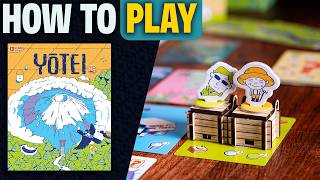
- Yoté is played over several rounds where you'll use your potatoes to occupy and collect a variety of cards to build the most charming town.
- The cards you acquire throughout the game provide permanent elements, mystery powers, and charm points.
- And that's Yoté.
References (from this video)

- Clever game design
- Nice to play as a solo game
- Scoring focuses on the two fewest resources, encouraging generalization and balance
- Can be difficult to diversify and shift the game over time.
- The player giving leftovers to the next player can be used to deny cards.
- Creating a coffee supply chain
Mechanics (from transcript analysis)
- Card Drafting — Players choose one of three cards each turn.
- Set Collection — Creating orthogonally adjacent sets of coffee beans, drying spaces, and roasting spaces.
- tile laying — Cards are laid on top of previous cards, covering at least two squares.
Video topics + discussion points
Quotes (from this video)
- 2024 is the season to eat too much food and play a lot of games
- happy New Year Happ New Year oh by the time you watch this it's probably too late I mean it's still the new year so still like you happy New Year thank you Taran
- we are going to split those into two so 11 to 20 and then 1 to 10 so that is coming
- however everyone does it we are going to do it maybe sometime mid January potentially
- these are games from various sources they're new to us games so not all of them are going to be new in December 2024 some of them have come to us as review copies games we've purchased games we've done content on but all of this video is our opinion
References (from this video)

- Simple to learn, yet cleverly designed tile placement
- Travel-friendly and portable
- Solid engine for economic actions
- Not a flashy or thrilling experience
- Publisher/designer details are uncertain in transcript
- Array
- Global coffee trade
- Tile-based, methodical engine-building
Mechanics (from transcript analysis)
- Action economy — Actions are spent to perform each stage of the coffee production process; actions can be chained when tiles are adjacent.
- tile laying — Players place tiles to grow, dry, roast, and send coffee while unlocking actions.
- Tile Placement — Players place tiles to grow, dry, roast, and send coffee while unlocking actions.
Video topics + discussion points
Quotes (from this video)
- it's one of the few of this style games that are this heavy that I'm willing to play the art cute helps and the very unique characters obviously helps as well
- we did a co-op game and I got to play my favorite lizards
- it's very simple to play but it's really clever
- travels easily
- not the type of game I like to play with anybody because people get pretty aggressive
References (from this video)
- Fast and thinky, 15–20 minutes per play
- Compact footprint suitable for quick sessions
- Sharp puzzle that rewards careful tableau optimization
- Suitable for solo play with a personal high-score challenge
- Expansion options to alter balance and replayability
- Can be challenging for newcomers due to placement optimization
- Requires attention to the exact coverage rules which can slow first plays
- Some players may prefer deeper thematic integration over the puzzle mechanics
- coffee production, resource management, optimization, and service throughput
- A competitive cafe management environment where players run a cafe and fulfill coffee orders across eight rounds.
- abstract puzzle with light thematic dressing; procedural flavor conveyed through coffee terms and cafe imagery
Mechanics (from transcript analysis)
- action selection from a three-card display — Each turn starts with three new cards; players choose one to add to their tableau, shaping their available actions for the round.
- end-game scoring tied to deliveries and warehouse — Score is earned for fulfilled cafe orders and for the two lowest bean types you have in your warehouse.
- placement optimization and coverage rules — When adding a card, players must cover certain slots on their board; over-coverage or under-coverage can break action flow and affect scoring opportunities.
- Set Collection — Beans of four types are managed, stored in a warehouse, with scoring tied to the two most scarce bean types and deliveries to cafes.
- set collection / resource management — Beans of four types are managed, stored in a warehouse, with scoring tied to the two most scarce bean types and deliveries to cafes.
- Simultaneous Actions — The game emphasizes concurrent decision-making and returns to a common round tracker; play is succinct, with eight rounds allowing quick plays.
- simultaneous/parallel play with fixed rounds — The game emphasizes concurrent decision-making and returns to a common round tracker; play is succinct, with eight rounds allowing quick plays.
- Tableau Building — Players select and place cards to build their personal action tableau, choosing where to place cards to maximize simultaneous actions and to connect related bean types.
- worker-like actions with production chain — Actions include gather beans, dry, roast, and deliver, forming a small engine for producing and delivering goods.
Video topics + discussion points
Quotes (from this video)
- it's thinky it's quick it's one you can pull out while you're having a cup of coffee
- I definitely recommend the game Cafe
References (from this video)

- beautiful production theme
- fast, thinky puzzle with satisfying overlaps
- publisher/designer details not specified in the transcript
- production optimization and chain management
- coffee production and distribution
- puzzle-like with overlaps and combos
Mechanics (from transcript analysis)
- card overlap / tile-building — arrange overlapping cards to build and optimize production areas
- production chaining — set up sequences to maximize output and scoring
Video topics + discussion points
Quotes (from this video)
- Calico I love Calico it's the game I've played the most ever in my life
- this top 10 focuses mainly on games that are either solo only or games that I've played that I think are better solo than they are multiplayer
- I could talk on and on about board games
References (from this video)

- easy to teach with abstract, puzzle-like depth
- compact playtime (20–45 minutes) with quick rounds
- solid digital implementation via Board Game Arena; Yukata availability noted
- lacks deep strategic depth for some players
- two-deck requirement for multiplayer in a live setting
- coffee/beans drafting and processing
- abstracted coffee production and trade
- card-lane puzzle with iconographic cues
- Trailblazers
- Pipelines
Mechanics (from transcript analysis)
- action-icon visibility and timing — Selected icons (coffee cups, beans) grant turns or scoring opportunities.
- Card Drafting — Players draft a row of cards to influence available actions and scoring opportunities.
- card drafting in a solo/2-4 player format — Players draft a row of cards to influence available actions and scoring opportunities.
- Compound Scoring — Roasting/processing beans and shipping to warehouses or cafes yields points.
- constrained asset flow and scoring — Roasting/processing beans and shipping to warehouses or cafes yields points.
Video topics + discussion points
Quotes (from this video)
- the biggest downside for me for Finsspan was the ratio between the complexity of this game versus the time length
- I would rather play Wingspan in a relatively quickly pace with gamers who knew Wingspan as well rather than play this game for 45 to 60 minutes
- This game is somewhat simple to teach but it does offer a little bit of complexity
- Visually, I think this game plays a lot like Bonsai
- Hey, that's My Fish—catchy title for my daughter as well
References (from this video)

- cafe/ingredients overlap
Mechanics (from transcript analysis)
Video topics + discussion points
Quotes (from this video)
- this video is about the games that we have gotten since Spiel
- it's about dogs in a home
- Simo is a great game one that I highly recommend
- this is a story storytelling puzzle game about Mary Shelly the creator of Frankenstein
- it's a pure negotiation game
- I love the Euros I love all of that but I really enjoy sitting that playing a fun story-driven game
References (from this video)

- lovely coffee theme for fans
- interesting tableau-driven engine
- solitaire variant may feel different with expansion content
- coffee beans, roasting, brewing, selling to shops
- coffee shop / coffee production theme
- tableau-like card drafting with overlapping cards
Mechanics (from transcript analysis)
- Card Drafting — draft three cards and build a tableau
- overlapping/stacking — overlap cards to activate multiple process icons
- resource flow — manage beans and process icons to produce finished product
- Resource Management — manage beans and process icons to produce finished product
Video topics + discussion points
Quotes (from this video)
- huge shout out to all my patrons
- the patreon link down below
- this video is sponsored by wsbg
- it's so comforting to me
References (from this video)
- coffee theming
- expansion included
- may be light for some players
- coffee economics
- coffee shop management and cafe culture
- light strategy with tableau-like mechanics
- Latte Throwdown
- Veggies
Mechanics (from transcript analysis)
- Card tableau — cards laid out to form a tableau of actions
- expresso expansion included — base game plus expansion content
- Tableau Building — cards laid out to form a tableau of actions
Video topics + discussion points
Quotes (from this video)
- you cannot experience everything in one day
- I'm a lot more introverted than I thought I was
- I wanted to stick to having like a hundred dollar budget
References (from this video)

- fun and flavorful theme
- interesting card interactions and production chain
- described as somewhat complex to explain
- coffee production from beans to shop
- coffee-centric cafe and production flow
- complex but explained with examples
Mechanics (from transcript analysis)
- Card Drafting — select and place cards to enable actions and production
- tableau action sequencing — card positioning reveals different production steps
Video topics + discussion points
Quotes (from this video)
- this game is so much fun solo
- I immensely enjoyed myself
- I really really enjoy this because there's two different phases
- I absolutely love the theme I love the art and just the vibe of this game
- Welcome To Your Perfect Home was so much fun to play on a live stream
- Dungeons Dice and Danger is a fantastic roll and write
- I think I enjoy Tiny Towns solo more than I enjoy it multiplayer
- Coffee Roaster is the only solo game that I have so it is very special to me
References (from this video)

- Low-stakes, cozy, high-score focus rather than win/lose
- Satisfying step-by-step coffee production flow
- Calm drafting mechanic that avoids pressure
- May be too light for some
- Solo mode could feel repetitive to certain players
- coffee crafting and shop management
- Coffee production and distribution with a cozy business vibe
- procedural, step-by-step with emphasis on low stakes
Mechanics (from transcript analysis)
- Card Drafting — Draft from a small hand of cards to perform actions
- Resource Management — Form plantations, dry and roast beans, and distribute to stores
- Resource/Process Progression — Form plantations, dry and roast beans, and distribute to stores
Video topics + discussion points
Quotes (from this video)
- easily the coziest solo game I've played
- the coolest part of the game is that you actually get to physically draw out the map
- this is about as stressfree as a board game can possibly get
- the solo is still really fun and a great cozy time when I just feel like experiencing an adventure story
- the theme obviously helps evoke this sort of sleepy fishing Village Vibe
References (from this video)

- pleasant coffee theme and components
- not something they'd revisit regularly
- coffee trading and shops
- coffee harvesting and commerce
- tableau/collection-driven
Mechanics (from transcript analysis)
- tile tableau stacking / resource management — A light, thematic tableau-driven game about producing and selling coffee.
Video topics + discussion points
Quotes (from this video)
- it's a full-time successful job for me
- the newest macbook pro line is significantly faster
- i'm in a much better headspace about the numbers
- i'm not sitting there thinking that a three video per week plan is sustainable
- there's a lot of evidence to show that putting out more videos is not necessarily better for me
References (from this video)

- Strong thematic flavor
- Strong line in this publisher's coffee-themed games
- Box size / production quality could vary
- Economic/engine-building
- Cafe/coffee shop theme
- Thematic, cozy
Mechanics (from transcript analysis)
- Resource Management — Players manage coffee/roast resources to earn points.
Video topics + discussion points
Quotes (from this video)
- Shark Park, a memory kind of game.
- they're essentially just more complex versions of the last.
- it feels like it's a bigger game that was streamlined and streamline is often very good, but this one I felt almost a little streamlined too much.
- This one's almost there. And I know a lot of people love the Talisera.
References (from this video)
- thematic flavor with coffee culture
- tight, thinky decisions
- less accessible without explicit component quality or art in some versions
- beans, roasting, and service
- Cafe and coffee shop culture
- mechanics-driven, flavorful theme
- Sees the Bean
Mechanics (from transcript analysis)
- Layering cards — stacking cards to trigger actions and maximize efficiency
Video topics + discussion points
Quotes (from this video)
- Switches get stitches.
- Pumpkin spice latte time.
- Century Pumpkin Spice Road was the obvious choice.
- This is the worst cash grab I've ever seen.
- Shoots and Ladders mixed with Candyland.
- What about a Muppets version of Robo Rally?
References (from this video)
- Rock-solid, thematic integration
- Good weight balance with engaging tension in decisions
- Might be a touch heavier for true light-game fans
- coffee supply chain
- A coffee production and distribution cycle (grow, roast, dry, ship to cafes)
- thematic and industry-tinged
- Sushi Roll
Mechanics (from transcript analysis)
- engine-building / card drafting — build an action engine around coffee production steps by selecting cards
- grouping actions by coffee cups — the number of actions you can take scales with the number of coffee cups you have
Video topics + discussion points
Quotes (from this video)
- Two very rare crossovers.
- This is the only one I thought we would cross over on.
- We'll see you guys and gals on the flip side.
References (from this video)

- Beautiful box art and graphic design
- Strong presentation noted in the transcript
- Economic strategy in a roasting business
- Coffee roasting industry
Mechanics (from transcript analysis)
- card overlap / action typing — Overlapping cards with six action types; on your turn you draw a card and transpose to reveal actions
Video topics + discussion points
Quotes (from this video)
- "it's kind of a weird year for board game releases"
- "this is top five most anticipated essens digital releases"
- "we are going to discuss our top five"
- "there's 500 coming out this year"