/pic4350783.jpg)












Campy Creatures Deep Dive
What the Community Thinks About Campy Creatures
Campy Creatures stands out in the gaming community as a beautiful marriage of theme and gameplay. Reviewers consistently praise the game for its evocative monster artwork and strong thematic cohesion. The game resonates particularly with players who appreciate retro horror movies, with its creature designs drawing inspiration from classic Universal Monsters. What elevates Campy Creatures beyond theme, however, is the mechanical elegance that underwrites every play. Reviewers emphasize that the game mechanics integrate seamlessly with the theme of mad scientists competing to capture valuable mortals, creating a satisfying experience that feels both thematically appropriate and strategically engaging.
Core Mechanics That Define Campy Creatures
Simultaneous Card Selection and Bluffing
At its heart, Campy Creatures is a game of deduction and educated guessing. Each player starts with an identical hand of creature cards numbered 0 through 8, and on every turn, players simultaneously select one card to play face down. When cards are revealed, the creature with the highest strength value typically claims the first mortal, with subsequent players choosing in descending order. However, the brilliance lies in the special abilities tied to many creatures. The Blob (0) allows a player to see all revealed creatures and swap in a different creature from their hand, using only its strength. The Vampire cancels the creature ability to its left while retaining its numerical strength. The Mummy captures before other creatures if a Kaiju is played. These abilities create cascading strategic decisions, forcing players to anticipate not just what creatures others might play, but which abilities will trigger and how they interact. The game's deduction layer deepens significantly as players gain information about which cards have been played, allowing them to make more informed choices in later rounds.
Set Collection and Variable Scoring
Mortals themselves are divided into multiple categories, each with distinct scoring mechanics that reward different strategic focuses. Base mortals offer straightforward victory points ranging from negative three to positive six. Teenagers, while individually worthless, score seven points to whoever collects the most in a round, with second place receiving four points, encouraging players to pursue majority control. Engineers introduce risk and reward by scoring three points per card if collected in even numbers, but negative two points per card if collected in odd numbers, allowing canny players to force opponents into unfavorable positions. Assistants persist across rounds and form a set collection scoring cascade, rewarding players who accumulate them over the course of the game. In the newer edition, location cards add another layer, granting special bonuses to whoever holds the most location icons captured that round. This multiplicity of scoring paths means that a player trailing on points can pivot strategy mid-game, pursuing teenagers or location icons instead of high-value individual mortals, keeping every round competitive.
The Campy Creatures Experience
Gorgeous Retro Horror Aesthetic
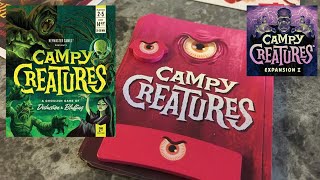
One element that cannot be overlooked is the production design. Reviewers universally highlight the artwork as exceptional, describing it as evocative, gorgeous, and worthy of being framed. The cards feature monster designs rendered in a retro movie poster style, with vibrant, saturated colors that immediately conjure the aesthetic of 1950s Universal horror films. The artwork reinforces the theme at every turn, making mortals and creatures feel like characters in a pulpy narrative rather than abstract game pieces. One reviewer noted that they would proudly hang poster-sized versions of each card on their wall, and another commented that the game's design makes it approachable enough to play with casual groups, but the aesthetic gives it sufficient personality to excite enthusiasts. The overall presentation elevates Campy Creatures from a mechanical curiosity to an experience that delights players simply by existing on the table.
Fast-Paced, High-Replayability Gameplay
Despite the tactical depth available to serious players, Campy Creatures plays remarkably quickly. A full three-round game typically completes in 30 minutes or less, making it ideal as an opener, closer, or palette-cleanser during game nights. The speed doesn't come at the cost of engagement, however. Reviewers note that the game remains engaging because of its push-your-luck elements and the constant flow of new information. As players reveal cards and mortals are captured, the table develops a shared understanding of which creatures remain in players' hands, sharpening decision-making in later turns. The game's replayability stems not from random variability in setup, but from the dynamic interactions between players. Since all players start with identical hands, the game becomes a mind game where knowledge of likely plays combines with psychology and bluffing. Reviewers frequently mention bringing the game to every game night, using it to fill time between heavier games or to close out an evening, cementing its status as a personal favorite rather than a occasional curiosity.
What Makes Campy Creatures Stand Out
Elegant Integration of Theme and Mechanics
Campy Creatures succeeds where many games fail by ensuring that its mechanical systems reinforce its narrative. A reviewer noted that the creature abilities are not simply good or bad, but function as a cohesive ecosystem. The Kaiju dominates by raw power but can be trumped by the Mummy through clever timing, adding narrative tension (why does the Mummy have such power?) alongside strategic depth. The Swamp Creature forces you to give away captured mortals, thematically fitting a creature that exchanges its victims. The Beast scores points by sitting unused in hand, rewarding patience and creating a tension between using a strong card and saving it for a future turn. Even the lower-numbered cards serve meaningful roles. The Blob, despite starting as a 0, becomes one of the best cards through information gathering and adaptation, creating a satisfying dynamic where the apparently weakest card often proves most valuable. This mechanical elegance ensures that Campy Creatures never feels like a theme bolted onto a system, but rather a unified experience.
Strategic Depth Beneath Accessible Rules
Campy Creatures occupies a sweet spot in the design space. Learning the rules takes minutes, and a first game is enjoyable for casual players seeking quick entertainment. However, reviewers note that true strategic mastery emerges only after multiple plays. The game presents obvious strategies at first. The Mummy beats the Kaiju. The Invisible Man dumps bad mortals. The Invader captures two mortals if available. But once players internalize these baseline strategies, the game's psychological layers activate. Players begin asking themselves: does my opponent know I've already played my high card? Will they play their highest card expecting competition, or will they conserve it? If I play a mid-range card early, will that signal to others that I'm saving my strongest creatures for later rounds? Reviewers emphasize that foresight matters significantly. Knowing which creatures remain in your hand allows you to plan captures several turns in advance. A player who recognizes that their opponent likely holds the Blob can adjust their creature selection to minimize the advantage gained from information gathering. This escalating complexity ensures that Campy Creatures stays fresh across dozens of plays, appealing both to newcomers and veterans.
Potential Drawbacks
Variance and Luck Factors
While reviewers overwhelmingly praise Campy Creatures, some note that luck can overshadow strategy in certain scenarios. The mortal deck is shuffled before play, meaning the distribution of high-value and negative mortals across the three rounds varies significantly. A player who draws a round heavy with negative-value mortals has limited opportunities to score, regardless of their play quality. Additionally, the Clash Meter, which resolves ties, can swing momentum unexpectedly. One reviewer noted that if a player fails to secure the top position on the Clash Meter early, ties may consistently work against them, creating a compounding disadvantage. In the newer edition, the introduction of location cards adds another variable. A player pursuing locations may find that opponents consistently deny them the icons they need, while a random shuffle leaves better-positioned players unable to capitalize. These luck elements matter less in longer series of plays but can frustrate players seeking pure skill-based competition.
Setup Complexity and Deck Construction Variability
A secondary concern raised by reviewers involves the setup process, particularly with the expansion. The mortal deck construction requires careful attention to player count and the specific combination of sets being used. With multiple sets of mortals (base, teenagers, engineers, angry mob, and others) and different quantities required depending on player count, mistakes are easy and common. One reviewer expressed frustration with the setup overhead, noting that it is extremely easy to create an incorrect deck, though they acknowledged this primarily affects the expansion. The base game setup is straightforward and streamlined, especially in the new edition, which simplified the structure compared to the original version. However, for players seeking maximum variability by combining multiple sets, the setup demands attention that detracts slightly from the elegance of the core experience.
If You Enjoy Campy Creatures
Players drawn to Campy Creatures typically appreciate games where theme and mechanics dance together seamlessly. Games like Eggs and Empires offer similar simultaneous selection mechanics with shared hands, though Campy Creatures' creature abilities add tactical layers absent in competitors. Fans of the retro horror aesthetic will gravitate toward other games with strong thematic artwork, such as Mansions of Madness or Horrified, though those games lean more heavily into cooperative gameplay and puzzle-solving. Players who love the deduction and bluffing elements might explore trick-taking games like Skull King, which shares the strategic foresight and card management components. For those seeking quick-playing fillers with surprising depth, titles like No Thanks and Love Letter provide similar snappy decision points and high replayability, though without Campy Creatures' thematic cohesion. The game's position at the intersection of light accessibility and hidden depth makes it a natural stepping stone for players exploring their preferences within the hobby.
What Reviewers Are Saying
"I absolutely love the artwork in this game by the way it is absolutely gorgeous gorgeous artwork and I love this genre of games where everyone has the same cards and the whole game play is like when do you play which card."
— Going Analog
"The mechanics are just so solid and seamlessly integrate with each other, there's a lot of cool strategic synergies that happen with these cards and some foresight that you can do in this game to really play a neat game."
— The Secret Cabal Gaming Podcast
"This is a game that you can bring along to every game night because it plays quickly and you're always gonna have like an extra ten minutes to play, and I highly recommend campy creatures because I found out it was a really great game besides just loving weird monsters."
— The Secret Cabal Gaming Podcast