




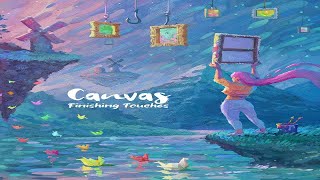









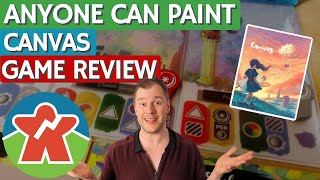
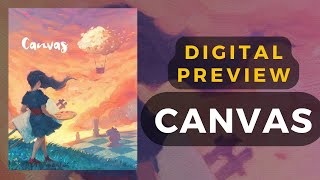
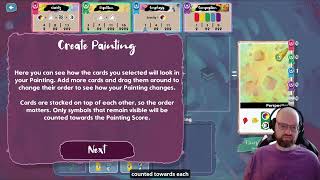




In Canvas, you play as a painter competing in an art competition. Players will collect art cards, layering 3 of them together to create their own unique Painting. Each card contains a piece of artwork as well as a set of icons used during scoring. Icons will be revealed or hidden based on the way players choose to layer the cards making for an exciting puzzle. Paintings are scored based on a set of Scoring cards which will change each game. Once players have created and scored 3 paintings the game ends.
On your turn you may take an Art card or make a painting. Art cards are selected from a row of cards in the center of play. Each of these cards has a cost associated with their position. After selecting an Art card you must pay its cost by placing an Inspiration token on each of the cards to its left. If you do not have enough Inspiration tokens, you may not select that card. Any tokens on the card you have selected are kept for future turns. The far left card costs no Inspiration tokens to take.
If you have three or more Art cards you may choose to make a painting. Select 3 of your art cards, arrange them in any order and then score them by comparing the visible icons on your painting to the Scoring conditions.
Once all players have made 3 paintings the game ends.
The player with the most points wins!
—description from the publisher
- unique mechanic using acrylic cards
- beautiful art and standies
- short, approachable playtime
- abstract feel may not appeal to everyone
- layering painted cards to meet palette goals
- artistic world of painting and illustration
- visual storytelling through artwork and card layering
Mechanics (from transcript analysis)
- card drafting — draft illustrated acrylic cards and layer up to three to build a final artwork
- card drafting and layering — draft illustrated acrylic cards and layer up to three to build a final artwork
- set collection — create palettes at the bottom to meet varied goals
- set collection and palette matching — create palettes at the bottom to meet varied goals
Video topics + discussion points
Quotes (from this video)
- epitomizes what whimsical means, and that is Wondrous Creatures.
- the art and the colors just really make Wondrous Creatures feel whimsical.
- I think this is just one of those that has a little bit for everybody.
- this is Canvas. And in canvas, you are drafting these really cool illustrated acrylic cards that you're going to layer on each other.
- the acrylic standies are gorgeous.
References (from this video)
- Beautiful art and board presentation
- Accessible and enjoyable online play
- Some players may want stronger thematic flavor
- Array
Mechanics (from transcript analysis)
- set collection — Collect art cards to build paintings for scoring.
- set-collection — Collect art cards to build paintings for scoring.
Video topics + discussion points
Quotes (from this video)
- it's a big topic and it probably requires a couple of episodes
- I love the action queue in Ark Nova
- the upkeep of the score for you
- it's chill but surprisingly strategic
- it's the perfect gateway game for many people
- the admin is done and it makes it smoother
- you can play from the same IP address
- the tactile nature of moving the cubes up and down
References (from this video)
- beautiful components and tactile feel
- calm, relaxed pace that suits date nights
- efficient to teach with meaningful decisions
- some scoring conditions require planning ahead
- layering decisions can be subtle and require careful attention
- art creation and display
- Art-themed card-drafting draped in a gallery/creative vibe
- nonlinear scoring through layered paintings
Mechanics (from transcript analysis)
- card drafting — Players draft semi-transparent cards and layer them to create paintings, scoring based on pattern matching and layering.
- set collection / pattern matching — Participants aim for specific symbol and color patterns to maximize points.
Video topics + discussion points
Quotes (from this video)
- it's a date night classic for us
- Escape rooms in a box
- it's such a beautiful like calm game
- it's a terrific tile placement game
- this is the heaviest of all of the games on this list
- it's a two-player only game
- it's meanest game on this list
- it's a modern classic
- Bandido is slippery
References (from this video)
- Excellent two-player worker-placement puzzle
- Tight resource management with the wheel
- Cascading combos when buildings activate
- Varied building packs add replayability
- Engaging without slow turns
- Beige theming and art; very euro-style
- Iconography requires looking up rules in the appendix
- Building packs could use more explicit explanations
- Heavy math orientation may be dry for some players
- Array
- Industrial city canal construction
- Euro-style puzzle
- Patchwork
- Fields of Arle
Mechanics (from transcript analysis)
- End-of-Deck Scoring — Endgame scoring for buildings, coins, resources, roads, rails, canals; penalties for empty spaces.
- Pattern/Adjacency Activation — Buildings activate when surrounded by roots and connected by bridges.
- Resource management — Wheel-based resource yield with coins to modify the wheel.
- tile placement — Place roads, waterways and bridges to activate buildings.
- worker placement — Two-player-specific worker placement with a fixed set of action spaces.
Video topics + discussion points
Quotes (from this video)
- The resources are very, very tight. And so you're trying to do a lot of things and all of that is within a worker placement system that's specifically for two players.
- the wheel is such an interesting system.
- this is just, hey, here's some math. It's fun math, but that really is what you're doing.
- it's beige in color. It is beige in soul.
- I think this is a really interesting alternative.
References (from this video)
- Accessible and quick to learn
- Strong thematic appeal with a vivid art aesthetic
- Playtime is short, making it suitable for families and casual groups
- Expansions add new goals and layers of depth (Reflections, Finishing Touches)
- Replay value may depend on goal variety and card draw luck
- Artistic expression through card drafting and painting, with scoring determined by goal completion.
- Art studio/gallery-inspired setting where players draft art cards to craft paintings and satisfy center-goal ribbons.
- Array
Mechanics (from transcript analysis)
- card drafting — Draft art cards to build paintings and pursue goals.
- Compound Scoring — Ribbons earned for achieving center-goal objectives, contributing to final points.
- end game bonuses — After all players have made three paintings, tally points to determine the winner.
- End-game scoring — After all players have made three paintings, tally points to determine the winner.
- Goal-based scoring — Ribbons earned for achieving center-goal objectives, contributing to final points.
- Set/collection of art for paintings — Assemble cards into three-card paintings; manage a five-card hand limit.
Video topics + discussion points
Quotes (from this video)
- "canvas is a card crafting and card drafting game"
- "on your turn you'll simply draft a card or create a painting"
- "your max hand size is five but paintings are only made of three cards"
- "goals set out in the center of the table"
- "you'll grab ribbons for each goal that you've accomplished"
- "and those will score you points at the end of the game"
- "after all players have made three paintings you'll count up your points and the player with the most points wins"
- "oh and a friendly cat reminder that there are also two expansions with this game Reflections and finishing touches"
References (from this video)
- Vibrant components and accessible rules
- Tangible, tactile gameplay with aesthetic appeal
- Rules interplay can be a bit abstract at first
- Some players may prefer more interactive confrontation
- art and creativity as a core mechanic
- art-themed world where players paint cards to create stories
- visual storytelling through art cards
- Wavelengths
Mechanics (from transcript analysis)
- card drafting — players draft cards to create their own tableau and scoring opportunities
- card-drafting — players draft cards to create their own tableau and scoring opportunities
- hand management — managing a hand of transparent art cards to construct a painting
- hand-management — managing a hand of transparent art cards to construct a painting
- set collection — players collect art cards to assemble improved palettes and scoring opportunities
Video topics + discussion points
Quotes (from this video)
- the thing about horoscopes is they're daily
- we only got one out of 12
- horoscoping out
- maybe somebody out there matches and wavelengths way better with me than Ilia does
References (from this video)
- Centralized score tracking reduces clutter and improves visibility of who’s ahead.
- Cleaner card costs and resource requirements in the new version.
- Square cards simplify tableau layout and reduce component clutter.
- Iconography and texture on tiles aid differentiation for players with visual difficulties.
- New tokens and streamlined activation mechanics reduce setup and risk of mistakes.
- Aesthetics and production quality (box art and presentation) are appealing.
- Some editorial issues with iconography and balance across certain cards.
- Removed some cards and effects from original version, reducing variety.
- Balance compared to the older version may shift; some cards feel more powerful than others.
- Bag count is insufficient for fully bagging decks, requiring additional bags from player supplies.
- economic development through network construction (canals, roads, railways)
- Industrial-era Europe focusing on canal network and transport infrastructure
- puzzle-like economic planning with tableau building
- Canal (Oranienburger Kanal) original
- Glass Road
- Newford
Mechanics (from transcript analysis)
- board/token integration — A dedicated resource wheel and tiles integrate with the tableau to visualize resources.
- card-based action economy — Cards provide actions, costs, and rewards; the card pool evolves with each set.
- Multi-use cards — Cards provide actions, costs, and rewards; the card pool evolves with each set.
- Resource conversion — Paths, roads, railways, and canals convert and spend resources to advance cycles.
- score tracking — Scores are tracked on a central score track, with consolidated point tracking per player.
- tableau building — Cards and tiles are assembled on your personal display to unlock actions and rewards.
- token management — Action tokens, activation tokens, and other tokens are used to manage actions and activations.
- worker placement — Players place workers to take actions on their own tableau and on shared tracks.
Video topics + discussion points
Quotes (from this video)
- "If you are interested in this game and hadn't had the chance to back or any burger canal then the new version of canal is probably the best way to go."
- "I really only think you need one version of these games and you're more likely to be well suited for the future if you have the new version of Canal."
- "the puzzle aspect, you know, remains in question for me as far as how interesting is the puzzle?"
References (from this video)
- engaging experience
- beautiful interface
- tactile experience via components and handling
- accessible entry point for viewers new to the hobby
- Steam save/export and screenshot capture behavior is imperfect, making content capture awkward
- the digital presentation was described as less charming/tactile compared to physical play
- Artwork creation and display; capturing aesthetic ideas on a composite canvas by assembling painting-style cards.
- Canvas is framed around the idea of painting and exhibiting artworks in a studio/gallery setting. The player experience is described in terms of tactile card handling, with emphasis on visual composition rather than a narrative journey.
- Casual, experiential review focusing on tactile feel, interface, and engagement rather than lore or story.
- King Domino
Mechanics (from transcript analysis)
- card drafting — The transcript does not detail Canvas mechanics explicitly, but the game concept is commonly described as drafting painting cards to form a tableau and score based on features. For this entry, the description reflects the notional drafting/collection nature inferred from the game's premise and the discussant's emphasis on assembling a pleasing set.
- Compound Scoring — In Canvas, scoring is tied to the combination of features across the selected cards to form a painting. The transcript does not spell out concrete scoring rules, so this item is provided as a structural context rather than a transcription-quoted mechanic.
- Pattern-based or feature scoring — In Canvas, scoring is tied to the combination of features across the selected cards to form a painting. The transcript does not spell out concrete scoring rules, so this item is provided as a structural context rather than a transcription-quoted mechanic.
- set collection / tableau building — Players assemble a collection of painted cards to create cohesive artworks, aligning features across tiles. The transcript does not provide explicit rules, so this description is anchored in the general known framework of Canvas as a card-art tableau-building game.
Video topics + discussion points
Quotes (from this video)
- thoroughly engaging, really pretty
- a really, really nice interface for the game
- This is really cool. It's a fantastically easy streamlined system.
- There are four different ways to play this game
- the game actually just takes you about 15 minutes to play
- the one benefit of having the game on Steam is that it automates that system for you
References (from this video)
- compact, quick to teach
- thematic with a Nordic/Viking flavor
- efficient engine-building feel
- less widely known; availability varies by region
- tableau-building with exploration and region control
- Viking-era exploration and trade
- mythic, explorative
- Wingspan
- Parks
Mechanics (from transcript analysis)
- action selection — choose actions in a structured order with limits on available slots
- open draft / set collection — draft from a market of cards to satisfy region requirements and activate abilities
- tableau building — assemble a tableau to gain actions and bonuses as you explore regions
- tableau-building — assemble a tableau to gain actions and bonuses as you explore regions
Video topics + discussion points
Quotes (from this video)
- Cascadia ... Gem of a game.
- I find it one of best game ever play ever played yeah it's great
- there is the open drafting elements where you pick the type of dogs that you want to build your walk
- one of the greatest games released in the last decad phenomenal game
References (from this video)
- Beautiful transparent card mechanics
- Elegant artwork creation
- Each painting gets unique name
- Better than expected
- Creating artwork
- Art Gallery
- Creative
- Gloom
Mechanics (from transcript analysis)
- Layered Card Play — Stacking transparent cards to create art
- Objective Matching — Matching colors, patterns, and shapes
Video topics + discussion points
Quotes (from this video)
- Foster the Meeple - a channel all about board games
- we have our team jeff team jamie patreons who are going to be voting on what the loser has to do
- i love res arcana res arcana is quickly becoming one of my favorite games
- adult where's waldo
- knocked our socks off
- i love it
- so much fun
- winter is coming
- board game city up in here
References (from this video)
- Accessible gateway game with added variety through expansions
- Aesthetically pleasing components and frame display visually appealing
- High per-expansion cost for limited added depth
- Storage and setup complexity increases with frames and multiple boxes
- Art creation and color blending
- Art world / painting cards in an art studio context
- Abstract, aesthetic scoring
- Canvas (base game)
- Canvas: Reflections
Mechanics (from transcript analysis)
- blending/icon copying — Blend icons using blend cards to copy adjacent symbols and unlock new scoring opportunities
- card drafting — Draft painting cards to assemble icons and symbols that score points
- Compound Scoring — New scoring tracks and wild symbols affect final scoring and frame-based bonuses
- scoring variability — New scoring tracks and wild symbols affect final scoring and frame-based bonuses
Video topics + discussion points
Quotes (from this video)
- this expansion just feels like you've chopped up your base game in order to make more expansions
- a race element and one icon on a card you could have had that in the base game
- it's a gimmick and for practicality it's an annoying gimmick
- 6 out of 10
- it's not cheap and all you're getting is one new icon
- the first one is better overall
- storage problem because you saw how much room these frames took up
References (from this video)
- beautiful components; tactile; creative
- subjective aesthetics may affect scoring
- visual art as engine
- art creation and layering
- puzzle/beautiful production
Mechanics (from transcript analysis)
- layered cards/tiles — overlay transparent cards to form pictures and meet goals
- set collection / goals — points come from meeting visual patterns and color combos
Video topics + discussion points
Quotes (from this video)
- Number 50 for me is a Vital Lerta game. A big cool thematic experience about what happens after a heist. This is Escape Plan.
- Invincible is my number 50.
- San Juan's one of my favorites; I love how those buildings synergize with crops and selling them.
- Spectral is one of those deduction games where you're just trying to avoid the curse and getting gems out there.
- This is one of those classic polyomino games. My favorite in the genre. This is Baron Park.
- Twilight Inscription is infinitely expandable.
- Adrenaline is a bit of everything: euro, shooter vibe, and tense last-hits moments.
- Robinson Crusoe—cooperative survival with fantastic stories.
References (from this video)
- Beautiful production and components
- Clear scoring via ribbons and back-of-card explanations
- Accessible and family-friendly
- Artistic process and orchestration of color/icon-driven artwork
- Art creation in a studio/creative space
- Ambitious, gallery-style competition to assemble masterpieces
Mechanics (from transcript analysis)
- color/icon matching and background integration — icons/colors determine scoring ribbons for finished art
- transparent cards — players manipulate translucent art cards to form compositions
Video topics + discussion points
Quotes (from this video)
- mind your business
- one board gamer at a time
- we love you bye
- epitome of a flip and ride experience
- it's not our job to police others or interrogate others, it's our job to just live our lives
- mind your business and last but not least just leave people alone who are not bothering you
References (from this video)
- beautiful components and theme
- layering puzzle is satisfying and tangible
- can be mentally challenging; not always light
- layered transparency cards forming a painting
- art studio; painting creation
- aesthetic-driven drafting
Mechanics (from transcript analysis)
- deck-building/ drafting of transparent cards — you draft cards that overlay to form a painting and influence scoring.
- set collection and layering — you layer cards to reveal icons and complete scoring conditions.
Video topics + discussion points
Quotes (from this video)
- D's not a rules follower
- on each person's turn you know one person draws calls out a resource and then everyone has to place that resource
- it's a gateway game and it looks beautiful on the table
- the alien player is giving the human team a word and saying this is the score for this word
- Lost Cities is tense and cutthroat in a very clean, simple way
- this is basically Dominion but with words in Paperback
References (from this video)
Mechanics (from transcript analysis)
Video topics + discussion points
Quotes (from this video)
- Two recommendations per category — a curveball for Jeff since he didn't know I was pulling out two classic picks.
- Draftasaurus and Catapult Kingdom are great for kids because eight-and-a-bit-year-olds can engage with simple rules and bright components.
- We want other people to love games, so you're going to get them games for Christmas whether they want them or not.
References (from this video)
- box is pretty and visually appealing
- innovative art-oriented mechanic that involves constructing a piece on a canvas
- core scorer/objectives feel vague at times
- set-collection focus may seem repetitive or underwhelming for some players
- artistic creation and scoring via set collection
- abstract art creation; players assemble art pieces using icon tiles on a canvas backdrop
- non-narrative; abstract/creative expression
- Clue
- Blue
Mechanics (from transcript analysis)
- area manipulation on a canvas — icons slide onto a pre-printed canvas to form art pieces and trigger scoring
- set collection — players collect icon tiles to complete objectives and score points
Video topics + discussion points
Quotes (from this video)
- we're going to retire on our board game collection
- we bought Canvas for some reason
- it's a social deduction version of Blue? I've never played Clue but they kept saying that
- I don't like deduction games but I really like this one
- it's so easy for new players
- shame on you buy more games
References (from this video)
- beautiful art, accessible, strong gateway feel
- great visually and tactically engaging
- Board Game Arena version loses tactile feel
- creative composition and scoring through layered artifacts
- artistic painting layering
- visual puzzle with tactile element
- Canvas (base)
- Canvas: Reflections (expansion)
Mechanics (from transcript analysis)
- card layering / transparency overlay — layer transparent cards to paint a final image
- Pattern-building scoring — score based on how cards layer and cover areas
Video topics + discussion points
Quotes (from this video)
- It's 80 through 71. We're counting down the list.
- This is a delightful game that is accessible, easy to teach, and incredibly replayable.
- Onward is the new version of Sky Tier. It's a MOA-style game with a volcano eruption climax.
- Canvas is a delightful game. It’s accessible, a great gateway, and the art is stunning.
References (from this video)
- Interesting component design
- Component was difficult to identify
- Art/Painting
- Mission-based gameplay
Mechanics (from transcript analysis)
Video topics + discussion points
Quotes (from this video)
- hey everyone this is rythekus and welcome to component monday where i had a board game component and you tell me in the comments which game do you think this belongs to
- shout out to scott gleason who was the only one to guess this game correctly
- this is week 8 and here is this week's component it's a little bit hard to see but i hope you can see it well there it's like a blue skull what game is this from what do you think
References (from this video)
- Beautiful, evocative art and components
- Accessible to families and casual players
- Tight, approachable decision space with meaningful choices
- Expansion adds extra depth and flexibility
- Too light for two players seeking deeper strategy
- Small components can feel fiddly for some players
- creative composition and layering of transparent cards to form artworks; public objectives drive scoring.
- Art studio and gallery space where players blend translucent artworks to craft three unique paintings.
- abstract, visual storytelling through art
- Honu Honu
- Hokkaido (card-laying puzzle family-weight titles)
Mechanics (from transcript analysis)
- card drafting — Players draft transparency cards to place into their artworks, choosing which colors and shapes to lock into their painting.
- end-game reveal scoring — At game end, players reveal their three paintings and tally ribbons for final points, with art composition and overlap affecting outcomes.
- inspiration tokens as currency — Inspiration tokens act as currency to acquire new transparencies or trigger painting actions, adding a small strategic economy.
- overlay/ layering — Placed transparencies overlay one another to create each painting, with outcomes dependent on how cards interact visually.
- public objectives and ribbons — Public objectives award ribbons based on how well a painting aligns with goals; ribbons convert to points at game end.
Video topics + discussion points
Quotes (from this video)
- it's very light but still with enough strategy
- the art is very nice
- Unique because in most trick-taking games you have to follow the leader
- I think it's very puzzly and that's the sweet spot for me
- the look of the board when you're placing out fire it's scary
- it's quiet; a tense environment knowing there are dire consequences for these cats
References (from this video)
- Stunning visual design and high-quality components
- Transparent cards create striking, display-worthy artworks
- Good options for solo play and relaxed multiplayer with downtime favorable to thoughtful decisions
- Retail price around €30 is reasonable for the component quality
- Two-player games can feel slow and interaction-light
- Aesthetic spectacle can outpace engaging gameplay for some players
- Mismatch between the art-focused presentation and the actual gameplay experience
- Kickstarter hype may not fully translate to retail experience
- Art creation, painting composition
- Art studio / painting world
- Abstract, gallery-style scoring
- Project L Vertical
- Splendor
Mechanics (from transcript analysis)
- card drafting — Players draft transparent art cards to assemble a painting across three cards per painting.
- Compound Scoring — Scoring is driven by specific symbols and backgrounds visible on the cards and painting, with particular conditions for each round.
- hand management — On a turn, players either play a card to their painting or draw; when holding five cards, the player must finalize a painting (three cards).
- Pattern Building — Each painting consists of three cards; players aim to maximize scoring by assembling optimal combinations.
- Pattern building / triptych painting — Each painting consists of three cards; players aim to maximize scoring by assembling optimal combinations.
- Symbol-based scoring conditions — Scoring is driven by specific symbols and backgrounds visible on the cards and painting, with particular conditions for each round.
- Transparency-based art construction — See-through cards allow layering to form composite paintings and reveal combined artwork.
- Turn structure with hand-limit and painting requirement — On a turn, players either play a card to their painting or draw; when holding five cards, the player must finalize a painting (three cards).
Video topics + discussion points
Quotes (from this video)
- it's beautiful
- the biggest party piece is the looks of this game
- it's gorgeous
- the cards are transparent and they look good
- not good with two
- not what you expect from seeing it
- the selling point for me was the painting aspect, but it doesn't matter in the end
References (from this video)
- beautiful art and components
- elegant box design with room for extras
- high-quality tokens and color palettes
- strong thematic cohesion between art and gameplay
- storage considerations due to non-insert packaging
- instructions occasionally unclear in places (as noted in the video)
- some components may be delicate and require careful handling
- creating and collecting art through layered painting cards and color palettes
- art studio and gallery environment with a focus on painting and curation
- abstract, painterly aesthetic emphasizing color, composition, and display
Mechanics (from transcript analysis)
- card drafting — players select art cards to construct their painting sets across rounds.
- overlay / transparency layering — art cards with transparency layers are stacked to create artwork and influence scoring.
- palette management — players manage color palettes that impact scoring and card interactions.
- set collection — points are earned by assembling cards that match scoring patterns and palettes.
Video topics + discussion points
Quotes (from this video)
- this is canvas
- it's a very pretty box
- it's a beautiful piece of art
- the back looks like a canvas stretched over a frame
- space in that box
- i'm actually really looking forward to this
- it's tiny and i like it
References (from this video)
- demonstrates collaborative models in game production
- publisher-designer collaboration and joint decision-making
- a co-designed game example in a publishing context
- product development discussion within a real-world framework
- Genius Square
- Quizzle
Mechanics (from transcript analysis)
- co-design collaboration — joint development with publisher input and shared decision making
Video topics + discussion points
Quotes (from this video)
- The key is building human relationships with publishers, not just pitching a concept.
- If there's something that doesn't need changing, we're not going to change it.
- Ownership for designers and publishers should be shared and respectful.
- Audacious creativity and positive energy are important to work with designers again.
References (from this video)
- gorgeous art
- innovative use of transparent cards
- strong visual storytelling through cards
- production complexity
- potential fiddliness with layering
- set collection with a strong art-forward aesthetic
- art-gallery themed world where paintings are layered to score
- conceptual/artistic presentation
- Moonrakers
Mechanics (from transcript analysis)
- hand-management — players curate a hand of transparent cards to layer for scoring
- pattern-building / layering — cards are layered to form scoring patterns and objectives
- set collection — players collect painting cards and set them into patterns for points
Video topics + discussion points
Quotes (from this video)
- Canvas is a really cool hand management set collection game with these really awesome transparent painting type cards that you layer on top of one another to score points
- the art is just absolutely amazing
- Wingspan continues to be one of my favorite games of all time
- this game is perfect for anyone who's interested in escape rooms or ciphers and puzzles
- it's really easy to get to the table which is one of the reasons why we played it so often
References (from this video)
Mechanics (from transcript analysis)
Video topics + discussion points
Quotes (from this video)
- I know the games I play. I know the games I love to play. And I know the games that I theoretically want to play but don't actually play.
- I need at least one of those two things in play - either high personal interest or good reputation
- Designers, reviewers, other people mentioned
- I'm going to be trying to be more mindful about reality as opposed to the desires that I have
- These tend to be less of a priority. Like occasionally I dive into an unplayed game that isn't a review copy, but more often than not if I'm diving into an unplayed game, review copies do take precedence
- I have so many euros I love and so many that I'm behind on
References (from this video)
- beautiful, accessible artwork
- light and quick to play
- abstract theme may not appeal to everyone
- limited depth for repeat plays
- art creation and display
- art-themed card drafting and painting visuals
- abstract, aesthetics-forward
- Wingspan
Mechanics (from transcript analysis)
- card drafting — draft art-creation cards to assemble paintings
- tile/board construction — place cards to form a cohesive artwork on a canvas
Video topics + discussion points
Quotes (from this video)
- it's dry as a bone
- beiges all get out
- the church track doesn't seem worth the cardboard it's printed on
- I gave this a 10 out of 10
- this is probably the best trick-taking game I've ever played
- it's unwieldy as anything can you tell what is going on
- the IP is important and you better make it thematically rich
References (from this video)
Mechanics (from transcript analysis)
Video topics + discussion points
Quotes (from this video)
- This is highly subjective in general I award this to games that I find especially entertaining designed especially well or elegantly or view as a great overall package.
- I don't rate games on this channel with a number I don't really like doing that; rating a game is more complex than slapping a number in front of it.
- The definitive rating is how much I would recommend a game, and all games that award the Ace of Games too I would definitely 100% recommend.
- these three seconds is games award if a game is exceptionally good in my opinion and that concludes today's video.
- Wingspan is my most favorite game of all time... it gets the golden Ace of Games Award.
References (from this video)
- Accessible for new players
- Beautiful art and presentation
- Good introductory game
- Mediocre depth for heavier gamers
- Visuals can overpromise on theme
- Set collection with art-driven cards
- Suburbia
- The Castles of Burgundy (comparison in conversation)
Mechanics (from transcript analysis)
- set collection / pattern building — Draft cards featuring artwork to score toward abstract thematic goals.
Video topics + discussion points
Quotes (from this video)
- I'm very bold in my opinions, I hate it but I'm still willing to give it a second and third try because it's better it's an expensive game
- America blue shell is when you brace Mario Kart and then if you're in last place you get rewarded the blue shell
- it's a shared objective, you really pay attention to what other people are doing
- canvas... what a stinker... you're a pile of poops I love that game
- Rise of X added ... I had the Dreadnought portion and it replaced the main board
- I'll take it from me, I think he's French no he's Jamaican
References (from this video)
- visual beauty and clever overlay mechanics
- creative and accessible for many players
- setup and rule explanation can be lengthy
- artistic expression through layered visuals
- artist's studio and painting world
- Dixit
- Pictomania
Mechanics (from transcript analysis)
- image overlay — overlay translucent cards to create composite artworks.
- pattern fulfillment — achieve pattern-based objectives using layered artwork.
Video topics + discussion points
Quotes (from this video)
- Wavelength's a lot of fun
- Canvas is a great game it's beautiful and clever
- Crowd games sponsoring this giveaway
- a smaller more portable version of Terraforming Mars
References (from this video)
Mechanics (from transcript analysis)
Video topics + discussion points
Quotes (from this video)
- we are back on it
- we will be at cardboard caucus in des moines
- it's ladies night and the feeling's right
- oh that was such a great trailer i'm so excited to be among all these people
- we are going to be featured in the film series the first 20
- super thanks button on our videos
References (from this video)
Mechanics (from transcript analysis)
Video topics + discussion points
Quotes (from this video)
- we have only 19 unplayed games since then we played 14 of the games that were on that list
- we are challenging ourselves to play all of these games by the end of the year
- star wars rebellion is on the list and it's at the top