/pic5673416.png)



















Cape May Deep Dive
What the Community Thinks About Cape May
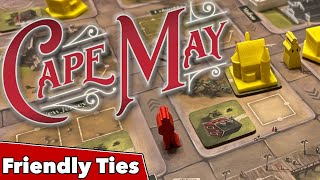
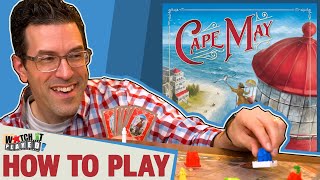
Cape May has earned warm praise from reviewers as a fresh take on economic city development that respects both strategy and accessibility. Watch It Played walks through its blend of movement puzzle and town-building, Board Games for One dwells on how thematically satisfying it feels to develop the town, and Meeple University hosted the designer's own studio to dig into its systems. The consensus positions it as an excellent step beyond roll-and-move games while staying engaging for experienced strategists, grounded in the real history of the New Jersey seaside resort.
Core Mechanics That Define Cape May
Movement Puzzles and Hand Management
Cape May revolves around a hand of numbered movement cards that shape every decision. Each card shows a cost and a movement distance you must travel exactly, and the board's one-way streets and no-backtracking rules turn each move into a small puzzle. Across four seasons you decide when to play cards, when to discard them, and when to spend an action recovering ones you let go. Board Games for One frames the card draw as introducing a welcome element of push-your-luck for players who do not want complete control, since you cannot always reach exactly where you hoped.
Building, Upgrading, and Income Tracks
Adjacent to your position you build cottages or shops at zone-based costs, then upgrade cottages into Victorian homes and landmarks, and shops into businesses, each step raising your income and unlocking bonus cards with ongoing effects or end-game points. The income track matters deeply: at season ends you collect coins equal to your income, fueling further investment. Reviewers describe this loop as economically satisfying because you are directly rewarded for developing the town rather than punished for expanding, and the upgrade cards add powerful one-time and persistent effects.
The Cape May Experience
A Thematic Journey Through Victorian New Jersey
The game is grounded in real history. Cape May was a famous seaside resort that endured floods, fires, and other disasters in the Victorian era, and the board approximates the actual map while event cards inject period flavor that sometimes helps and sometimes hinders. Watch It Played introduces the setting through designer Eric Mosso's framing of becoming the town's most prestigious developer. The theming is woven in naturally, from developing neighborhoods to the birdwatching that Cape May is famous for, without overwhelming the gameplay.
Bird Tokens as the Wild Card
Landing on bird spaces lets you draw random tokens representing different species, which you collect privately and score at the end by forming sets of unique birds, with larger sets worth dramatically more. The mechanic introduces welcome randomness and a push-your-luck feel. Reviewers diverge on its weight: Board Games for One notes the birds can be a genuine swing in a close game or a red herring if they do not come your way. That variability is part of the charm, ensuring no two playthroughs feel identical even when your strategy holds steady.
What Makes Cape May Stand Out
Accessible Strategy Without Sacrifice
Cape May occupies a sweet spot reviewers rarely find. Board Games for One describes it as a nice combination of strategy and push-your-luck, with room for planning but space for chance. New players grasp the core loop in a single round, while veterans discover nuanced decisions about when to upgrade, whether to chase majority bonuses in one zone, or how to hedge across all four. The rulebook is quick to get through, but the game rewards careful planning, and a strong start is no guarantee against a late collapse.
Visual Clarity and Real Board Development
Many reviewers contrast Cape May favorably with Wingspan, the other bird-themed economic engine. The key difference is that Cape May's board visibly grows as you play: cottages become Victorians, Victorians become landmarks. Board Games for One finds it more interesting than Wingspan precisely because you watch the town build and grow, an easier and more tangible way to visualize progress. The chunky pieces and tokens give the developing town real presence on the table.
Potential Drawbacks
Bird Randomness Can Overshadow Planning
While bird collection adds spice, it can feel unfair when the bag does not cooperate. If you need birds, land on bird spaces, and draw duplicates, you have spent valuable movement for little. Board Games for One frames it plainly: if you want one hundred percent strategic control, this is not the game for you. Early plans built around bird sets can collapse if circumstances shift, and some players will simply draw luckier than others.
Limited Direct Interaction
Cape May is not confrontational. Players compete for zone majorities and can block each other by occupying spaces, but there is no direct attack. The hidden bonus cards add some indirect tension since you cannot see opponents' objectives, but compared to games with trading, auctions, or bidding, Cape May keeps players largely in their own lanes. That suits players seeking lighter social engagement, though anyone craving negotiation or conflict may find it gentle.
If You Enjoy Cape May
Reviewers place Cape May alongside Wingspan and Parks as nature-themed economic games, while emphasizing that Cape May is more interactive and board-focused. If you like the gentle engine of Everdell or the development arc of Suburbia, you will find similar rewards here. For players seeking a step up from light card games into approachable strategy with a real spatial puzzle, Cape May lands comfortably between casual and mid-weight, rewarding hand management and planning over dice luck.
What Reviewers Are Saying
"The thematic experience is very strong. You are building up the town of Cape May, and that is what you feel like when you are doing it. You get rewarded for actually building up the town; if you don't build it up, you are not going to win."
— Board Games for One
"Compared to Wingspan, I find this more interesting than Wingspan, because in Wingspan there's not a whole lot happening; here you actually see the board build and grow, and it's a nice, easier way to visualize what is happening."
— Board Games for One
"Cape May, designed by Eric Mosso and published by Thunderworks Games. Although it's one of America's oldest seaside resort areas, Cape May has had its challenges, and you've been tasked with becoming its most prestigious developer."
— Watch It Played