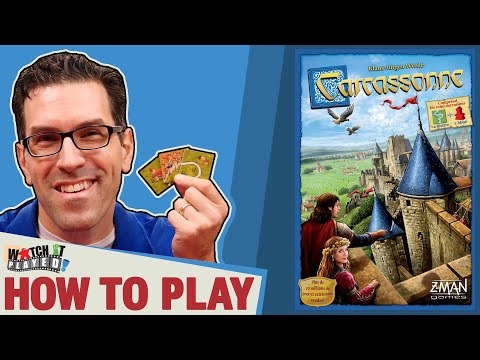
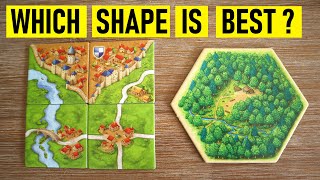
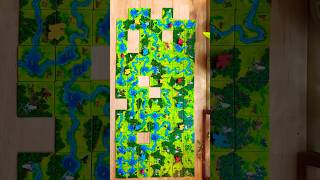
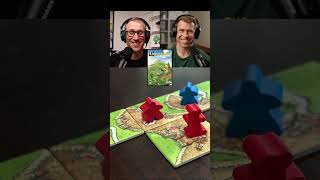
Carcassonne is a tile placement game in which the players draw and place a tile with a piece of southern French landscape represented on it. The tile might feature a city, a road, a cloister, grassland or some combination thereof, and it must be placed adjacent to tiles that have already been played, in such a way that cities are connected to cities, roads to roads, et cetera. Having placed a tile, the player can then decide to place one of their meeples in one of the areas on it: in the city as a knight, on the road as a robber, in the cloister as a monk, or in the field as a farmer. When that area is complete that meeple scores points for its owner.
During a game of Carcassonne, players are faced with decisions like: "Is it really worth putting my last meeple there?" or "Should I use this tile to expand my city, or should I place it near my opponent instead, thus making it a harder for them to complete it and score points?" Since players place only one tile and have the option to place one meeple on it, turns proceed quickly even if it is a game full of options and possibilities.
First game in the Carcassonne series.
Mechanics (from transcript analysis)

Video topics + discussion points
Quotes (from this video)
- we're approaching 10 000 subscribers on our channel
- merchandise is available
- we are launching our own discord channel
- this is absolutely 100% optional
- thank you so much for all the support that you guys continue to give us
- this is our two year anniversary
- we want to foster more of an aycb community
References (from this video)
- territory building and strategy
- medieval tile-laying world
Mechanics (from transcript analysis)
Video topics + discussion points
Quotes (from this video)
- Stellar is not a super well-known, well-talked-about game. I found it randomly in a local board game store.
- it's basically a two-player only game, asymmetric
- Lost Cities is a hand management game
- Patchwork is a tight, solid Uwe Rosenberg design
- Santorini is my favorite abstract game
- Castles of Burgundy... there's nothing like it for me in two-player
- Race for the Galaxy is my number two two-player game of all time
References (from this video)
Mechanics (from transcript analysis)
Video topics + discussion points
Quotes (from this video)
References (from this video)
- Encourages a quiet, patient approach and meaningful table-talk; players influence the board through cooperation and competition.
- Rich potential for emergent strategies as the map evolves with each tile.
- High replayability due to variable tile draws and placement options.
- Initial setup can feel passive or underwhelming; some players may not feel immediate impact from their moves.
- Certain configurations lead to analysis-paralysis or slow pacing at lower player counts.
- territory control through tile placement, city-building, road networks, and monastic expansion; players craft a narrative of shared space through deliberate placement and timing.
- A medieval landscape unfolds tile by tile across a flexible map; cities rise, roads connect, cloisters gather, and fields extend beyond the edge of the board. The setting is intentionally abstracted to emphasize spatial planning and negotiation among players as they lay down tiles that re-create a living map of a shared territory.
- observational, reflective, and conversational; the player is invited to interpret the board as a living story of cooperation and competition.
Mechanics (from transcript analysis)
- area scoring — Points are earned for completed features and for strategically controlled areas; the scoring often depends on the completion of roads, cities, and cloisters, with farmers scoring at the end of the game.
- meeples — Each player has followers (meeples) that are placed on features to claim them; their placement and subsequent score outcomes drive competition and negotiation.
- tile-based strategy — The game rewards patience and long-term planning as the map grows; the value of a tile depends on future tiles and the surrounding features already placed.
- tile-drafting — Players draw and place landscape tiles to form roads, cities, monasteries, and fields; the choice of which tile to play next creates subtle strategic tension.
Video topics + discussion points
Quotes (from this video)
- In many ways, board games have never been as popular as they are today.
- We're not just building a board together. We're having a conversation.
- Patience isn't complacency, patience is living.
- Two phases.
- You choose what matters. Because you build the board. You splay the cards. You choose what you let go of. You choose what you keep.
- Sometimes you just need to wait for the right thing to say.
References (from this video)
- House rule nearly eliminates analysis paralysis by changing timing
- Faster and more engaging gameplay
- Official rule led to long setup and thinking times
Mechanics (from transcript analysis)
- Area Control — Placed tiles determine scoring for features.
- area_control — Placed tiles determine scoring for features.
- board_game_pacing — Turn structure and placement tempo influence playtime.
- tile placement — Place tiles to build roads, cities, and fields.
- Tile-laying — Place tiles to build roads, cities, and fields.
Video topics + discussion points
Quotes (from this video)
- The bottom line, if you're going to buy these games, implement the house rule on day one. Don't suffer through the official rules.
- We refuse to play without these house rules. We get the games we actually wanted.
References (from this video)
- Iconic, approachable entry point to modern board gaming
- Great family-friendly design and easy to teach
- Depth may be limited for some veteran players
- city-building and territorial development
- Medieval Europe, city-building
Mechanics (from transcript analysis)
- tile placement — Players place landscape tiles to create medieval towns, roads, and monasteries; scoring emerges from connected features.
- Tile-laying — Players place landscape tiles to create medieval towns, roads, and monasteries; scoring emerges from connected features.
Video topics + discussion points
Quotes (from this video)
- Mental health is something that is really important to us and ever since then it's kind of been a big proponent of our channel and of our community.
- This allows us more opportunities to do topics like that on the podcast.
- bi-weekly podcast every other Friday.
- Carcasson being my true love in my wife's wedding vows.
- Seven Wonders Duel showed how you don't need to play a three-hour game to be completely enraptured by a board game.
- Gloomhaven opened doors to ongoing legacy and campaign experiences for us.
- There is now an entire audience that might not have found us because they don't consume YouTube or watch video content; podcast opens that door.
References (from this video)
- Strong, accessible tile-placement with emergent strategy
- High replayability and social familiarity
- Some players may find it less innovative than newer heavy games
- Long-term memory of optimal placements can dominate play
- Territory building and tile placement with end-game scoring
- Medieval landscape tile-laying board game with city/town features
- evolving landscape with area control
- Castles of Burgundy
- Lost Cities
Mechanics (from transcript analysis)
- Area Control — Players claim features like roads, cities, and farms for points.
- area control/placement strategies — Players claim features like roads, cities, and farms for points.
- Compound Scoring — Points are awarded for completed features and remaining features at game end.
- scoring based on completed features — Points are awarded for completed features and remaining features at game end.
- tile placement — Players draw and place land tiles to build a landscape.
Video topics + discussion points
Quotes (from this video)
- the rivers will always flow from high ground to low ground
- it's so fighty and kind of weird
- this river thing is just so cool. I've never seen anything quite like it
- First plays are for discovery
- fun is much more important than winning in board games
- gatekeeping is the worst part of the hobby
- do not listen to recommended player count or reviews on board game when you make a board game purchase
- cards are better than dice
- minimaxing kills games
References (from this video)
- Accessible and approachable for new players, while still offering depth.
- The Love Letter-style rule adaptation speeds up decision-making and keeps momentum in casual games.
- Downtime can still occur with larger groups if turns are long.
- Some players may find scoring subtle or less exciting without thematic hooks.
- Territory development, area control, and scoring via intersecting features.
- Medieval Europe depicted through tile-laying to form cities, roads, fields, and cloisters.
- Eurogame-centric, straightforward yet deep enough for varied strategies.
- Love Letter
Mechanics (from transcript analysis)
- Compound Scoring — Cities, roads, monasteries, and farms are scored as features are completed or evaluated.
- feature_scoring — Cities, roads, monasteries, and farms are scored as features are completed or evaluated.
- in_hand_drafting — Love Letter-style rule variants in play speed up information flow and reduce downtime while waiting turns.
- tile placement — Players draw and place tiles to extend the landscape and create features that can be scored later.
- tile_placement — Players draw and place tiles to extend the landscape and create features that can be scored later.
Video topics + discussion points
Quotes (from this video)
- The goal is the laughter. The goal is the fun. The goal is interaction around the table.
- A card laid is a card played.
- Jump in in real time as fast as possible and the gameplay continues in that direction.
- Dirty Spades is like ... this is how we're playing the game. It's silly. It's fun. Adds a little level of chaos to the thing.
- Bus rules. You could play it out and take a lot of time or it could just okay, now we know this what's going to happen.
- If the game state hasn't changed, go ahead and pay for it now.
References (from this video)
- classic, approachable for beginners
- satisfying spatial puzzle with tangible end result
- can get mean in competitive plays
- tile-laying with shared board growth
- medieval landscape-building
- emergent storytelling through terrain and meeples
Mechanics (from transcript analysis)
- area majority — score based on control of features like cities and roads
- interaction/mean edge — players can affect each other via placement
- neighbor interaction — players can affect each other via placement
- tile placement — create a landscape by placing tiles to maximize points
Video topics + discussion points
Quotes (from this video)
- it's the long game versus the short game
- it's a really fun dice puzzle
- the depth grows the more you play
- it's a legacy you can actually finish in a campaign
References (from this video)
Mechanics (from transcript analysis)
Video topics + discussion points
Quotes (from this video)
- the bones of the game are so simple
- I love bag Builders
- the tracks are so continuously rewarding
- you can see so much of kind of the DNA of Clank
- it's so satisfying to slide those workers into that Mech
- this feels like a Dungeon Crawler but with Euro systems
- I love horror movies
References (from this video)
- classic gateway game
- easy to teach and learn
- high replayability with varying tiles
- can feel lightweight for some players
- player interaction is indirect
- territory building with tile placement
- Medieval southern France
- abstract/engine-lite
- Pandemic
Mechanics (from transcript analysis)
- Area Control Scoring — points scored for completed features (roads, cities, monasteries).
- meeple placement — place a meeple on features to claim scoring points.
- tile placement — players draw and place a tile to extend the landscape.
Video topics + discussion points
Quotes (from this video)
- This is something that's a living document, which is really, really cool.
- It's driven by y'all.
- Dominion put deck building on the map.
- Sky Team won. That's incredible.
- It's truly one of the most replayable games ever.
References (from this video)
- Clear introductory explanation of core rules and setup
- Demonstrates river expansion setup and how it changes initial play
- Step-by-step guidance covers basic rules for multiple versions
- Includes notes on 20th anniversary expansion mechanics
- Edge-case rules interactions are not exhaustively explored
- Some examples are simplified for a beginner audience
- territory building and area control in a medieval setting
- French landscape with roads, cities, monasteries, and rivers
- instructional guide with step-by-step setup and rules explanation
Mechanics (from transcript analysis)
- end_game_scoring — final scoring accounts for remaining meeples and unfinished features with tie-break rules
- expansions_integration — 20th anniversary expansion tiles introduce arrows/activation effects that influence scoring and placement
- meeple_claim — players may place meeples on features (roads, cities, monasteries, fields) to claim them for scoring
- river_expansion — an alternate river setup adds a river before normal tiles, creating new layout and scoring considerations
- scoring_on_completion — completed features score points (roads by tiles, finished cities, monasteries, gardens); unfinished features score minimally at game end depending on rules
- tile placement — players draw and place tiles so that adjacent edges match (roads, cities, fields, rivers) and build the landscape
- tile_placement — players draw and place tiles so that adjacent edges match (roads, cities, fields, rivers) and build the landscape
Video topics + discussion points
Quotes (from this video)
- this is a game for two to five players
- the river must continue in either direction but it can never go back on itself
- and that's how you play carcassonne
- specifically the 20th anniversary edition
References (from this video)
- Accessible to new players
- Fast-playing social experience
- Can encourage over-analysis in multiplayer, depending on player count
- tile placement, area control, resource management
- Medieval southern France, landscape and city-building
- pragmatic, instructional
- Twilight Imperium Fourth Edition
- Eclipse
- Two Rooms and a Boom
- A Game of Thrones: The Board Game Second Edition
Mechanics (from transcript analysis)
- Area Control — Players place followers on features to claim points when features are completed or scored.
- area control / meeple deployment — Players place followers on features to claim points when features are completed or scored.
- tile placement — Players draw and place a tile to extend the map, connecting roads, cities, monasteries, and fields.
Video topics + discussion points
Quotes (from this video)
- First off, accept that you can't own all the games.
- you can't even own all the games that you like because there are so many great games out there
- the Netflix effect of where you have way too many choices such that it becomes overwhelming
- focus on how to best appreciate and enjoy the experiences that you can and will be able to execute on.
- does this spark joy?
References (from this video)
- rapid teaching curve, highly accessible
- extremely scalable with expansions
- strong gateway game with enduring popularity
- can feel light without expansions for veterans
- territory-building and city/monastery features
- medieval landscape
- tile-placement with evolving board
- Torres
- Ticket to Ride
- El Grande
Mechanics (from transcript analysis)
- Area Control — meeples are placed to claim features that score at the end of rounds
- area_control — meeples are placed to claim features that score at the end of rounds
- tile placement — draw and place tiles to form cities, roads, monasteries, and fields
- tile_placement — draw and place tiles to form cities, roads, monasteries, and fields
Video topics + discussion points
Quotes (from this video)
- the biggest one ever in the history of the modern board gaming possibly the biggest one ever
- Ticket to Ride is a hand management game that's what it is
- Dominion... it's the deck building game
- Bear Park feeling
- it's essentially root building right it's a root building game, much like Ticket to Ride in some way
- Treat yourself
References (from this video)
- Simple rules and quick rounds
- Great gateway game with broad appeal
- Can feel lightweight for heavy gamers
- Some expansions can dramatically increase complexity
- territory building and city/road development
- Medieval landscape around the city of Carcassonne
- light, approachable, family-friendly
- Port Royal
- Lords of Waterdeep
Mechanics (from transcript analysis)
- area scoring via followers — Followers placed on features score points when completed.
- tile placement — Players place tiles to build roads, cities, and cloisters.
Video topics + discussion points
Quotes (from this video)
- This town is filled with friends.
- Dragons and sleeping, and there's a dragon hopefully being asleep.
- Delusions of grandeur require a leap, but playing the fool is his full-time job.
- Africa—read me the lyrics.
- Twilight Imperium, you are correct.
- I thought I nailed it.
References (from this video)
- Iconic, accessible gateway euro with broad appeal
- deep yet approachable tile-laying strategy
- Can feel light for experienced players over time
- tile placement, territorial control
- Medieval countryside development
- gentle, family-friendly strategy
- Ticket to Ride
- Katan
Mechanics (from transcript analysis)
- Competitive scoring with shared board — Strategic placement yields points for yourself and affects others.
- tile placement — Players place tiles to create roads, cities, and farms.
- Tile placement with meeples — Players place tiles to create roads, cities, and farms.
Video topics + discussion points
Quotes (from this video)
- Exploding Kittens was raised $8 million on Kickstarter for many years. It opened the floodgates for other publishers to look at Kickstarter as a viable medium.
- I don't think we'd have Gloomhaven without Exploding Kittens.
- Blood on the Clock Tower is the de facto social deduction game taking shape.
- It's a beautiful game about nature reserves.
- ARCs has done very very well and other games in the leader lineup as well as the sister company.
References (from this video)
- Accessible yet strategic tile placement
- Foundational area-control mechanics
- tile placement and area control with meeples
- shared landscape in a medieval French region
- analytical, territorial strategy
- King Domino
Mechanics (from transcript analysis)
- Area Control — place meeples to claim features and score
- tile laying — place tiles to form a landscape and features
- tile placement — place tiles to form a landscape and features
Video topics + discussion points
Quotes (from this video)
- Mechanics first, theme second.
- The fastest way to lose new players is with a dull 3-hour game.
- This is a perfect entry-level co-op game.
- Open drafting lets you see what everyone is taking as they take it.
References (from this video)
- Classic, highly accessible
- Strong family appeal
- Can become familiar if played frequently
- Ticket to Ride
- Smash Up
Mechanics (from transcript analysis)
- area majority — Players deploy followers to control features for scoring.
- tile placement — Players draw and place tiles to build a medieval landscape.
Video topics + discussion points
Quotes (from this video)
- we have a very round catalogue so we have something for every type of gamer
- it's nice to be able to kind of give something to everybody in every type of gamer
- we look far and wide between our Studios internally and then also external Studios we work with as third parties
References (from this video)
- Very accessible and quick to teach
- Solid gateway Euro with broad recognition
- Can feel repetitive after many plays
- Scalability depends on player count
- Tile drafting with area/meeple-based scoring
- Medieval landscape tile-laying
- Casual, accessible tile-laying Euro
- Cascadia
- Caverna
Mechanics (from transcript analysis)
- meeple placement — Place followers to score areas and complete features
- tile placement — Draft and place tiles to build the landscape
Video topics + discussion points
Quotes (from this video)
- "Bonanza does a great job of putting that negotiation forward and creating more of a social interactive experience that I feel like Katan offers as a Euro game that is somewhat unique amongst Euro games today"
- "Katan by creating that social interaction the fluidity and the kind of non-scripted approach to that"
- "Sleeping Gods is an amazing experience very reminiscent of an open world game"
- "This is definitely a step up in complexity"
References (from this video)
- easy to learn, quick to play
- highly social with dynamic play between players
- quite strategic despite simple rules
- scaling can feel repetitive for long sessions
- theme is abstracted; some players want more thematic flavor
- cultivating towns, roads, monasteries, and fields
- medieval France, urban planning and city-building
- abstract tile-placement with evolving map
- Cascadia
Mechanics (from transcript analysis)
- Area Control — players score points for features controlled by their followers.
- builder-style scoring — points are awarded for completed features and adjacent formations.
- Compound Scoring — points are awarded for completed features and adjacent formations.
- tile placement — players place square tiles to build a shared landscape.
Video topics + discussion points
Quotes (from this video)
- Sleeping Gods.
- Not a game.
- I believe he got nine out of 10.
- Paladins.
References (from this video)
- Elegant simplicity and quick plays
- Good for teachable moments and family gaming
- Blocking can be indirect and passive
- Some expansions can complicate the core rules
- Tile placement and area control
- Medieval land with expanding cities and countryside
- gateway tile-laying with evolving landscapes
- Catan
- Puerto Rico
Mechanics (from transcript analysis)
- meeple placement — Place followers to claim features for points
- Scoring districts by feature — Points awarded for completed features and strategic blocking
- tile placement — Draw and place tiles to build landscapes
Video topics + discussion points
Quotes (from this video)
- a game like Katan is because it was the first german-made board game to really hit the international stage with such success
- the act of deliberately taking an action or a resource that you know somebody else wants or really badly needs is what we call hate drafting
- it's what we call a merit trash despite sounding derogatory that is the term that the board game Community sort of adopted to compare americanmade games to European style games
- Twilight Imperium ... it is extremely thematic features sculpted plastic miniatures has a high degree of conflict and role to resolve battles
- in 2004 Ticket to Ride entered the scene ... hate drafting
- Pandemic came out in 2008 and it stood out as an exciting Cooperative game where players could share with one another what cards they were holding and strategically line up a plan
References (from this video)
- easy to learn, quick to teach
- great gateway for families and groups
- deep optional strategies via expansions
- scoring can feel binary (completed features yield points)
- tile placement and area-control through meeples
- medieval countryside around Carcassonne, France
- storytelling through modular landscapes and features
- Catan
Mechanics (from transcript analysis)
- area_control_scoring — points awarded for completed cities, roads, and cloisters when features are finished
- dice placement — place followers on features to claim ownership and score points
- end game bonuses — after the last tile is placed, final scoring occurs for uncompleted features
- end_game_scoring — after the last tile is placed, final scoring occurs for uncompleted features
- meeple_placement — place followers on features to claim ownership and score points
- tile placement — draw and place tiles to build out a landscape with cities, roads, and cloisters
- tile_placement — draw and place tiles to build out a landscape with cities, roads, and cloisters
Video topics + discussion points
Quotes (from this video)
- tagline says it all what do we got here collect and trade resources to build up the island of Katan it's all you do
- you can trade with another player it can be even uneven doesn't matter or you can trade with the bank at quite a loss or you can trade with a port if you've got a settlement on a port for a better deal
- the goal of the game is to have the most points you gain points by having the most built City
References (from this video)
- classic gateway game
- high variability with expansions
- easy to teach
- can become cutthroat in later rounds
- lengthier with new players
- territory control through tile placement
- medieval landscape development across a modular board
- abstracted historical milieu with evolving map
- Beacon Patrol
Mechanics (from transcript analysis)
- area majority — Points are earned by controlling features via meeples and strategic placement.
- Area majority / scoring — Points are earned by controlling features via meeples and strategic placement.
- tile placement — Players place tiles to form roads, cities, and fields, shaping the board.
Video topics + discussion points
Quotes (from this video)
- If you like Carcassonne and you want to go cooperative nicer, you might try Beacon Patrol.
- Kinfire Council gave me a real Lords of Water Deep vibe when I play.
- Katon with nukes. Yes, katon with nukes. That's all you need to know.
- This is like Ticket to Ride but with polyomino drafting—it’s Sunrise Lane for Tickets to Ride.
- Coffee Rush snuck into that category—tower defense vibes without real-time play.
References (from this video)
- Classic gateway to Eurogames
- Accessible entry point for families
- Can become repetitive over long campaigns
- Requires map reading
- tile placement and area control
- Medieval landscape in a French region
- Modular, map-building with expanding features
- Killer Bunnies
- Dominion
- Small World
Mechanics (from transcript analysis)
- dice placement — Followers are placed to control features and gain points.
- expansion-driven planning — Expansions add new rules and strategies over time.
- meeple placement — Followers are placed to control features and gain points.
- tile placement — Players place tiles to expand a shared map containing cities, roads, fields, and cloisters.
Video topics + discussion points
Quotes (from this video)
- Killer Bunnies really opened our minds and then we found more games like Small World and Dominion.
- 320 plus plays later, we got over that.
- Time has been the bigger constraint on our hobby than money.
- Production quality matters, there is this toy factor and tangible aspect of board games.
- We grew into a taste for simpler, shorter games and still love our heavy titles, but the curve shifted.
- We want a collection that can serve up our favorites for any scenario.
References (from this video)
- high variability with tiles and expansions
- easy to teach
- some expansions can slightly complicate rules
- tile-laying and city-building
- medieval landscape building
- light, adaptable
- Takenoko
- Kingdom Builder
Mechanics (from transcript analysis)
- Area control / scoring regions — score based on control of features
- tile laying — place tiles to form a map and complete features
Video topics + discussion points
Quotes (from this video)
- I don't know very much about wargames I haven't played many war games
- these games are for adults
- these are the vast majority these are available easily
- abstract strategy games don't really look like that anymore
- these are not children's items they're for adults to have a serious time together
References (from this video)
- tight, elegant engine
- doesn't have the same joy as Carcassonne's peak
- medieval city-building
- tile-laying kingdom
- classic Euro
Mechanics (from transcript analysis)
- tile placement — place tiles to create cities, roads, fields; score building
Video topics + discussion points
Quotes (from this video)
- One of the greatest experiences I've ever had playing a board game ever.
- It's all about board games, but especially the people who play them.
- This is Look Back, a series that I do where I talk about games that I reviewed one year ago, 5 years ago, 10 years ago, and 20 years ago during this time frame.
References (from this video)
Mechanics (from transcript analysis)
Video topics + discussion points
Quotes (from this video)
- gaming is for everybody
- Black history is American history
- If it happened on American soil it's American history
- History is not a priority in this country; comfort is the preeminent american value
- we're here we're here we're here
References (from this video)
- Innovative tile-laying mechanic (board built during play)
- Great introduction to hobby games
- Accessible rules
- Multiple expansions available
- Works well with base game plus a few expansions
- Highly playable
- Farmers expansion is tricky but optional
- Tile building
- Medieval
- Landscape building
Mechanics (from transcript analysis)
Video topics + discussion points
Quotes (from this video)
- i'm looking for games which really connect with me and i have an emotional sort of reaction to
- you're going to find it much easier to get it to the table
- the rule set was so simple
- i'm very very impressed by the designer of this one
- it takes everything that's good from puerto rico and does away with all the sort of extra stuff
- essentially it's just one big toy box i absolutely love it
- you're really doing what it says you're doing
- this really was the the first of the sort of european style modern games that was introduced to me
- there's not many games that give me that sense of i've set a trap
- anything they create just is fantastic
- it just feels right for that style of game
- you don't have to think playing talisman
- you've got to like the other people
References (from this video)
- Innovative tile-laying mechanic (board built during play)
- Great introduction to hobby games
- Accessible rules
- Multiple expansions available
- Works well with base game plus a few expansions
- Highly playable
- Farmers expansion is tricky but optional
- Tile building
- Medieval
- Landscape building
Mechanics (from transcript analysis)
- Area Control
- area majority
- Majority
- tile laying
- tile placement
- worker placement
Video topics + discussion points
Quotes (from this video)
- i'm looking for games which really connect with me and i have an emotional sort of reaction to
- you're going to find it much easier to get it to the table
- the rule set was so simple
- i'm very very impressed by the designer of this one
- it takes everything that's good from puerto rico and does away with all the sort of extra stuff
- essentially it's just one big toy box i absolutely love it
- you're really doing what it says you're doing
- this really was the the first of the sort of european style modern games that was introduced to me
- there's not many games that give me that sense of i've set a trap
- anything they create just is fantastic
- it just feels right for that style of game
- you don't have to think playing talisman
- you've got to like the other people
References (from this video)
- Easy to learn
- Strong replayability
- Modular with expansions
- Can become sprawling on larger maps
- Player interaction limited by tile draws
- Territory and city building via tile placement
- Medieval landscape building in Gaul
- Tile-placement with area control
Mechanics (from transcript analysis)
- Area Control — Place followers to claim features and score points.
- tile placement — Place tiles to build features like cities and roads.
Video topics + discussion points
Quotes (from this video)
References (from this video)
- versatile, plays well at 2-4
- easy to teach and family-friendly
- some expansions can complicate
- territory control and area scoring
- medieval landscape building
- classic
- Seafarers
- Seeland
Mechanics (from transcript analysis)
- Area majority / scoring — score points based on completed features.
- tile placement — place tiles to build roads, cities, fields.
Video topics + discussion points
Quotes (from this video)
- "Point City... looks like this really cool game about pretty tactical about building up a really streamlined engine and just trying to get a bunch of points"
- "I’ve been fatigued by rolling rights"
- "the more you pull back or pull me back from being like in instruction mode the faster you’re going to find I end up"
- "Nostalgia definitely does apply"
References (from this video)
- classic, approachable, family-friendly
- base game can be repetitive; expansions often improve depth
- tile placement and area control
- Medieval landscape-building with tiles and followers
- classic, straightforward
Mechanics (from transcript analysis)
- pattern-building — Strategic placement to maximize scoring opportunities.
- tile-placement — Lay tiles to expand a growing map and claim features with followers.
Video topics + discussion points
Quotes (from this video)
- "This game, it's timeless."
- "Five Tribes is a cutthroat head-to-head game for us."
- "Dominion is the classic."
- "Terraforming Mars is ugly, but yet a fantastic game."
- "I love the little panda."
- "The acrylic meeples and pieces"
References (from this video)
Mechanics (from transcript analysis)
Video topics + discussion points
Quotes (from this video)
- did you know that the monopoly has a monopoly man has a name
- it's the yak game
- it's five thousand years is a long time
- jenga deride from the swahili word kajunga meaning to build
- ghostbusters
References (from this video)
Mechanics (from transcript analysis)
Video topics + discussion points
Quotes (from this video)
- I'm giving away a copy of Dead of Winter: The Long Night with this video
- To be in with a chance of winning, simply like this video, comment below and subscribe to Actualol
- If you're new to Actualol then check out the rest of my videos.
- I'm Actualol on Facebook and Twitter. I'm Jon Purkis, thanks for watching.
References (from this video)
- Engaging tile-placement
- Replayability with expansions (though not used)
- Family-friendly
- Can be long with many tiles
- Luck of tile draw affects pacing
- Tile-laying city-building and territorial development
- Medieval southern France, around the city of Carcassonne
- Abstract
- Catan
Mechanics (from transcript analysis)
- area/feature scoring — Score completed features and strategic layouts
- meeple placement — Assign followers to features to score points
- tile placement — Place landscape tiles to create roads, cities, fields and cloisters
- Variable board — Modular board created by players arranging tiles
Video topics + discussion points
Quotes (from this video)
- we're gonna give you five in no particular order
- these are real places i know but could i still want to visit japan
- education value of board games... we love that
References (from this video)
- accessible, quick to teach
- modular with many expansions and references
- tile-laying and territory scoring
- medieval landscape-building with tiles
- abstract geography
Mechanics (from transcript analysis)
- area_control — placing features yields control and scoring opportunities.
- tile-placement — players place tiles to build the landscape and score points.
Video topics + discussion points
Quotes (from this video)
- two Ninjas they're saying Mission failed
- Mission failed he found us
- it's a math exercise
- this is called Indiana Bones and the Doom Temple
- Santa Claus oh my God she's so small there's a hobbit house somewhere there
- Essen is the capital of board games
- Arc which was the hype in 2024 ... they are fuel cartel
- this is an homage to Kim Stanley Robinson
References (from this video)
- Accessible for families
- Solid gateway game
- Can feel repetitive over time
- tile-placement, city-building
- medieval French landscape
- classic
- Tsuro
- Qwirkle
Mechanics (from transcript analysis)
- area majority — place followers to claim features
- tile placement — lay tiles to build a landscape and score features
Video topics + discussion points
Quotes (from this video)
- it's mechanics that make the game
- the Rondale (rondel) mechanic is strong
- Survive is the most treacherous blood curdling game in our household
- Starla month
References (from this video)
- still played occasionally
- foundational game
- tile laying
- landscape building
Mechanics (from transcript analysis)
Video topics + discussion points
Quotes (from this video)
- it's only a game
- you're listening to the broken meeple show a podcast that speaks passionately about board games
- I am very much a cold blooded I'm a cold blooded lizard I need cold
- the top 50 has finally finished finally it's done
- there is nothing apart from it being bright and sunny there is nothing about the summer that really gets me like you know excited or interested because it's just too hot
- I look at these top 50s uh they certainly increase a bit
- there's a lot of good feedback in terms of what's up next hard to say really
- I would give it at least a seven out of 10 right now and say it's good
- the Arkham Horror games are still pretty solid and you know they're fun to play but they are definitely getting to a point where I don't think I can uh like really say that they're practical
- my tastes were new at that point you know I respected terroriser for its thiness
- I have definitely developed to want more theme in my games
References (from this video)
- iconic, accessible gateway euro
- strong core mechanic
- heavy expansions can complicate experience
- landscaping with tiles and meeples
- Medieval countryside
- euro classic
- Isle of Skye
- Isle of Skye (Pfister)
Mechanics (from transcript analysis)
- area majority — scoring based on placed meeples on completed features
- area majority / meeples — scoring based on placed meeples on completed features
- tile placement — tiles create a medieval landscape as players place and populate features
Video topics + discussion points
Quotes (from this video)
- don't let the customer create their own shadow product in their head; you tell them what the product is, who it's for and why they should care
- the game maker gets to set the context
- if you innovate you risk confusing potential purchases but if you stick with familiar concepts how are you ever going to stand out
- you tell them to just play a few rounds and they'll enjoy it
References (from this video)
- Simple to learn; quick plays
- Encourages strategic planning and adaptation
- Can become repetitive for experienced players
- Tile placement and area control with meeples
- Medieval landscape building across tiles
- Abstract thematic integration
- Catan
- Ticket to Ride
Mechanics (from transcript analysis)
- Follower placement (meeples) — Place followers to score features like cities, roads, and fields.
- tile placement — Place tiles to build landscapes and features.
Video topics + discussion points
Quotes (from this video)
- PAX unplugged is going to be huge and a fantastic positive force in the board gaming community.
- open gaming area is huge and there are vast numbers of tables where everybody could be gaming.
- PAX is bringing in a whole new crowd this is a great thing for our industry right now.
- Philadelphia is a beautiful city, absolutely gorgeous, a classic northeastern United States City with grit.
- This is going to become like a Gen Con and even more, I think, going forward.
References (from this video)
- Great gateway game
- Tile placement mechanics
- Many expansions available
- Can be a filler game rather than main event
- medieval
- landscape_building
- South Sea
Mechanics (from transcript analysis)
Video topics + discussion points
Quotes (from this video)
References (from this video)
- accessible gateway to strategy
- high replayability with expansions
- some may prefer more modern mechanics
- tile placement and territorial control
- medieval landscape building
- classic, tile-placement
- Sagrada
- Azul
Mechanics (from transcript analysis)
- territory scoring — points earned from features completed by players
- tile placement — lay tiles to build landscapes and cities
Video topics + discussion points
Quotes (from this video)
- we celebrate women's history month by looking at some of the women in board game design
- gatekeeping and systemic racism in board gaming that we all need to overcome
- we need less games that are about cis white maleness we need more feminism we need more racial diversity
- acceptance and being a good human is saying that you're adequate and you're welcomed
References (from this video)
- fast, accessible, and scalable for many players
- clear, straightforward tactics and scoring
- works well with or without expansions; age-friendly
- 2-player compatibility makes it versatile
- abstract feel for some players
- early dominance by tile draws can create uneven scoring
- expansions may slow or overly complex the game
- territory control and city-building through tile placement and meeple deployment
- medieval landscape built tile by tile with roads, cities, farms, and cloisters around churches
- spatial drafting with emergent scoring and shared map interaction
- Settlers of Catan
Mechanics (from transcript analysis)
- end-game and area scoring — score completed features and farms at game end; intuitive scoring
- meeple placement and feature claiming — place followers to claim roads, towns, farms, and cloisters
- tile placement — place tiles to extend the board and create features
- variable play length with expansions — short, fast games that scale with player count
Video topics + discussion points
Quotes (from this video)
- Settlers is more of a thinking person's game; Carcassonne is more of a mindless activity
- the big balancing element is trading
- open trading is maybe the funnest aspect
- Settlers is more of a thinking person's game and Katan's more of a Mindless activity
- it's quick and accessible
- two-player experience is viable but different from 3-4 players
References (from this video)
- easy to teach, quick to play
- strong spatial puzzle feel
- may feel repetitive across a long campaign
- territory expansion and scoring via feature control
- Medieval tile-placement world
- classic, approachable
- Castles Burgundy
- Tile placement family classics
Mechanics (from transcript analysis)
- tile placement — Place tiles to build structures and landscapes, scoring via features.
Video topics + discussion points
Quotes (from this video)
- "top 23 board game terms that we mentioned quite a bit"
- "we want to ramp up quicker"
- "we're going to pick out the top 20 is where we started but then we said well it's 2023 so we're going to give you the top 23 board game terms"
References (from this video)
- Innovative gameplay
- Interaction between players
- Enduring design
- Simple yet strategic
- Looks dated
- Potential for getting meeples locked
- Tile-laying and territory building
- Medieval landscape
- Abstract
Mechanics (from transcript analysis)
- tile placement — Players place tiles to build a shared map
- worker placement — Players can place meeples on tiles to score points
Video topics + discussion points
Quotes (from this video)
- These are not the best board games I would recommend to you
- This is a very personal list that I've honed over the years
References (from this video)
- Simple rules and quick setup
- Relaxed yet strategic table presence
- Accessible for new players
- Limited depth compared to more modern eurogames
- Can feel repetitive to some players
- connecting roads and farmland across a shared map
- Medieval southern France; town-building with roads and fields
- casual, collaborative tile-laying with light competition
- Isle of Sky
Mechanics (from transcript analysis)
- meeple_placement — Place meeples on features to claim scoring opportunities.
- scoring — Score completed features; end-game scoring based on enlisted meeples and areas.
- tile_laying — Draw and place a tile to extend a shared board, ensuring features align.
Video topics + discussion points
Quotes (from this video)
- This is the grandparent of all tile-laying games.
- You draw a tile and then you must place that single tile.
- It's very simple. It's very laid-back, but there's just enough strategy to it that it's quite enjoyable.
- I actually really enjoyed it.
- There are no ways to mitigate the dice.
- This is the heart and soul of the game. It's this resource gathering mechanic.
- I actually really liked it.
- The tempo of the game is really nice.
- Your entire economy is built off of these workers that you have.
- There are three different colors of workers and you have to keep them hidden.
- This is the heaviest of the four games that we played.
References (from this video)
- Gateway into the hobby
- Welcoming to new players
- Scales well with many editions
- Can feel repetitive over long sessions
- Tile-laying and area control with modular board.
- Medieval Europe, tile-based city/road/monastery building.
- Abstract thematic through placement.
- Ticket to Ride
Mechanics (from transcript analysis)
- Area Control — Players claim features by placing followers on them.
- Tile-laying — Players place terrain tiles to build features.
Video topics + discussion points
Quotes (from this video)
- these are essential to any collection
- gateway into the hobby
- we're a competitive family
- it's essential for our family collection
- the ultimate deck builder
- it's a party game you gotta have
- it's racing you know
- pickup and delivery, this is essential
References (from this video)
- elegant and smooth
- great gateway game with lasting appeal
- watching the map expand is satisfying
- can feel repetitive for some players after many plays
- competition for space can be tense
- territory building and area scoring
- medieval landscape with roads and cities
- abstract, tile-placement driven
Mechanics (from transcript analysis)
- Area Control — score based on completed features and followers
- area control / scoring — score based on completed features and followers
- tile placement — lay tiles to build roads, cities, and fields
Video topics + discussion points
Quotes (from this video)
- it's a really therapeutic game
- the production is gorgeous
- I just enjoy looking at all the arts
- extremely relaxing to play
- I don't care about winning, I just enjoy the process
- lose myself in this one
References (from this video)
- iconic and approachable
- rapid play and accessible for families
- can become repetitive for longer sessions
- tile placement and city-building
- medieval landscape
- story-building through tiles
- Stone Age
- Suburbia
Mechanics (from transcript analysis)
- meeple placement — claim features with followers to score points
- tile placement — lay tiles to extend landscapes and cities
Video topics + discussion points
Quotes (from this video)
- board games do a lot they're an asset to your lifestyle
- I love engine building
- Stone Age has a lot of math
- Carcassonne every time there's nothing to do with this
References (from this video)
- Very quick to play
- Simple rules
- Family-friendly
- Extensive expansion support
- Enduring popularity
- Host regrets placing it at #2
- Medieval
- Landscape Building
Mechanics (from transcript analysis)
Video topics + discussion points
Quotes (from this video)
- 170,000 logged plays... almost 500 times each day - how can this be the most played game
- the news must be fake in 365 days
- by the mission 35 you're like are we even playing the same game
- you have to go fast but the faster you go the closer the corner gets
- took something classic trick taking games been around for hundreds of years and made it into something more modern
- a lot of people play solo and if you play game solo it's much easier to get the gaming group together
- what's on the board stays on the board