











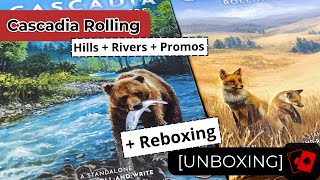

Cascadia: Rolling Hills Deep Dive
What the Community Thinks About Cascadia: Rolling Hills
Cascadia: Rolling Hills (2024) stands out as a surprising success in the roll-and-write adaptation space. Reviewers who initially approached the series with skepticism found themselves pleasantly stunned. All You Can Board noted playing the game five times in a single week, drawn repeatedly to its cozy yet engaging puzzle. The game has earned particular praise for condensing the charm of the original tile-laying Cascadia into a quick, accessible format that somehow manages to feel weighty despite its modest footprint.
Core Mechanics That Define Cascadia: Rolling Hills
Dice Rolling and Wildlife Collection
Each round begins with a player rolling four central dice alongside personal dice from each player. Rather than simply taking whatever animals match the dice faces, Cascadia: Rolling Hills layers meaningful choices atop randomness. Players collect one animal type based on what was rolled, counting all matching faces and adding them to their animal inventory. What makes this compelling is that the central special die offers multiple pathways: standard wildlife options, wild animals (any creature of your choice), the ability to use personal dice twice, or powerful bonuses like rolling personal dice up to two times. This foundation ensures that no two rolls ever feel identical, and the dice mitigation system stays at the heart of meaningful decision-making.
Nature Tokens and Dice Manipulation
The game inherits from its parent the powerful nature token system, but reviewers agree it functions at a higher level of importance here. Players can spend nature tokens to convert animals down the hierarchy (bears to elk to fox to hawk to salmon), convert animals upward at greater cost, or even take two different animal types in a single round instead of one. Unlike the original Cascadia where these tokens feel optional, reviewers found nature token management essential to success in Rolling Hills. Managing when to spend versus save these tokens creates constant tension, especially in mid-game when you are torn between immediate habitat completion and preserving flexibility.
The Cascadia: Rolling Hills Experience
A Cozy Puzzle Every Round
Reviewers consistently describe the experience as surprisingly cozy despite the tense decisions it demands. The round structure never overstays its welcome, and the habitat cards that flow through the center create a moving target that rewards planning but punishes overthinking. The Board Gaming Doctor explained the emotional arc: early rounds feel straightforward as you gather resources, but by rounds three and four the choices become genuinely agonizing. You are balancing whether to complete a habitat card about to leave the tableau against saving resources for better habitats appearing soon, whether to spend your precious nature tokens now or bank them, whether the animals you are collecting serve your immediate map needs or some future bonus. This pleasant struggle scales the game from accessible to genuinely meaty.
Solo Play and Replayability
The four different environment sheets (A through D) build dramatically in complexity. Sheet A requires you simply to write down habitat numbers and track sun bonuses. Sheet B introduces landmarks earned by completing rows and columns. Sheet C has you outline hexagons on a growing map, starting from central star spaces. Sheet D presents two separate versions: in Rolling Rivers you place specific wildlife on habitat cards and score through wildlife positioning and adjacency; in Rolling Hills you complete regions by marking wildlife types, competing for diversity bonuses. Reviewers particularly praised sheets three and four, noting they hit that sweet spot of feeling most like Cascadia while remaining distinctly fresh puzzles. The inclusion of achievement systems gives solo players concrete goals to chase. One reviewer shared playing the same game multiple times weekly specifically to unlock the achievement system, something they rarely do with other solo games.
What Makes Cascadia: Rolling Hills Stand Out
Capturing Cascadia in a Roll-and-Write Format
The accomplishment here deserves emphasis: adapting a beloved tile-laying, hand-drafting game into a simultaneous-play, dice-drafting vehicle without losing the core appeal is genuinely difficult. Reviewers noted that the game preserves Cascadia's fundamental satisfaction of puzzle-solving and ecosystem-building while introducing the speed and simultaneous engagement of the roll-and-write format. The habitat card system creates time pressure that the original game lacks, forcing you to prioritize which cards to pursue before they advance off the tableau. This borrowed tension is precisely what elevates Rolling Hills beyond a simple port.
Habitat Cards as a Conveyor Belt
The habitat cards flow across the tableau in four available slots, advancing each round until the rightmost card is discarded. Only having a few rounds to complete any given card before it vanishes forces tactical commitment. Some cards arrive with discount completion cards (blue background, placed above) offering reduced animal costs; others pair with bonus completion cards (brown background, placed below) granting rewards like extra nature tokens or free habitat space. The interplay between card scarcity and bonus composition creates countless interesting puzzles within each round.
Potential Drawbacks
Dice Randomness and Mitigation Limits
While reviewers praised the dice mitigation system, some noted that despite the options available, the core luck factor never fully dissolves. One reviewer mentioned wondering whether slightly more control over the dice would make the game feel even more like a thinky roll-and-write. The nature token pool is finite, and some rounds you will find yourself simply unable to pivot the dice toward your goals. Most reviewers framed this as acceptable tension rather than frustration, but players seeking maximum control may occasionally feel the randomness.
Complexity Scaling and Sheet Variety
While the range of environment sheets is a strength, Sheet A (the introductory map) is so straightforward that experienced players are unlikely to return to it. Reviewers suggested starting with Sheet B or jumping directly to a favorite after one or two plays. The higher-complexity sheets demand significantly more table time to parse, which is not a flaw but is worth noting for session planning.
If You Enjoy Cascadia: Rolling Hills
Players drawn to Cascadia: Rolling Hills often appreciate the original Cascadia tile-laying game, which shares thematic DNA and some core objectives. Rolling Realms offers similar dice mitigation and quick decision-making within a broader game series framework. Hadrian's Wall, another roll-and-write, delivers more punishing spatial decisions on paper. Cascadia: Alpine Lakes, a standalone in the Cascadia line, introduces elevation and lake-surrounding mechanics for players craving additional puzzle layers. For those who want shorter plays with deep solo depth, Second Chance provides comparable engagement in the flip-and-write space.
What Reviewers Are Saying
"I played it with my partner and then I played it solo two more times. I played it five times this past week, and I am having such a blast with these little cozy roll-and-writes."
— All You Can Board
"This game offers a lot of tense decisions each round, especially because of how fast those habitat cards go by. The choices each round are: do I collect certain animals to fulfill habitat cards nearing the end of the road, or do I double down on resources to hit some of the earlier habitats?"
— The Board Gaming Doctor
"The roll-and-write version really jumped out at me. It's probably hit the table the most for me in the past few weeks. I continue to be surprised by how much joy it brings and how cozy it feels, to the point where I'm asking myself if I prefer this version to original Cascadia."
— All You Can Board