/pic3984592.png)
Castell is a rich folk tradition in Catalonia, for which people gather at festivals to build human towers up to 8-10 people high! In the game, you run a castell team and are traveling around the various regions of Catalonia, recruiting castellers to your team, training new skills to build more impressive towers, and performing at festivals in the Catalan villages and towns. Do you have what it takes to be the best colla, or castell team, in the land?
A game of Castell takes place over the course of 10 rounds. Your goal is to recruit castellers from the regions of Catalonia, then build towers with those castellers to compete in the festivals. You’ll need to train your castellers in various skills so that you can build taller, wider, and more creative towers. The more diverse your performances and the better you tailor your towers to each audience, the higher your final score will be.
Harness your strength, balance, courage, and common sense to take your team to victory!

GTS 2013 - Castellan

Castell - How To Play

1000+ Board Game Collection Tour

- Thinky puzzle of building pyramids
- Fun to recruit people
- Rule-breaking as you level up
- High scoring potential in festivals
- Great at 3 players
- Long setup and teardown
- First player advantage can be an issue
- Human pyramids
- Catalonia, Spain
- Snake Oil
- Shake That City
- Race for the Galaxy
- Blueprints of Mackin
Mechanics (from transcript analysis)
- Area Movement — You're going around and you're making human pyramids... you have this little map of Catalonia with all these different like villages in it and you're traveling around these villages.
- End game scoring — There's like three big festivals throughout the game. And the LA what you're doing over those three big festivals... is you only get to keep the score of your highest your highest scoring pyramid.
- Objective Fulfillment — You can go in and do these little local shows where you're just trying to reach objectives that you're trying to get.
- Set Collection — Collecting the right people to recruit into your group to build these pyramids.
- Variable player powers — Every time you level up on one of them, you get to break the rule a little bit more of one of the rules of building the pyramids a little bit more.
Video topics + discussion points
Quotes (from this video)
- So Castell is very much a Euro game, but in a very unique way.
- It's really really thinky. It's really hard to build these pyramids. Uh which is what I love about the game. That puzzle of building these pyramids and collecting the right people to recruit into your into your group to build these pyramids is so thinky. It's so hard, but it's so much fun.
- One is setups kind of long. Um, and putting away is even longer with the insert that they have.
- This game is a quarter century old at this point.
- The game that got me into the hobby, the modern hobby, and that is Carcassone.
- What blew my mind is, and we take it for granted now, but think about your first time ever hearing about a board game that starts with one tile and it builds out.
- It's a very simple game. It's truly an OG style Euro game and uh it's it's wonderful.
- Still one of the most popular games to this day. One of the most played games on BGG to this day, 25 years later.
References (from this video)
- Unique theme
- Educational aspect
- Recommend checking it out
- Hard to find
- Traveling around Catalonia training and recruiting castellers to join your team and perform at festivals.
- Catalonia
- Building towers of people with specific rules, training can help break rules. Try to create the most impressive tower at festivals to score points.
Mechanics (from transcript analysis)
- Set Collection — Recruiting castellers to join your team and perform at festivals.
- Worker Placement — Training can help you by kind of allowing you to break some of those rules.
Video topics + discussion points
Quotes (from this video)
- this is Tiny epic galaxies and this is its first year on my top 100
- Mombasa this is a game that I don't really want to spend a whole lot of time talking about because I'm not really a fan of the theme but the mechanisms in it are really solid
- TWA another the reason that this one slid back in this year is because I had a chance to replay it again this time with the ladies of TWA expansion which added some things that I really liked
- Root this is a really great asymmetric game about Waring Woodland creatures and it also has some really awesome artwork by Kyle Faren
- Castell I really love the different theme in this game it's pretty unique compared to other games that I've played
- Lords of Waterdeep this is a really popular introduction to the worker placement genre but it's also one that I continue to to enjoy all these years later
- Osta which is a game that I will admit I've only played once and this is the first year it's been on my list but this game's mechanism is what puts it onto the top 100 for me already
- Eldritch Horror in our earliest days of board gaming Jen and I loved to play Arkham Horror together and so it was no surprise that we loved Eldritch Horror from the first time we played it
- Wonderlands War so just like earlier when I said that I really like games with a mangala mechanism I also really like games that have me pulling tokens or other pieces out of a bag
- Endless Winter Paleo Americans this game has so many things going on um although it managed to do it while not feeling overly complex as far as rules go
References (from this video)

Mechanics (from transcript analysis)
Video topics + discussion points
Quotes (from this video)
- tomorrow matthew and i are going to live stream sagrada the physical copy of it actually playing that together
- they introduced me to like catan
- Castell is a big one I like
- Gentes Cinque Terre which is hard to get
- Ticket to Ride is constantly up there
- For Sale... prior to 2000. that's a game I still love today
- Resistance and still play it loads
- Blood on the Clocktower
- Don't mess with Cthulhu it's another great
- Deception Murder in Hong Kong is a big favorite
- the concept's fantastic the idea that you just buy a pack and you're good to go and there's nothing to build now
- this is going to disrupt the entire system
- I love teaching that to people
References (from this video)
- theme aligns with coral reef ecosystems
- engine-building approach could offer interesting decisions
- limited explicit detail in transcript; uncertain weight or depth
- attract diverse species and build a thriving ecosystem
- coral reef ecosystem
- engine building in an underwater setting with ecosystem management
Mechanics (from transcript analysis)
- animal_influx — attracting different species to your ecosystem.
- engine_building — developing an ecosystem through card interactions.
Video topics + discussion points
Quotes (from this video)
- 24 games that I'm going to be talking about I'm going to go through them in alphabetical order
- my heart skipped a beat when I saw this on the list
- time will have to tell on that one
References (from this video)

- Appeals to liking organizing and building.
- Appears to be a solid Euro game.
- Slight concerns about replayability.
Mechanics (from transcript analysis)
- Euro Game — it looked like a solid Euro kind of about building these towers of of people.
- tower building — it looked like a solid Euro kind of about building these towers of of people.
Video topics + discussion points
Quotes (from this video)
- Um I'd have slight concerns about the replayability of the game, but please do correct me uh on that.
- Maybe a little bit maybe a bit oversaturated in terms of how many there are out there.
- Unfortunately, I'm not familiar with either of those.
- Um I also thought that there wasn't enough mitigation in terms of activating the spots that you wanted.
- Um and pretty much the uh the cards not doing anything terribly interesting either.
- Um but I just like it in every way. But I'm a big sucker for really good Dawn games. I think he's a brilliant designer.
- Um hopefully I'll get copies of those for for sale relatively soon.
References (from this video)
- Abstract strategy with root building
- Dynamic gameplay where everything is changing
- Cross-contamination between players' plans
- Simple mechanisms (place a tile or move markers)
- Attractive components
- Highly AP prone
- Significant downtime watching opponents
- Fun factor might be lacking, too zero-sum and transparent
- Optimal placement exists and is hard to find
- Time consuming
- Root building and connecting markers on a grid
- Abstract strategy
Mechanics (from transcript analysis)
- Race — The game is a race to get to 50 points.
- Route Building — Players aim to connect their markers on the extremities of the grid by passing through root lines on the tiles.
- Set Collection — Points are scored based on the number of tiles passed through and the height of the stacks.
- Tile Placement — Players place tiles with different root patterns on a communal board.
Video topics + discussion points
Quotes (from this video)
- This is where I take a look at the last five new to me board games that I've played and I rank and review them in order of preference.
- The production value is absolutely insane and not an EAS it Gorge to look at.
- I think it's a gorgeous design this is like my tailor made style of artwork kind of has this kind of stained glass medieval look that suits the game perfectly.
- My oh my is this game fantastic.
- This one for me is like s tier Kia like the best of the best.
- Could not recommend this one enough if you like the style of games that I do.
References (from this video)

- The way the tiles turn is really fascinating
- Cards are really cool
- Really rubbed me the wrong way
- Made me feel like I have seen implementation of these features... done much better
- Chance to draw cards and not know what you're going to get
- Could grab all the cards that don't necessarily help you
- Luck into getting a five over the three is kind of ridiculous
- Really silly
- Not equal turns with three players
- Never like a game that doesn't give players equal chance to play
- This game is not going to be played again
- This goes. This goes. I don't care where it goes, but it's going out of the house.
Mechanics (from transcript analysis)
- Area Control — Implied by gaining power and control in different areas to place castellis (castles).
- Card Drafting — Involves drawing cards from a deck with unknown outcomes, including victory point cards.
- Tile Placement — The core mechanic of the game.
Video topics + discussion points
Quotes (from this video)
- So, one of the things that is problematic about having a board game collection is that they're margins too many.
- We decided to kind of go through our collection and try to play as many of those games as possible.
- And on BG its ranking is a 6.4 out of 10.
- So, I don't like blind auctions. I don't like them at all.
- So, this has a little bit of a runaway feature to it. Not my favorite.
- And dice is a big critique of mine in this game.
- Um it's just so swingy and so like you lucky.
- And so you just don't get the things that you've invested in because you do get to invest in things.
- This game really really rubbed me the wrong way in a variety of ways and it made me feel like I have seen implementation of these features, this kind of tile placement done much better.
- And so I feel like just to like luck into getting a five over the three is kind of ridiculous.
- And then the last thing is there is not equal turns with three players and that was like not in my opinion I I never like a game that doesn't give players equal chance to play or some kind of makeup for that.
- This game is not going to be played again, no matter how many players it says is best with.
- There's a cool feature in this game, which is that this center space spins for every player.
- Um this game had a kind of fizzle ending for me.
- I could not wrap my brain around this game.
- So we're probably going to get rid of Castelli.
- We've made so many leaps and bounds and different mechanics and things that I really enjoy now as a gamer that I don't necessarily enjoy and didn't enjoy when I first started gaming that were kind of like the staples or the mainstay, the kinds of mechanics that um just rub me the wrong way andor make me feel like I don't have a chance in the game.
References (from this video)
- Fine for kids.
- Quicker setup than Rhino Hero.
- Less prone to falling than Rhino Hero.
- Kids might get bored of it.
- Rhino Hero is considered more fun.
- Castles
- Rhino Hero
Mechanics (from transcript analysis)
- dexterity — Players stack castle pieces, requiring a steady hand.
- Memory — Players must remember tile placements to match colors.
Video topics + discussion points
Quotes (from this video)
- It's a to me it's the perfect sort of intro game to a board games day.
- there's Easter eggs on the cards for all the games which was really cool.
- It's beautiful and it's just very enjoyable.
- I think it's just the theme, the way it looks. It just it gives something more than the mind.
- It's really tight resource management.
- as soon as the treasure is found, it becomes a cat and mouse chase.
- I would argue that the only thing that I think lets it down a little that I would probably change might be the roll and move.
References (from this video)
- Very intrigued by the concept.
- Trusts the designer's work.
- Excited for the polyomino bakery gameplay.
- No guarantee of liking it, as some of the designer's games work better than others.
- Run your own pastry business.
- Scenario-based
Mechanics (from transcript analysis)
- polyomino tiles — Uses polyomino tiles for bakery management.
- scenario-based — Features 12 unique scenarios.
- Solo Gameplay — Designed for solo play.
Video topics + discussion points
Quotes (from this video)
- This is the most chaotic opening. I probably should just restart, but it's too late now. We're here.
- This is based on the video game, not based on the board game, which also is not based on the video game.
- Teamwork is optional and betrayal is rewarded.
- A big fan of Terraforming Mars said this is the best Terraforming Mars experience they have ever had, period, full stop.
- A lemonade apocalypse game. That's what it is.
References (from this video)

- great
Mechanics (from transcript analysis)
Video topics + discussion points
Quotes (from this video)
- Our board game collection has surpassed the 1,000 board game mark.
- It feels like it's time to do another collection tour.
- This is Tiny Epic Galaxies. It's a really fun dice rolling, resource management, engine building kind of game.
- Terraforming Mars. This is a classic.
- The feeling of terraforming Mars is just epic.
- Too Many Bones. This game has some of the coolest dice I've ever seen.
- It's a cooperative adventure game with really satisfying combat.
References (from this video)
- Reopening a family's corner pastry shop
Mechanics (from transcript analysis)
- polyomino tiles — Used for making pastries
Video topics + discussion points
Quotes (from this video)
- And this is uh Jason and the Argonauts. So, a solo quest with uh silver foiled cards, you know,
- But I felt like it was a bridge too far. I hope that they I I think a couple of of little tweaks honestly could have turned it into a really good game.
- Um, I think stealth in board game form is a little hard to pull off.
- Why why why would you call this Legacy of Mars?
- The legacy is the biggest complaint about this. The calling it a legacy, calling it legacy of Mars, I think is a problem.
- It's just a big old gamble on a piece of tech that you don't know is proven, right?
- My pick of the week is Jason and the Argonauts, a solo quest.
- I really like the theme. Jason the Argonauts is a great theme. I think the production value here of Envorn Games is fantastic.
References (from this video)
- Unique and thematic board folding mechanic.
- Good integration of theme with components.
- Innovative use of a cloth board.
- Familiar theme (pastries, polyominoes).
- baking pastries
- pastry shop
- Fold It
Mechanics (from transcript analysis)
- Folding Board — The game board is a foldable cloth that is folded to represent dough.
- Polyominoes — Another polyomino game.
Video topics + discussion points
Quotes (from this video)
- I'm still not sure what this is for.
- this is probably I don't see how this is not being used for nefarious reasons
- This is so weird.
- You know what I want to use this for? No joke.
- This is no longer crowdfunding is not the right way to go about this unfortunately.
- Hamsterium.
- I am crazy for hamsters on drones.
- I was very very charmed by this game.
- It's a game split down the middle, right?
- Shattered Peaks.
- Don't No need to reinvent the wheel on this one.
- Come play games with us Orlando at the Curry Royale Resort.
References (from this video)
Mechanics (from transcript analysis)
Video topics + discussion points
Quotes (from this video)
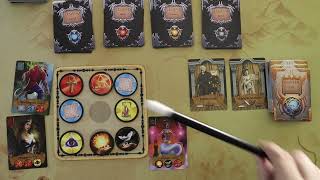
- Masters cards are in order from Act I to Act III in this video, but those are supposed to be all shuffled at the beginning.
References (from this video)

Mechanics (from transcript analysis)
Video topics + discussion points
Quotes (from this video)
References (from this video)
- A lot of fun
- Engaging pattern placement
- Variety in recipes
- High replayability
- Interesting choice between ingredients and money
- Fun employee variety
- Malfunctions add a cool element
- More exciting and nuanced than Conservas
- Can lead to analysis paralysis
- Malfunctions can be random and potentially annoying
- Achieving gourmet victory is difficult
- preparing and serving pastries
- running a pastry shop
- Conservas
- Bullet
Mechanics (from transcript analysis)
- Folding — Players physically fold sheets to create different recipe shapes.
- polyomino placement — Players place polyomino tokens on folded sheets to fulfill customer orders.
- Push Your Luck — Deciding whether to take ingredients or money, and whether to repair equipment or risk a malfunction.
- Resource Management — Players manage money to pay employees and repair equipment, and manage ingredient tokens.
- scenario-based play — The game is played through different recipes/scenarios with unique rules and objectives.
- Set Collection — Players collect ingredient tokens and use them to match customer desires.
- Worker placement (implied) — Hiring and paying employees with special abilities suggests a form of worker management or influence.
Video topics + discussion points
Quotes (from this video)
- I take no money from publishers for my previews. I just want to show off the game so you can make an informed decision.
- It's a chaotic week while you train a lot of new employees, and the busy season has started.
- The idea is that you are not just actually like doing the folding to make it fit the right shape, but you're also trying to look at your customers and make sure you have as many of their icons available as possible so you can start feeding them.
- I don't know. I don't think I'm playing great here.
- I really don't want that to go negative, so I'll spend four, unfortunately, but I get to get a size four token of my choice.
- The nice thing about the final round is you don't have to get any ingredients. They do nothing for you. It's all about the money money money.
- Probably the worst thing I have to say about it is that it can lead to a lot of analysis paralysis.
References (from this video)
- Abstract yet tactile and satisfying
- Short, teachable, good for quick sessions
- Expandable for more players
- Not as widely discussed or promoted
- Theme may feel minimal to some players
- Abstract strategy around surrounding walls to score points
- Medieval fortress-building theme
- Minimal narrative; focus on puzzle-like placement of castle pieces
Mechanics (from transcript analysis)
- Area Control — Score based on the number of surrounded squares and internal turrets
- area control / scoring by enclosure — Score based on the number of surrounded squares and internal turrets
- expansion-enabled player count — A second pack allows play up to four players
- Tile Placement — Place tiles to form squares; fully enclosing yields scoring opportunities
- tile placement and enclosure — Place tiles to form squares; fully enclosing yields scoring opportunities
- tile-drafting / card drafting — Draw castle-section tiles that depict walls, turrets, and other features
Video topics + discussion points
Quotes (from this video)
- five hidden gems inside my collection
- the art style is amazing the cute animals and creatures
- this is a dungeon crawling rolling right game
- that one extra roll I need to beat him and take his final Health down and defeat him
- it's a very interesting little game
References (from this video)
- It's reminiscent of the old pen and paper dot and line game.
- It offers strategic depth with decisions about how to use cards and pieces.
- The ability to merge sets for more players is a good feature.
- It's a great two-player game with different strategies that work at different times.
- You could be potentially leaving opportunities for your opponent.
- You might have to pass pieces to the next person if you can't use them.
- The red and blue set includes rulebooks in multiple languages which might not be needed if you only speak English.
- Dot and Line
Mechanics (from transcript analysis)
- area enclosure — The primary goal is to play cards to enclose areas on the board, which can be of any size and configuration as long as they have 90-degree angles.
- Hand Management — Players manage a hand of four cards, which represent their resources, and must play at least one card per turn. Playing cards generates building pieces.
- Modular Board — Multiple sets can be combined to create larger games for more players.
- Resource Management — Players must use every piece they generate. If they cannot, they must pass it to the next player, potentially creating opportunities for opponents.
- scoring — Score is equal to the number of towers that touch an area surrounding one of your keeps. Players can choose to double score an area once per game by placing two keeps.
- Set Collection — Players draw cards from either a wall deck or a tower deck, with each card in the wall deck having at least one wall, and each in the tower deck having at least one tower.
Video topics + discussion points
Quotes (from this video)
- hi welcome to gts distributions come and play day here in seattle
- i've been joined by randy from steve jackson games
- this looks like it's a little a little more advanced than that though
- you have to use every piece you generate if for some reason you can't use it you have to pass it to the next person and they'll be forced to
- so this is a whole other layer then okay
- this is this is a two-player game here that we're looking at
- the length of the game will increase just because there's more time in before you play again
- there are only three of these spread throughout the two decks
- for any of the steve jackson games products uh you can go to sjgames.com
- for this specific game you could go to costellon c-a-s-t-e-l-l-a-n dot sjgames.com
References (from this video)
Mechanics (from transcript analysis)
Video topics + discussion points
Quotes (from this video)
- this is not meant to be just a token bang fact I think yeah I'm pretty sure I think this is meant to be a hat
- it's definitely a hat and that's why on Twitter I posted recently this picture and my good friend Marty canal from the rolling dice of taking his podcast agreed that it was a swamp fashion choice
- take a picture of yourself wearing your new fancy castel chapeau and post it to Twitter with the hashtag Castel Fez contest
References (from this video)
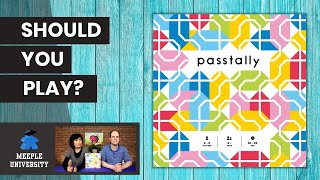
- Simple rules allow players to focus on strategy
- Balanced action point system with two actions per turn
- High-quality, thick components; pastel aesthetics
- Effective catch-up mechanic preventing runaway scores
- Direct two-player tension and the ability to block opponents
- Clear end conditions that avoid runaway scoring
- Rotation elements add cognitive load and require mental rotation
- Time pressure from a timer can induce AP (action point) stress
- Maintaining balance by not leaving matching heights for opponents can be frustrating
- Connecting colored dots through tile placement to form paths
- Abstract, pastel-colored aesthetic with no explicit theme or setting
- Abstract puzzle-like presentation without a story
- Photosynthesis
Mechanics (from transcript analysis)
- Action Timer — A timer option can be used to impose 60 seconds per turn and increase pressure.
- end_condition — Game ends when a stack of tiles is exhausted, there is no legal placement, or someone reaches 50 points.
- Limited Resource Pool — There are always three tiles available; when this supply is exhausted, players get one more turn.
- passing_and_scoring_conversion — Passes are tallied and then converted into victory points via a scoring table.
- scoring_passes — Players score by counting passes through connected tiles; the number of passes is tied to the height of tiles.
- tile_height_and_connections — Connections between tiles of various heights contribute to the total passes counted.
- tile_laying — Players place a tile onto the board on their turn.
- tile_rotation — Some tiles can rotate, adding complexity and requiring players to rotate or reposition tiles.
- tile_supply — There are always three tiles available; when this supply is exhausted, players get one more turn.
- Tile/Map Shifting — Some tiles can rotate, adding complexity and requiring players to rotate or reposition tiles.
- timer — A timer option can be used to impose 60 seconds per turn and increase pressure.
- token_movement — Players move one of their tokens up to two spaces around the board, skipping over other players.
Video topics + discussion points
Quotes (from this video)
- Pastali is a tile laying and fast changing route building game
- It's an abstract game
- This is actually quite cute
- It's a filler for us
- It's a race to 50
References (from this video)

- solo-focused
- cozy theme
- cakes, recipes, and customers
- pastry shop; solo-friendly
Mechanics (from transcript analysis)
- Grid coverage — grid-based ingredient/recipe placement
- Solitaire — single-player emphasis
- Tile Placement — placing tiles to complete recipes and shops
Video topics + discussion points
Quotes (from this video)
- Stem and Branch is in a different language here on the box.
- Three Sisters the Harvest Edition includes a solo campaign, which I am so excited about.
- Compania is a very cool game where you are placing out your workers and revealing behind a screen.
References (from this video)
- Valyria universe appeal; established setting
- Accessible core mechanics with thematic depth
- Part of a broader universe; familiarity may affect enthusiasm
- area control / dice-rolling with variable powers
- Valyria universe
- unfolding quest within a shared universe
- Valyria games
Mechanics (from transcript analysis)
- Area Control — control of regions on a map
- Dice Rolling — dice-driven actions and outcomes
Video topics + discussion points
Quotes (from this video)
- It's 2026 now, which means it's time for that thing that I like to do every single year
- I want to play 30 of the 35 games I set out for myself
- Three games a month would make it doable
References (from this video)

- Chaotic and fun with six players
- Strong two-player variant
- Blue box line feels less supported over time
- Area control via card placement
- Medieval fort-building / castle construction
- Chaotic, highly interactive
Mechanics (from transcript analysis)
- Area Control — Players place cards to claim areas; cards can be forced back to hand
- Card placement / area control — Players place cards to claim areas; cards can be forced back to hand
- take-that / disruption — Actions can force opponents to discard or alter board state
Video topics + discussion points
Quotes (from this video)
- "The concept of jumping out at the right moment, I think it's amusing"
- "Doom was the precursor. Doom the board game, which was 83 for me in 2005, fell off the list instantly"
- "Waterfall Park has better components. It's brighter"
- "It's a very strategic, very fun game"
References (from this video)
- Elegant tile-laying mechanic
- Flexible for mixed player counts
- Can be cognitively dense for new players
- tile-laying and area control
- Castle-building theme
Mechanics (from transcript analysis)
- Tile Placement — Players build up a castle using available tiles; strategic placement matters
- Tile placement with modular components — Players build up a castle using available tiles; strategic placement matters
Video topics + discussion points
Quotes (from this video)
- Skyrockets is a Cooperative game for two to five players
- two different colors on them and those colors represent the sand timers
- This is a real-time game where you will be playing through a bunch of different scenarios
- I love collecting coffee games
- I grabbed four different onverse games for 10 15 20 25 bucks what amazing
References (from this video)

Mechanics (from transcript analysis)
Video topics + discussion points
Quotes (from this video)
- this would have absolutely blown our minds
- Gloomhaven would have been an absolute joyous experience
- HeroScape would have been just an absolute dream as a kid
- we would have salivated over and been obsessed with salivating little munchkins back in middle school
- If we had Aeon's End as kids, it would have eaten up so much of our time