






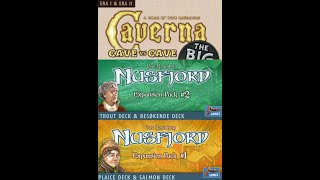



Caverna: Cave vs Cave Deep Dive
What the Community Thinks About Caverna: Cave vs Cave
Caverna: Cave vs Cave is a two-player condensation of Uwe Rosenberg's Caverna. Phil of Board Game Doctor describes it as a game of resource tracking, resource conversion, and tableau building with tiles, one that keeps the look and some of the feel of the original. Nick of Murf Brothers calls it by far the favorite among the two-player only versions of Rosenberg's games, placing it near the top of the two-player ranking. Johannes on Board Gaming Ramblings is less enthusiastic, calling it a fun, solid game, but saying there is no need to play it again and that the expansion made the session a bit too long. Jon Chong on Jon Gets Games defends it as a good game played several times, though Jon Chong removed the copy from the collection because the main two-player partner did not enjoy it. An unboxing on Watch Review concentrates on the components and how the box is put together.
The reception splits along a familiar line. Fans of the original value the excavation and the unknown order of actions. Critics feel the design gives up some pressure and depth in exchange for a smaller box and a shorter session.
Core Mechanics That Define Caverna: Cave vs Cave
Resource Conversion and Tableau Building
Phil describes the basic loop as gaining resources through actions and then spending them on buildings. What keeps the loop interesting, in Phil's telling, is that buildings interact with one another. Some award points, others let you convert resources at any time, and the combinations change from game to game. Era 2 adds donkeys and weapons to the resource mix, and Phil notes that donkeys can reproduce, which gives them a role beyond simple stock. The unboxing reviewer, by contrast, focuses on physical tracking. The goods sit on a pantry shelf, and the wooden pieces are sparing, a deliberate change from the heavy wood of the original.
Action Selection With Tile Blocking
Action selection keeps the structure of the original without much added paperwork. In Era 1, players take two actions in the first phase and three in the second, choosing from action tiles that come out during play. Phil highlights the way a claimed tile slides onto your side of the table, which removes it from your opponent's options. Phil argues that the designers kept this mechanism simple rather than burying it under extra rules, and that it makes the game easy to teach while still forcing hard choices about which action to take first.
The Caverna: Cave vs Cave Experience
Each Game Unfolds Differently
The most praised quality is uncertainty. Nick of Murf Brothers says the excavating and "the not knowing where stuff is" are highlights, calling the unknown order of actions one of the favorite parts of the original, now delivered in a smaller package. Phil finds the discovery of buildings in Era 1 enjoyable for the same reason. The buildings emerge in an order nobody controls, and that changes how players plan their food and their points from one game to the next.
Short Sessions Without the Sprawl
Murf Brothers call the game very short, with a playing time of about 45 minutes. Phil, citing comments on BoardGameGeek, gives a similar figure and notes that the Era 2 setup is quick, estimating that Era 1 with a teach took roughly an hour, the right length in Phil's view for a one versus one game. Phil also played the game solo and enjoyed it that way, which gives the box a use beyond head-to-head play.
What Makes Caverna: Cave vs Cave Stand Out
Excavation
Excavation is the signature feature. Buildings start face down in each player's cave, and players dig them out by taking the right actions. Once revealed, a building goes into a shared pool that either player may build from. Phil calls the mechanism very unique to the game, and says players can draft tiles to plan a route through their cave before digging out the buildings they want first. Nick of Murf Brothers credits the same mechanic with capturing the favorite part of the original.
A Spatial Puzzle in Two Players
Phil is particularly happy with the wall puzzle. Some buildings require walls around them, others require walls to be adjacent to other walls, and some have no such constraint. Phil points out that this kind of spatial puzzle appears in designs such as Orani, and is pleased to see it carried into a two-player Rosenberg game. The result is a tableau where the placement of walls matters as much as the buildings themselves.
Potential Drawbacks
Era 2 Can Feel Long and Scripted
Era 2 is the most divisive element. It adds a fourth action in each round, and Phil reports that it adds about twelve more actions, which comments Phil has read say can roughly double the playing time. Phil also says the Era 2 buildings lose the surprise of Era 1. Some players found the expansion more scripted, because the buildings no longer arrive in a fresh order. Phil admits to not having fully played Era 2, having stopped after Era 1 on the most recent game, so the assessment relies partly on other players. Johannes reached the same conclusion independently: the expansion makes the game a bit too long.
Watered Down Feel and a Clunky Weapon System
Phil reads critics on BoardGameGeek who describe the game as a watered down version of Caverna that is still fun and engaging but lacks real pressure. Those critics also consider the big box too large for its contents. The unboxing reviewer disliked the weapon system, which hands out a large pile of chits for upgrading dwarves. Digging through the chits to find the right one for a particular upgrade was, in the reviewer's words, not great.
If You Enjoy Caverna: Cave vs Cave
Players who enjoy the excavation and resource conversion will find the original Caverna the natural next step. Phil notes that the look and feel carry over, and the full game restores the farming, animals, and expedition layers that this version cuts. Players drawn to the farming economy in Phil's comparison will also find a kindred spirit in Agricola, since Phil links Caverna's farming mechanisms to it. For the wall-based spatial side, Orani uses the same kind of adjacency that Phil praises. Finally, Patchwork is one of the Rosenberg designs Phil plans to compare with this game in a future episode, which makes it a useful next stop for anyone exploring the two-player line.
What Reviewers Are Saying
"Cave versus cave is mostly a resource tracking, resource conversion, and tableau building with tiles type of game that has the look and some of the feel of the original Caverna."
— Board Game Doctor
"I like the excavating. I like the not knowing where stuff is. I like the part of Kverna of not knowing what actions are going to come out in what order. I really enjoy that you're doing one of my favorite parts of Kverna again in a smaller, easier to play, much quicker package that's really fun."
— Murf Brothers
"It distills down the caverna into a nice concise package. Honestly, it's a good game. I quite enjoyed the game, I played it several times."
— Jon Gets Games