/pic5598833.jpg)






























Caverna: The Cave Farmers Deep Dive
What the Community Thinks About Caverna: The Cave Farmers
The boardgame community views Caverna as a masterclass in worker placement design with compelling sandbox-like freedom. Reviewers consistently praise it as a game that captures both the precision of euro mechanics and the thematic immersion of farming, cave exploration, and dwarven adventure. While some purists maintain loyalty to Agricola, Caverna has earned respect as a meaningful evolution that reduces certain frustrations while introducing fresh strategic depth through its cave-building and expedition systems.
Core Mechanics That Define Caverna: The Cave Farmers
Worker Placement with Farming and Mining
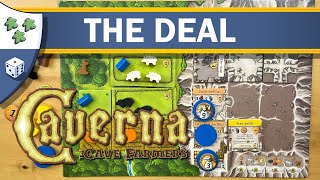
At its heart, Caverna is a worker placement game played over 12 rounds (11 in 2-player games) where players expand their dwarf families and manage two distinct regions: a farm for crops and animals, and a mountain cave system. Each round, players take turns placing workers on shared action spaces to gather resources, excavate caves, construct dwellings, and pursue expeditions. The game's elegance lies in how these two territories create meaningful decision-making, as players must balance developing their forest with crops and animals against building out their mountain region for points and special abilities.
Expeditions and Weapons System
One of Caverna's defining innovations is the expedition system, which fundamentally changes how players interact with the board compared to Agricola. By spending ore at the blacksmith, players forge weapons of increasing strength. These weapons enable expeditions where dwarves venture out to gather specialized loot—animals, crops, rubies, and building materials—based on the expedition's level and the dwarf's weapon strength. This creates engaging tactical layers where players must decide when to invest in weapon upgrades and which expeditions to pursue, adding adventure and resource discovery to the farming simulation.
The Caverna: The Cave Farmers Experience
Building Your Dwarf Family's Legacy
Caverna excels at creating an immersive sandbox where each player carves their own path. Whether focusing on growing sprawling crop fields, breeding large herds of sheep and cattle, or constructing elaborate cave systems with specialized rooms, players feel genuine agency. The wish for children mechanic—where dwarves simply wish for new family members who appear on the board—adds charming thematic flavor without complexity. Players can pursue animal husbandry where careful breeding multiplies herds, feed their growing families through diverse crop systems, and unlock sophisticated combos through furnishings that provide special abilities and victory points.
Tension Between Expansion and Optimization
The game brilliantly balances exploration with constraint. Players must excavate their cave network to reveal bonuses and create space for dwellings, yet excavation requires action economy. Meanwhile, food production demands constant attention—failing to feed the family forces begging markers that reduce final points. This tension creates memorable moments where players make painful choices about whether to expand their family, deepen their mines, or ensure adequate harvests. By late game, successful players have transformed bare mountain regions into thriving settlements with multiple working systems reinforcing each other.
What Makes Caverna: The Cave Farmers Stand Out
Sandbox Freedom Within Euro Structure
Unlike many euro games that penalize deviation from optimal strategies, Caverna's scoring system rewards diverse paths. While neglecting any resource type entirely results in negative points, players genuinely can focus on animal husbandry, crop cultivation, or cave development without feeling forced into a single winning formula. This sandbox quality separates it from denser optimization puzzles—there's an element of personal expression as each player builds a unique underground civilization. The game respects unconventional strategies, allowing players to feel that their farm is truly their own creation rather than a puzzle with a single solution.
Thematic Coherence and Narrative Depth
Caverna maintains exceptional thematic consistency where mechanics reinforce narrative. Mining ore literally strengthens your dwarves' tools. Building stables in forests grants access to wild boars and donkeys. Constructing furnishings like the milking parlor or weaving room directly supports feeding your family while providing points. The theme isn't window dressing but deeply embedded in how the game functions. Rooms have personality—the cuddle room holds many sheep because sheep are great to cuddle—adding moments of whimsy to the serious economic engine. This creates a hybrid experience where hardcore euro gamers appreciate the mechanical depth while narrative-focused players feel transported into managing a thriving dwarf settlement.
Potential Drawbacks
Complexity and Learning Curve
Caverna presents significant rules overhead that can intimidate new players. The animal husbandry system alone—with distinct placement rules for pastures, stables, fenced areas, and unfenced spaces—requires careful study. Newcomers must understand how dogs enable sheep herding, how mines accommodate donkeys, and why some animals prefer certain dwellings. The furnishing tiles number in the dozens, each providing unique bonuses. While experienced players navigate this intuitively, the game demands patience during teaching and early plays. Initial sessions often involve frequent rulebook consultation, which can slow momentum and frustrate groups seeking lighter experiences.
Playtime and Player Scaling Issues
While Caverna supports up to seven players, higher player counts significantly extend play duration. Published at 30 minutes per player, a seven-player game can stretch toward three hours with analytical groups, straining attention and energy. The two-player game performs admirably through dedicated rules, yet the base game architecture creates more downtime at higher counts as players wait for turns in distant positions. Additionally, the game's complexity becomes more pronounced with more players, as teaching and execution slow considerably. Players seeking quick gaming experiences or regular large groups may find Caverna demands commitment that doesn't reward hastily played sessions.
If You Enjoy Caverna: The Cave Farmers
Players who love Caverna should explore Agricola, the original design that pioneered many mechanics here. While Agricola's feeding pressure feels more intense and its scoring more restrictive, both games share Uwe Rosenberg's elegant design philosophy and deep satisfaction of watching a bare board transform into a thriving farm. Farmers of the Moor, another Rosenberg creation, offers similar themes with different mechanisms including renting farmland. For those seeking worker placement with thematic depth, Viticulture delivers wine-making satisfaction where the production process—planting, harvesting, aging, selling—feels thematically coherent. Brass: Birmingham provides that engaging euro density with limited actions forcing opportunistic play rather than perfect planning, while Paladins of the West Kingdom combines engine building with thoughtful worker placement mechanics.
What Reviewers Are Saying
"This one does a really good mix of visiting the town where you get to stock up on your villagers and your animal transport before you can then go on an adventure and try and go as far as you can. There's a sandbox-ish feel to this euro game which not a whole lot of euro games do. I can either be the person going after growing my crops or maybe I'm just gonna hunt a bunch of sheep and things like that, and it's really cool where you could do that or maybe you can just focus on your cavern."
— Our Family Plays Games
"Caverna is a game that's probably the biggest benefit is its flexibility in scoring where you're not really heavily penalized for doing so, but you also introduce a fixed amount of buildings that you try to pursue. It creates more of a chess-like experience compared to Agricola. What carries Caverna for me is one, the mechanisms being very similar to my favorite game of all time, but two, the fact that this has some expansions that really make this game feel different in terms of adding character."
— The Board Gaming Doctor
"This is a sandbox-ish Euro game because Agricola was very much about having everything, this one does not penalize you as much so you can kind of do what you want in this game. You can feel like yes, I am making my farm, I'm making my cavern, I might be going out on quests to make my dwarves into warriors, and I find that to be super cool while also being a really nice puzzle."
— Room 51: Non-Binary Gaming