/pic1367245.jpg)
In the mountain there are veins of precious stones. The players build tunnels in the mountain, establish stations in the mountain and in the city, discover veins of precious stones, acquire precious stones, and sell them. The players get points for stations in the city and for selling precious stones. The winner is the player with the most points.
Game Summary
The board is a hex grid, with city spaces along most of the edges. The center hex is a vein of yellow gems: place all 9 in a stack there. The rest of the gems go in their individual market areas (priced 1-9 based on supply).Each round (3 in game), add 5 contracts (showing gem combinations; score big VP if completing them; lose some VP if cannot) to the display. Then auction (using VP) turn order chips 1-4. Players then each get the same set of tiles (hexes with various numbers of track exits, prospecting tiles, veins, option tiles, etc.) plus a dynamite hex based on their turn order chip. Take turns taking contracts until everyone passes.
Then, on your turn, play 1-4 of your 12 actions. These allow you to place tracks (expanding previous tunnels; you can also cover track tiles with tiles having more exits), stations, or veins (which you supply with gems of your choice). Gems (6 types, 9 tokens each) each have their own market where they are stored and which set their max sell price. The last action is prospecting, where you create a path from one of your stations to another, passing through as many veins as possible: take one gem from each vein.
After everyone's 12 actions are used, any exposed dynamite tracks explode and take the adjacent tracks as well (all these are placed in the Buy Pool, which can be accessed by turning in Option tiles)! You score for stations in cities based on the number of empty hexes. Then, for each gem type, players bid (Dutch auction style, bidding for the lowest price they'll accept) and may sell their gems for VP at their bid price.
At game end (after 3 rounds), players sell off all their remaining gems (with lowest VP selling next gem), there's another city scoring, and players lose VP for incomplete orders. Most VP wins!


- A lot of strategy involved
- Really fun blocking others from getting their gems
- Great player interaction
- Good rule book examples, well-written
- Nice production
- Not much randomness, all about skills
- Don't like the town scoring element
- Town scoring is easy points, some players can just focus on that instead of gems to win
- Mining for gems
- Mountains and surrounding towns
Mechanics (from transcript analysis)
- Action Point Allowance — Players can do one to four actions on their board during the action phase.
- action selection — Players use action tokens on their board to perform actions, choosing one to four actions per turn.
- Area Control — Placing factories in towns and connecting them to factories in the mountain scores points.
- bidding — Players bid victory points to determine turn order and also bid on selling gems.
- Push Your Luck — Bidding on selling gems where players can sell for lower points if others also have the gem.
- Set Collection — Players collect gems from veins to fulfill order cards.
- Tile Placement — Players place tunnel tiles to build tunnels, and can place a tunnel tile on top of another as long as the new tile has more exits.
Video topics + discussion points
Quotes (from this video)
- If you rearrange the letters you can come up with vacuum.
- Cav is a tile game that evolves a lot of strategy.
- The dynamite token will explode at the end of the round taking with it all the empty tunnel tokens surrounding it.
- We're giving a 6.5 on 10
References (from this video)
- New expansion adds pets and companions
- Frog companion has an interesting risk/reward mechanic
- Expansion was not needed but wanted
- Journey with companions
Mechanics (from transcript analysis)
- Companion pets — Adds pets and companions to the game, including a giant frog.
- Resource Management — The frog's potential to eat carried items implies a need to manage its needs.
Video topics + discussion points
Quotes (from this video)
- It was a 7 and 1/2 hour game day, and I played 10 games while during that time. And there was one group that played this game World Order that played That's all they played.
- The frog can give it and the frog can take it away.
- This is we really worked on like the rules, the reference card, the packaging, the card design, every single element to make it as onboarding friendly and player friendly as possible.
- So, I went online and I picked up this, which is the Spin Master release of the CMON DC Super Heroes United Batman Hush.
- I just remember solving puzzles in my head and just like the thrill of like knowing that I was figuring stuff out, not even winning or losing. Just the thrill of knowing, 'Oh wow, I can figure this out. I can suss this out.'
- It's a beautiful game.
- It's like the drawer of no touchies, which again sounds very inappropriate
References (from this video)

Mechanics (from transcript analysis)
Video topics + discussion points
Quotes (from this video)
- We're playing a game with famous people.
- The assassin... If you guess the assassin, your team loses instantly.
- This is Code Names giant here just for fun.
- Boom. Boom.
- I think magnifying glass is the clue.
- Okay, let's hold up for that and she will help us.
References (from this video)
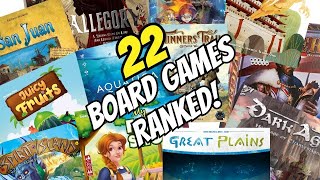
- tight pacing, 40-minute playtime
- elegant abstract design
- requires careful pacing and planning
- area control with set-collection bonuses
- Ancient trading/majority control in bowls
- elegant abstraction
- Santorini (area-control abstraction)
Mechanics (from transcript analysis)
- area majority with row/column scoring — End up with rows/columns of symbols for higher scoring multipliers.
- endgame risk and Sabotage — Spots may be sabotaged by opponents using their colors to lower points.
Video topics + discussion points
Quotes (from this video)
- this was definitely the hardest to rank these games
- none of these games I thought were bad this month
- this is an absolute delight
- ultra smooth ultra fun
- this is a thinky filler game with a great weight and repercussions
- you can teach this one in 30 seconds
- very elegant and easy to teach
- the elegance of the system is amazing
- I'm absolutely hit for me
References (from this video)
- interaction is strong and meaningful
- concise 30-minute game with depth
- board interaction can be tight to grasp for some players
- tile placement and area scoring
- puzzly grid-building with color lines
- abstract strategy with interaction
- Agricola: All Creatures Big and Small (control via placement)
Mechanics (from transcript analysis)
- area scoring and blocking — adjust lines to maximize own points while hindering opponents
- Set collection bonuses — line/column ownership grants bonuses
- tile placement with color ownership — place tiles to form lines/columns of your color
Video topics + discussion points
Quotes (from this video)
- this is an absolute masterpiece this game is
- this is like the best game ever made
- it's a real cool idea a really cool concept
- when you get the right cards together, it can be fantastic
- the more you play it the better it becomes