/pic2869714.jpg)






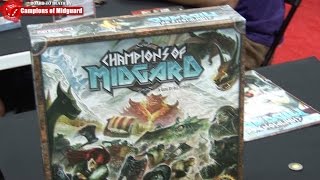
















Champions of Midgard Deep Dive
What the Community Thinks About Champions of Midgard
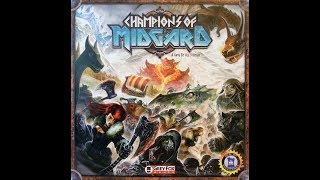
Reception across the community skews strongly positive. Reviewers repeatedly return to the same throughline: a worker placement game wrapped in Viking raiding and monster hunting, resolved with dice, that stays approachable while still offering real decisions. All You Can Board frames it as a natural bridge for newer players moving from lighter worker placement games toward heavier fare, pointing to how it teaches risk assessment for contested spots before tackling something like Feast for Odin. The Flip Side ranked it highly on their all-time list two years running, calling it a favorite Viking game and pointing to how much the Valhalla expansion adds to it. The Dice Tower folded it into a mythology-themed list and enjoyed it enough to rank it there, though they were more skeptical of how much actual mythology comes through on the base board. Actualol took the most conflicted position: going in hoping for a historically grounded Viking game, disappointed to find fantasy creatures layered over it, then won over anyway by how thoroughly every action still ties back to the Viking setting.
Core Mechanics That Define Champions of Midgard
Worker Placement in a Viking Harbor Town
Worker placement forms the game's backbone. Actualol describes it plainly: players take turns placing a worker on a spot and completing that action, and because a spot can only be used once per round, it becomes a race to grab what you want before someone else does. All You Can Board highlights how the town itself pressures those choices: certain locations, like the troll's lair, can only be visited by one player each round, and if nobody goes there the whole table gets penalized because the town suffers for it. That shared consequence, alongside the more ordinary contest for food, warriors, and building materials, is part of why All You Can Board describes the spots here as more intimidating than in lighter worker placement games, especially once expansions add even more of them to track.
Dice-Driven Combat
Combat runs entirely on custom dice. Actualol explains that the warriors recruited are represented by dice split into three tiers, a weak swordsman, a sturdier spearman, and a brutal axeman, so building an army means choosing between fielding large numbers of cheap fighters or a smaller handful of stronger ones. When a group sails off to fight, the dice are rolled together and the result determines whether there are enough hit points to bring down the monster. The Flip Side describes the same system from the player's seat: every warrior taken is a die, and when it comes time to fight, those dice get thrown at monsters like trolls and draugr, with shield results potentially saving a warrior's life and sword or axe results simply doing damage. Losses are expected, whether the fight is ultimately won or lost.
The Champions of Midgard Experience
Fast, Approachable Play
Actualol singles out pacing as one of the game's biggest strengths, noting that the randomness of the dice helps rather than hurts the flow: it keeps the game from becoming a session of careful mental arithmetic, since the dice force players to take chances instead of calculating everything perfectly. That, combined with a limited set of worker placement options that never leaves anyone feeling stuck, gives the game a quick pace that Actualol calls a happy medium between something simple enough for new players and interesting enough to hold everyone's attention. All You Can Board reaches a similar conclusion from the other direction, describing it as a step up in complexity from lighter worker placement games without becoming overwhelming.
Weighing Risk Against Reward
Every trip to fight a monster is a gamble that reviewers keep coming back to. Actualol frames it as a choice between committing a large group to guarantee a win or sending a single warrior who might die but could also sneak out a victory, with favor tokens available to reroll and soften the worst outcomes; sea voyages add another layer, since a journey card can mean smooth sailing or a fight with something like the Kraken along the way. All You Can Board points out how punishing a failed attempt can be: if the dice do not cooperate, every resource and worker spent getting a group to that fight is lost along with the fight itself. The Flip Side offers its own cautionary tale on the same theme, warning newer players against sending a group after one of the tougher monsters on their very first turn, after doing exactly that cost them an entire game.
What Makes Champions of Midgard Stand Out
Theme Woven Into Every Action
Actualol repeatedly comes back to how consistently the mechanics reinforce the setting. Every action ties back to the theme: recruiting Viking warriors represented by dice, gathering wood to build the longships that carry them overseas, and making sure those warriors have enough food for the journey before they leave. That thematic integration, paired with artwork and production Actualol calls impressive, is credited with elevating the game above other similar worker placement titles, with the dice, the blame mechanic, and the journey system singled out as the elements that make the whole package worth attention.
The Valhalla Expansion
Multiple reviewers single out the Valhalla expansion as the game's biggest improvement. The Flip Side explains that it gives warriors who die in battle a purpose, turning them into tokens that can be spent on new benefits rather than simply removing them from play, and adds archers, shield maidens, and berserkers to recruit. The Dice Tower agrees that the expansion deepens the mythology on display, adding giant creatures to fight and even letting fallen warriors be called on to help take them down. Both channels describe the change in similar terms: an outcome that would otherwise feel like a setback, a warrior dying in battle, becomes something a player can turn to their advantage instead.
Potential Drawbacks
Dice Randomness Isn't for Everyone
The reliance on dice for combat is the clearest fault line. Actualol acknowledges upfront that rolling dice means luck is involved, and some players will not like the game for that reason, even though favor tokens exist to reroll and soften bad results. That same randomness Actualol credits with keeping the pace brisk is, for players who prefer tightly deterministic optimization, exactly what makes the game feel like it is taking decisions out of their hands at the moment that matters most, when warriors are sent off to fight and their fate comes down to a die roll.
A Theme That Doesn't Always Land
Not every reviewer connects with the theme in the same way. Actualol went in wanting a Viking game grounded in real history and was disappointed to find trolls and other mythological creatures layered over it instead of the raids and conquests Vikings actually carried out. The Dice Tower raises a related but separate complaint about presentation: despite drawing on Norse mythology as a subject, the base game's board is not particularly evocative of that mythology on its own, with the deeper thematic material only really arriving once the Valhalla expansion is added to the table.
If You Enjoy Champions of Midgard
Feast for Odin is the clearest recommendation, drawn directly from All You Can Board's own path through the hobby. They use Champions of Midgard as a stepping stone toward it, pointing to the shared Viking theme, the overlapping use of worker placement and dice, and the way both games gradually hand players more to do as play goes on. Learning to weigh a risky sea voyage or a contested troll fight here, they suggest, prepares players for the bigger, more demanding version of those same tensions waiting in Feast for Odin.
What Reviewers Are Saying
"What makes Champions of Midgard unique is its Viking warrior dice. At the end of a round where you've chosen to fight a monster, you send your Viking warriors off to battle to fight the monster. You roll your dice and see if you get enough hit points to defeat it."
— Actualol
"A lot of the dice rolling comes into play in these games where you can go to a spot when you're not too well equipped and think, hey, maybe I can get by and win that battle or achieve that goal without having to stock up more. And then you roll those dice and you fail, and you realize I should have taken one or two more turns to collect some more resource or get some more fighter swordsmen."
— All You Can Board
"Let's go fight some ogres. Let's go fight some trolls. Let's go fight some Leviathans. You're not really getting mythology from that board."
— The Dice Tower