






Chronicles of Avel Deep Dive
What the Community Thinks About Chronicles of Avel
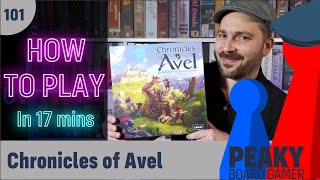
Reviewers consistently present Chronicles of Avel as a cooperative game that works for families while still rewarding experienced players. Designed by Przemek Wojtkowiak and published by Rebel Studio, it casts players as heroes answering the call of Queen Sarisa, who needs them to protect the Healing Jewel from a monstrous Beast. Peaky Boardgamer frames it as a family game that plays in under an hour for up to four players, pointing to its story, its world, and its simplified mechanics as reasons children engage with it while older players still feel the excitement. Board Game Sanctuary goes further in praising its depth, and its host admits to having lost nearly every game they have played, which signals that the challenge is real.
Opinions diverge mainly on how original the game feels. Grant's Game Rex places it just below Castle Panic in weight and says it does not reinvent the genre, but argues that its pieces fit together so well that it is simply fun to play. Rolls in the Family takes a warmer view, calling it a personal favorite among the family's children's games and comparing its progression to Mage Knight. Get into games, a podcast hosted by Craig, discusses it as a strong pick for children learning to cooperate, and Your Nerd Shelves ranks it at number 46 on its list of the top 100 board games.
Core Mechanics That Define Chronicles of Avel
Dice Combat and Equipment Management
Combat is the centerpiece of play. Reviewers describe a battle as up to three clashes in which the hero rolls colored dice against a monster's attack and defense faces, and the player may withdraw without penalty between clashes. Equipment modifies those dice. Weapons and shields add dice or grant one-time effects, and potions can be consumed for an extra magic die, which functions as a wild result. Peaky Boardgamer explains that equipment is drawn blind from a cloth bag, so players must feel the distinctive shapes to find the item they need. Board Game Sanctuary highlights the tension this creates, because equipment that is used in a clash is exhausted, forcing players to decide when to commit their dice. This is a mechanic derived directly from the reviews, since the community reference for the game's mechanics does not match its cooperative fantasy combat system.
The Astrolabe Clock and the Beast
Time pressure is driven by the Astrolabe marker, which advances after each full round. Peaky Boardgamer describes how each player may take up to two actions per turn, choosing among moving, battling, using a tile action, or resting, and how a single monster entering the city ends the game for everyone. When the marker reaches its final space, the Beast is summoned, all remaining tiles flip, and monsters begin marching toward the city. Rolls in the Family describes this arc as the core of the design: players explore freely in the first half and then make a final stand in the second half, which they believe gives the game a satisfying shape. Designed by Przemek Wojtkowiak, the timing structure lets the game move from exploration to a tower-defense style defense without changing rules.
The Chronicles of Avel Experience
Adventure
Most reviewers describe the early game as a journey into unknown territory. The board is built from hexagonal tiles that remain face down until a hero enters them, so each session reveals new terrain and new threats. Board Game Sanctuary says the first half of the game feels like exploring across the land, uncovering tiles and locations to prepare for what comes next. Rolls in the Family adds that the face-down tiles create a sense of discovery, with players constantly deciding which corners of the map are worth the risk.
Collaborative Tension
The cooperative structure gives the game a shared sense of urgency. Board Game Sanctuary calls the second phase a tense experience of holding the fort, where players must fight with their wits in a defensive struggle to protect the kingdom. Rolls in the Family describes the endgame as a co-op last stand, comparable to the closing rounds of Mage Knight, where the group must be strong enough to face the Beast together. The reviewers agree that the tension comes from planning as a group, since traps, walls, and moon seals purchased earlier in the game determine how the final phase unfolds.
What Makes Chronicles of Avel Stand Out
Character Building and Customization
Reviewers repeatedly praise the way players shape their own heroes. Peaky Boardgamer notes that players can name their hero, draw silhouettes, create a banner, and color their character sheet, which makes the game feel personal from the first session. Board Game Sanctuary highlights the ability to create and customize a character and upgrade them with weapons and armor, along with the flat cardboard backpack in which items must physically fit. Grant's Game Rex describes the progression as satisfying because players physically place items on their character, such as a helmet or a weapon, and watch the hero grow stronger.
A Replayable Board and Tactile Equipment
Because the hexagonal board is assembled differently each time, reviewers argue that no two sessions look the same. Grant's Game Rex points out that the board changes from game to game and that different monsters appear, which keeps the experience fresh. The equipment bag adds a physical layer to that variety. Peaky Boardgamer shows how players reach into the bag with a five-second limit, and the reviewer notes a moment where a player drew a potion while expecting a weapon.
Potential Drawbacks
Setup Length and a Demanding Rulebook
The setup is extensive. Peaky Boardgamer walks through a long sequence of steps covering monster tokens, moon seals, traps, wall tokens, equipment shapes, the beast dial, and map patterns that differ by player count. The rules also include several special cases, such as equipment that cannot be rearranged during battle and monsters that negate attacks in specific ways.
Limited Originality and Luck
Grant's Game Rex acknowledges that the game does not break new ground, stating that it is not doing anything wildly different from other titles in its category. Dice rolls also introduce variance, and the reviewer notes that some luck is involved when fights go badly. Reviewers who prize strategic innovation may therefore find the design more comfortable than surprising, even though its polish and sense of progression win many fans over.
If You Enjoy Chronicles of Avel
Grant's Game Rex describes the game as a step above Castle Panic, so players who enjoy that title's cooperative defense may find Chronicles of Avel a natural next step with more strategic weight. Rolls in the Family draws comparisons to Mage Knight because of its exploration and final-battle structure, and it also mentions Last Bastion and Ghost Stories for their shared dice rolling and team-based fighting. Board Game Sanctuary links the Beast's arrival and the tile-based setup to Betrayal at House on the Hill, where the map is prepared in the first half and the threats escalate in the second.
What Reviewers Are Saying
"Chronicles of Avel is another great sort of family weight cooperative game. It feels a little bit like Castle Panic, but like with elevate just one notch up from that in terms of strategy, in terms of complex complexity, things like that. In Chronicles of Avel, you are moving around the board fighting different monsters, but you're doing it by leveling up your character in a really fun way."
— Grant's Game Rex
"Chronicles of Avel is a really fun cooperative game. I really love the sense of exploration across the first half of the game, and the fact that you use your equipment and exhaust your equipment during a clash means that you have to be really strategic about when you're going to use your dice."
— Board Game Sanctuary
"It's got this great arc of you're going out and exploring like all the tiles are face down. So, you're kind of finding where things are and you're like, I need to get stronger. I need to upgrade."
— Rolls in the Family