/pic7841232.png)
The zombies have taken over in City of the Living, a new edition of the game first released as Prosperity. We must rebuild, but amongst the masses of dead, our cities of the living must do it better than they did in the past. Hold off the zombies and build up your territory to be declared the best leader!
•••
Prosperity
You're the leader of a great nation which is currently expanding. Over the course of the seven decades covered by the game, you will have to invest in infrastructures and industries, provide your country with energy and invest in advanced research in order to remain competitive — but prosperity has a price. You owe it to future generations to leave them a healthy world. Pollution lurks, but will you be able to limit it?
Prosperity has players building up their countries on a grand but abstract scale, with them needing to balance concerns over energy and ecology with the constant need for capital and the long-term goal of prosperity points.
The game starts with 24 tiles available, half on the energy side of the shared game board and half on the ecology side. Two tiles on each side are placed on levels 1-6, with the players each having two research markers – energy and ecology – that start at level 1. Each player has an individual game board with color-coded spaces for tiles, a pollution track, and tracks for energy and ecology. A stack of 36 tiles – with tiles arranged by decades: the six from 2030 on the bottom, then the five from 2020, and so on to the five from 1970 – is set up during the playing area.
On a turn, a player draws the top tile from the stack, then everyone resolves the symbol highlighted on the tile:
Energy – for a positive value, earn money; for a negative value, lose money or increase your pollution
Ecology – remove or add discs to your pollution track
Capital – earn money for each capital symbol on the tiles you own
Research – advance one research marker one space for each research symbol on tiles you own
Prosperity – score points for each prosperity symbol on tiles you own, but only if your pollution isn't maxed out
Once everyone has done this, the active player takes two actions, repeating an action if desired. The possible actions are:
Take money.
Remove one pollution marker.
Move forward one space on one research track.
Buy a tile, with the amount owed being based on whether the tile is energy or ecology and the level of your corresponding research marker. If you buy a tile of the same level, the cost is €100; if the tile is of a higher level, you pay €100, plus €100 for each level; and if the tile is lower, you pay a flat €50.
Players have limited space for tiles on their individual boards, especially since the tiles and spaces are color-coded, but players can cover existing tiles, if desired, losing any benefits (or penalties) in the process. Some parts of the individual board are off-limits to new infrastructure until you first provide transport; toll roads, highways and even train systems have drawbacks of their own, but ideally you'll be able to build your way past those trouble spots without causing too much pollution.
When the final tile is drawn, that player finishes his turn, then everyone scores: twice for their energy and ecology levels, one for capital (with money being converted into prosperity points), once for research on both tracks (with points for those researching the most), and once for prosperity. Whoever tallies the most prosperity points wins!

City of the Living - Learn While Playing

- thematic immersion with strong match between theme and mechanics
- dynamic engine-building and tile economy
- versatile pacing with different player counts
- some learners may find the rule set and tile interactions complex
- depends on player familiarity to reach peak fun
- zombie survival, post-apocalyptic street-level building
- post-apocalyptic zombie theme; two-player core experience described; fortification encampment and city-building
- Prosperity
Mechanics (from transcript analysis)
- Cooperation vs competition — two-player example given; players may optimize engines differently and then compete on scoring
- defense and zombies — positive/negative defense icons determine zombies gained or removed; overrun can end scoring opportunities
- end-game scoring and zombie management — end-game scoring requires not having too many positive/negative zombies; zombies reduce scoring opportunities
- engine-building and tile purchasing — players buy tiles to improve their engine; tiles cost fuel and the relative position on the track determines price
- scavenging track — scavenging tokens determine tile costs; players move up tracks to influence tile affordability
- tile drafting and scoring — each player has a grid and a central track; at the start of a turn a top tile is drawn and immediately scores for everyone based on the tile's subset
Video topics + discussion points
Quotes (from this video)
- I was jumping out of my chair I was so freaking excited
- this was so much more thematic than I thought it was going to be
- the theme matched so well
- every tile has um a name essentially
- I really liked city of the living but I also really liked kingdoms which is also a really old game
- I could say the same thing about tiu
References (from this video)
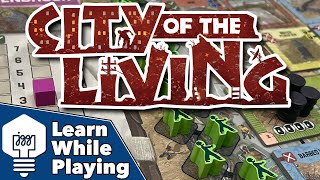
- survival in fortified territories against zombie hordes
- after a zombie apocalypse
- instructional/tutorial describing gameplay and rules
Mechanics (from transcript analysis)
- Advantage track — Gains Advantage via tiles with Advantage icons; most Advantage wins the game.
- Defense actions & zombies — Defense icons determine how many zombies arrive or are removed; positive defense reduces zombies and negative increases them.
- Double-sided boards & difficulty side — Boards have a harder side with fewer negative icons and longer zombie tracks; affects difficulty.
- End Game Bonuses — Game ends after 36 turns; endgame scoring includes cooperation, defense, and advantage scoring, plus a final advantage tally.
- End of game & scoring — Game ends after 36 turns; endgame scoring includes cooperation, defense, and advantage scoring, plus a final advantage tally.
- Gray tiles (one-time effects) — Gray tiles provide immediate one-time effects (e.g., removing zombies, granting advantage) when purchased.
- Icon activation types — Icons on tiles include fuel, fortifications (lock/unlock), and advantage, affecting resources, defense, and scoring.
- Market/tile placement — Purchased tiles are placed onto matching color spots and can cover existing tiles; some tiles unlock slots for future placement.
- Resource Management — Fuel tokens are gained via actions; zombies are gained via defense actions when negative and removed when positive.
- Resources: fuel and zombies — Fuel tokens are gained via actions; zombies are gained via defense actions when negative and removed when positive.
- Scavenging track & tile costs — Two Scavenging tracks; cost to buy tiles depends on your token position on the track, influencing fuel expenditure.
- Tile draw and activation — On a turn, the top tile is drawn and its activating icon activates effects for all players.
- Tile Placement — Purchased tiles are placed onto matching color spots and can cover existing tiles; some tiles unlock slots for future placement.
- Tile/Map Shifting — Gray tiles provide immediate one-time effects (e.g., removing zombies, granting advantage) when purchased.
- Track Advancement — Gains Advantage via tiles with Advantage icons; most Advantage wins the game.
Video topics + discussion points
Quotes (from this video)
- the most important icon is Advantage
- the game will end after 36 player turns
- Advantage is how we win the game
- the setting for it is after a zombie apocalypse