


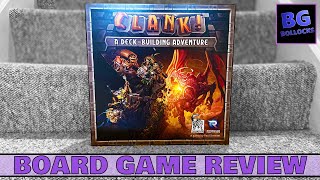











Clank!: A Deck-Building Adventure Deep Dive
What the Community Thinks About Clank!: A Deck-Building Adventure
Reviewers and ranking-video hosts speak about Clank!: A Deck-Building Adventure with a consistent affection. Published by Renegade Game Studios in 2016 for two to four players, the game comes across less as a niche deck builder and more as a title that groups keep returning to. The praise cuts across very different audiences, from families to long-time ranking enthusiasts, although the reasons differ from one reviewer to the next.
The warmest endorsements come from family and hobby-history perspectives. Our Family Plays Games calls the game a family favorite and a worthwhile addition to any collection. Foster the Meeple recalls it as the game where they first discovered they loved deck builders, even before Dominion. Getting Jiggly with It places it among a long list of favorites and remembers it as the first deck builder the group ever played, while When Harry Met Board Games ranks it thirteenth on a personal top 100 and praises the way it refuses to sell the deck building short.
Not every voice is uniformly enthusiastic. BoardGameBollocks is the sharpest critic on presentation, yet still concludes that the game is an enjoyable deck building experience with tense finales. Ryan and Bethany Board Game Reviews admit they rarely win but keep suggesting it, because the goal-driven trip into the dungeon is rewarding on its own terms. The common thread is that the theme and the dragon's pressure keep groups coming back even when results go against them. In a separate Foster the Meeple discussion about who plays which game better, the hosts say they would rather play Clank! In! Space!, which shows that fans still debate the strongest version of the system.
Core Mechanics That Define Clank!: A Deck-Building Adventure
Dungeon Crawl Movement and the Race for the Artifact
The dungeon crawl gives the game its physical shape. Players start at the top left of the board and work their way down through a labyrinth of rooms and corridors. Boots on cards move a thief one space, footstep spaces require an extra boot, monster-head spaces demand swords or a wound, and crystal cavern spaces halt movement unless a teleportation card is played. Market spaces let players buy tokens such as backpacks, while major and minor secrets reward those who cross them. Once a thief grabs an artifact and escapes, the race is on. Only a few turns remain, the first player out earns a bonus, and anyone still deep in the dungeon scores nothing. BoardGameBollocks describes the result as a constant reading of other players' routes, while Getting Jiggly with It stresses that players must build their deck with enough movement cards and swords to get through the paths.
Clank Noise and the Dragon's Pull
The defining mechanic is the Clank! track. Movement and certain cards generate noise, which players mark by placing cubes into the Clank! area. When the dragon wakes, cubes equal to the dragon's space on the track are drawn from the bag, and any cubes belonging to players inflict damage. Getting Jiggly with It frames the central trade-off as a choice between pushing one's luck deeper in the dungeon and beginning the escape. Foster the Meeple singles out this push-your-luck aspect as one of the mechanics that set the game apart from others they had played, and the hosts describe lingering in the depths to grab small idols as a deliberate, risky strategy.
The Clank!: A Deck-Building Adventure Experience
The Tension of the Dragon
Reviewers consistently describe the endgame as tight. BoardGameBollocks notes that one player can set the clock in motion by grabbing a cheap artifact and leaving quickly, forcing the others to scramble for the exit before the dragon catches them. Getting Jiggly with It describes the escalation in similar terms: once someone escapes, more cubes are pulled each round and fewer points are on offer, so the remaining players must weigh whether a deeper artifact is worth the danger. Players also watch one another closely, since choosing between a cheap artifact and a richer route toward the bottom right can decide the winner.
The Satisfaction of a Growing Deck
The deck building is what keeps reviewers coming back. When Harry Met Board Games says the game gives its genre real weight, with the player board serving as the heart of the experience as recruited cards are used to move, fight, and collect treasure. BoardGameBollocks adds that because all five cards in hand are played every turn, the ten-card starter deck is quickly reshaped by choices that no one else will make for the player. Board Game Coffee has grown fonder of the game with each play and singles out the pop culture references on many of the cards as part of its appeal.
What Makes Clank!: A Deck-Building Adventure Stand Out
Deck Building Where Every Decision Matters
BoardGameBollocks credits the game with tying success directly to what players choose to add to their decks. With more than 100 cards in the box, the market always presents something worth wanting, and the reviewer notes that six cards are on offer each turn, which keeps every purchase meaningful. Harry adds that the deck building still feels satisfying because players remain interested in the lineup of cards and the market as they decide which ones to acquire.
A Family Game With a Wide Spin-Off Family
Our Family Plays Games and Board Game Coffee both present the game as accessible and long-lasting at the table. The original has also grown into a broad family of products. BoardGameBollocks points to multiple maps and an adventuring party expansion that allows six players and adds unique character abilities. Getting Jiggly with It notes the Catacombs version and the legacy variants, Board Game Coffee highlights the Sunken Treasures expansion and the Clank! Legacy release from Direwolf, and the broader series includes Clank! In! Space!, which reviewers treat as a separate game with the same core structure.
Potential Drawbacks
A Washed-Out Look and Thin Components
BoardGameBollocks is the most direct about presentation, describing a palette of browns and blacks and a board that fails to evoke a dungeon. The black card borders are singled out as a poor choice for a deck builder, since they show scratches and wear, and the thin card stock does not hold up well after repeated play. Our Family Plays Games echoes the card concern, calling the cards a little flimsy and the only real negative of the game, and they plan to add sleeves to protect their copy.
Abstracted Monsters and a Fixed Dungeon
BoardGameBollocks argues that the board and the cards tell different stories. Monsters are never fought on the board and instead appear in the card offer to be defeated at random, while a goblin is always available to attack. The artwork also clashes with the anonymous, featureless thief figure, since the cards depict many kinds of human characters. The fixed board is the other concern, because each run through the dungeon tends to follow the same route. This rewards experienced players who memorize the best paths and makes it harder for newcomers, and the reviewer suggests that a modular system, like the tiles of Arkham Horror (third edition), would have been a better approach.
If You Enjoy Clank!: A Deck-Building Adventure
- Clank! In! Space!: Foster the Meeple say they would rather play this version, and Board Game Coffee describes it as a separate game with the same deck building and dungeon structure rather than an expansion.
- Clank! Catacombs: Getting Jiggly with It presents Catacombs as a classic delve into a dungeon with the same deck building and push-your-luck core, making it a natural next step.
- Clank! Legacy: Board Game Coffee reports consistently good things about the Direwolf release, and Harry describes it as a nice fantasy-themed board game with a deck building mechanism.
- Dominion and Marvel Legendary: BoardGameBollocks positions Clank! as a step up from these deck builders because it adds a loose linear story to the genre.
- Arkham Horror (third edition): the modular tile approach that BoardGameBollocks wished Clank! had adopted, useful for players who want a board that changes from game to game.
- Magic: The Gathering: Foster the Meeple had already seen the deck builder mechanic through this game before playing Clank!, so fans of its card-driven strategy will recognize the approach.
What Reviewers Are Saying
"Success and failure in this game is directly down to what you decide to put in your deck throughout the game."
— BoardGameBollocks
"I really don't win this game it just doesn't happen but I like the adventure of going in and um getting something."
— Ryan and Bethany Board Game Reviews
"That was the game that I learned that I loved deck builders even before Dominion."
— Foster the Meeple