/pic2921730.png)











Colony Deep Dive
What the Community Thinks About Colony
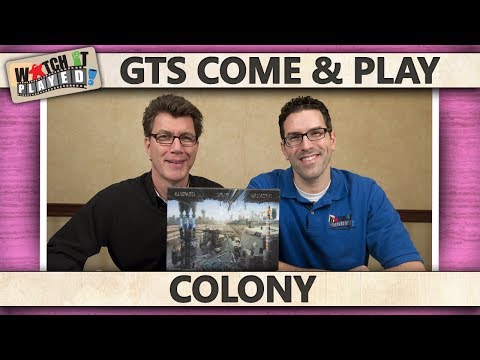
Colony, designed by Ted Alspach and published by Bezier Games, positions dice as the resources that fuel a growing colony of buildings. Watch It Played covered the game as a hands-on preview at a trade show event ahead of its release, with a Bezier Games representative walking through a sample turn on the table. That preview lands firmly positive, praising the catchup mechanism, the balance of strategy and simple play, and the box insert. The Dice Tower takes a cooler view in a rapid-fire roundup of many games, landing on Colony as competent but unremarkable. Getting Games gives the fullest picture from actual home play, enjoying the engine-building and building variety while flagging analysis paralysis and a cramped two-player experience. The throughline across all three is agreement on what Colony is: a dice-driven engine builder about constructing and upgrading buildings, with disagreement on how exciting that engine feels to run.
Core Mechanics That Define Colony
Dice as Resources
Watch It Played walked through the resource system directly: dice are rolled and distributed between players each turn, with unstable resources needing to be spent the turn they are acquired and stable resources able to sit in a warehouse until needed. Warehouse capacity is itself a building upgrade, so a player who upgrades their storage can hoard more dice than an opponent who has not. Players can also convert matching dice into a different value through a supply exchange building, or save up tokens earned from declining to build (called chippies in the preview) to buy extra dice on a later turn.
Buildings and Upgrades
Every building card has a starting side and an upgraded side, and flipping a card to its upgraded version keeps its basic ability but improves it and usually raises its victory point value. Watch It Played demonstrated this directly with a building that rolls three dice and scores based on the lowest result before upgrading, then rolls three dice and keeps the highest after upgrading, turning a single point into as many as six. Getting Games described the broader structure as an engine-building game with a whole bunch of dice rolling, where a large pool of building types is narrowed down to a smaller set used in any given game, with production buildings generating more of the dice used to build still more buildings.
The Colony Experience
A Sprint to the Finish
Watch It Played singled out the endgame as one of the game's best ideas. The match ends the moment a player crosses a score threshold that scales with player count, and any player can demolish one of their own buildings at any time to claim dice equal to the gap between their score and the leader's. That means a player who is far behind can still roll a large pile of dice on the final turns even if they cannot actually catch up, keeping the closing turns from feeling like a foregone conclusion.
Interaction You Can Dial Up or Down
Watch It Played also covered the game's optional conflict: a robber building lets its owner roll a die and take a matching die from every opponent who has one, while a barricade building can block that attack, with an upgraded barricade blocking one attack per opponent. Because the seven variable building types used in a given game are chosen from a larger pool, a group that dislikes that kind of interaction can simply leave the attack and defense cards out and lean on the manipulation, trade, and production cards instead.
What Makes Colony Stand Out
An Elegant Catchup Mechanism
Watch It Played called the demolish-for-dice catchup system one of the most elegant and fun mechanisms it had seen, and paired that with praise for the game's depth of strategy alongside genuinely easy gameplay, the kind of combination that keeps a game approachable without feeling shallow.
Variety From a Modular Building Pool
Getting Games pointed to the building variety as a strength, describing an immense amount of variety in the different buildings that generate dice and the buildings that spend them, and looked forward to seeing how that variety played out with more sessions. Watch It Played backed this up on the production side, calling out an insert with dedicated slots for the game's separate card sets and a divider that fits both sleeved and unsleeved cards without dice or tokens working loose.
Potential Drawbacks
Analysis Paralysis
Getting Games flagged real analysis paralysis potential in the game, and said there is not a whole lot a player can do while waiting between turns beyond some light planning. That same channel also found the two-player count constrained, since several buildings exist to let players trade resources back and forth and that trading rarely happens with only two players at the table, leaving Colony feeling closer to a three-player design.
A Muted Sense of Excitement
The Dice Tower's take was more lukewarm than the other two channels. Describing Colony as dice used as resources to buy cards in a Dominion-style structure, the review called it fine but said it just did not have any kind of air of excitement to it, a notably cooler read than the enthusiasm from the hands-on preview.
If You Enjoy Colony
The Dice Tower compared Colony's dice-for-cards structure to Dominion, pointing to the shared feel of spending a resource to acquire cards that build out an engine. Getting Games connected Colony to its own predecessor, Age of Craft, the earlier Japanese import from the same designer that Bezier Games and Ted Alspach reworked into Colony with clearer English rules and nicer components.
What Reviewers Are Saying
"Well, it's very easy, you just don't use the cards that your group doesn't like. If you have a group that doesn't like conflict, don't use any of the red attack cards or any of the yellow defense cards, which actually would be pointless without the red attack card. So you just don't use those, you use more of the manipulation or trade or production cards. You get to pick and choose the way that suits your group."
— Watch It Played
"This is from another game from Ted Alspach, and this is a game I think he was expecting to kind of be the next big thing. Dice as resources to buy cards, kind of like a Dominion-style game. And it was fine, it just didn't have any kind of air of excitement to it."
— The Dice Tower
"We had a good time playing this at the two-player count, however there is a lot of analysis paralysis potential in this game and not a whole lot you can do between turns. I guess you can do some planning when it's not your turn, but I think I am hoping to play this game at three players, but I will never play this game at four players, and I think it's probably best at three players honestly, because there are some buildings that let you trade your resources back and forth, and trading is going to pretty much never happen in a two-player game."
— Getting Games