
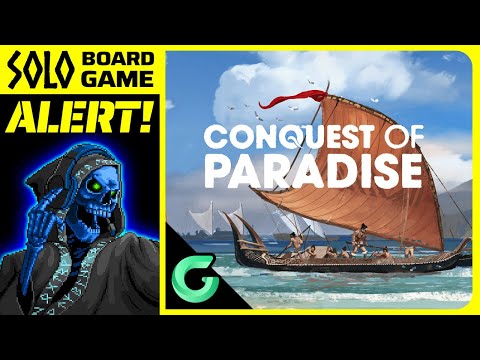






Conquest of Paradise Deep Dive
What the Community Thinks About Conquest of Paradise
Reviewers tend to describe Conquest of Paradise as a compact 4X with an unusually specific setting. The game places two to four players in the Polynesian Triangle around 500 A.D., where they explore unknown ocean, settle island groups, build canoes and warriors, and invest scarce resources in cultural development. The original design by Kevin McParland was published by GMT Games, and the new edition from Fallanks has become the focal point of most current discussion. Reviewers agree that the theme is the first thing that sets the game apart, and that the core loop of exploring, colonizing, and fighting holds up well for a design that is roughly two decades old.
The strongest praise comes from reviewers who value the historical framing. AzureDeath | Solo Board Gaming described the game as an introduction to Polynesian culture and history, and credited it with showing how much educational value a strategy game can carry. 3 Minute Board Games, whose host is based in Aotearoa New Zealand, said that the setting matters a great deal to them because the game puts the Pacific and its peoples at the center of a 4X experience rather than aliens and spaceships. The Discriminating Gamer took a similar view of the theme, calling it a fun Pacific-set take on exploration and empire building.
Opinions diverge mostly on weight and presentation. UndeadVikingVideos described the game as one of their favorite 4X titles while also noting that it is not a heavy game and that its combat is more deliberate than the open aggression found in Blood Rage. Some reviewers view the older art direction as a barrier, while others find the new edition a dramatic improvement. BoardGameGeek's hosts remarked that the original looked like a classic GMT wargame with many chits and little color, and that the new version finally makes it visually appealing for newer players.
Core Mechanics That Define Conquest of Paradise
Resource Management
Resource management in Conquest of Paradise centers on construction points. Each village generates one construction point per turn, and those points are spent on new villages, which cost two points and must be placed on island groups that display the matching white dot symbols, and on art and culture cards, which also cost two points and allow only one purchase per player each turn. ON TABLE Board Games emphasized that players count and spend construction points in secret, which turns a simple economy into a guessing game about what opponents can afford. The Discriminating Gamer summarized the design as an interesting game of resource management layered over 4X ideas, and that layering is where most reviewers locate the strategic depth. Because every village requires both an island group and a budget, expansion competes directly with cultural investment for the same limited pool.
Push Your Luck
Exploration is the game's clearest push-your-luck system. When an explorer sails into unknown water, the discovery marker reveals waves on its reverse side. ON TABLE Board Games explained that an explorer with four waves or fewer may keep moving or return home, an explorer with five waves must turn back, and an explorer with six or more waves is lost, with the marker returned to the owner's resources. AzureDeath | Solo Board Gaming connected this directly to the theme, describing the sea as a place where a ship might be lost, so players must weigh how far to chart the seas against the need to find islands to occupy. The result is a turn-by-turn calculation that becomes tense the moment a discovery pushes a voyage close to its limit.
The Conquest of Paradise Experience
Sailing Into Uncertainty
Reviewers consistently describe the exploration phase as the emotional center of the game. Each new discovery could reveal a rich island group, an open ocean space, or simply a wrong turn, and the wave count that accumulates on the markers keeps the decision open until the last moment. UndeadVikingVideos called the exploration mechanic fantastic, and the feeling of a voyage that might end in disaster gives the map a sense of danger that many 4X games lack. Players who enjoy watching a plan survive or collapse on a single draw tend to find this phase the most memorable part of a session.
Historical Warmth at a Family-Friendly Pace
The second theme in reviews is how approachable the game feels. AzureDeath | Solo Board Gaming played it with family members who were not hardcore gamers and found it accessible, and the 10 to 15 minute rules explanation supports that impression. Reviewers do not describe the game as a fast, light filler; rather, they describe it as a complete 4X that fits in an evening. The Polynesian setting gives the simpler systems a sense of purpose, so players who might otherwise dismiss the rules as thin tend to remember the cultures, islands, and voyages they helped shape.
What Makes Conquest of Paradise Stand Out
A Solo Experience With a Rare Place in the 4X Catalogue
AzureDeath | Solo Board Gaming argued that the game fills a real gap for solo players, since 4X games that support solitary play are uncommon. The reviewer described the solo bot as easy to run and the rules as easy to learn, and praised the design as a solo 4X that also works well with other people. UndeadVikingVideos, who ranks the game among their favorite 4X titles, offered a complementary view that the design rewards players who already enjoy the genre's core loop of exploring, expanding, and conquering.
Presentation in the Fallanks Edition
Production value is the other feature reviewers highlight. AzureDeath | Solo Board Gaming noted that the new edition replaces the mounted board with a neoprene mat, that the artwork looks spectacular, and that the components feel top-notch. BoardGameGeek's hosts described the revised design as a glow up for a game that originally looked like a traditional GMT wargame, and they argued that updating older wargames in this way may help bring in newer players who expect games to look attractive. That attention to presentation has made the new edition a major reason for renewed interest.
Potential Drawbacks
Dice-Driven Combat That Feels Like a Numbers Game
Combat is the feature reviewers are most willing to criticize. UndeadVikingVideos explained that each die roll has roughly equal odds of removing a unit from either side, which makes battles feel like a numbers game in which the attacker must weigh force size against luck. UndeadVikingVideos also noted that attacks are targeted and situational rather than reckless, a structure that suits some players but can feel mechanical to those who want a more tactical battle system. ON TABLE Board Games also documented a multi-step battle procedure involving front and rear lines, panic results, and village seizure, which some players may find heavier than the rest of the game.
A Visual Style That Divides Opinion
The original edition's appearance is the other frequent point of criticism. UndeadVikingVideos found the art style somewhat weird and a little off-putting, and felt that this may have contributed to the game receiving less attention than its design deserved. BoardGameGeek's hosts described the earlier look as drab, with lots of chits on a board and not much color. The new edition answers many of these complaints, but reviewers who prefer the classic GMT graphic design, as AzureDeath | Solo Board Gaming did, may prefer to keep their existing copy.
If You Enjoy Conquest of Paradise
Players who enjoy Conquest of Paradise's cultural and historical focus will find similar satisfaction in Comancheria. 3 Minute Board Games described it as a solo-only game with conflict and culture development set in a non-Western history, and the rise-and-fall arc of the Comanche Empire gives it the same sense of learning while playing. AzureDeath | Solo Board Gaming played Fields of Fire just before discovering Conquest of Paradise, so that title is a natural companion for readers following the same GMT path.
Players who want a larger version of the 4X experience should look to Twilight Imperium. The Discriminating Gamer named it as a favorite 4X game and praised its epic scale, along with the way the Prophecy of Kings expansion restores exploration to the design. That expansion scale comes with a much longer playtime, so it suits players who want the sprawl of Conquest of Paradise with more time and more decisions.
Players who appreciate Conquest of Paradise's tight design will find Oaxaca rewarding. 3 Minute Board Games praised it as a master class in fitting a large amount of play into a small box, with cascading engines that reward careful planning in a short session. For players who enjoy the aggressive side of Conquest, Blood Rage offers a different and more confrontational take on conflict, which makes the contrast with Conquest's situational fighting a useful point of comparison.
What Reviewers Are Saying
"It's kind of a bit of a push your luck element with how far you want to send your ship out because it might get lost at sea. So you want to be careful with how far you want to chart the seas, but you need to explore the seas in order to find islands for you to occupy."
— Robert, AzureDeath | Solo Board Gaming
"It's fundamentally just a solid 4X game where you go, you explore islands, you conquer them, you develop technologies, all of those classic things you expect from the 4X. It's just the Pacific and the Pacific people instead of aliens and space."
— 3 Minute Board Games
"It looks like an old GMT game, right? The old 2007. Lots of chits on a board. Not a lot of color. But now it looks a lot prettier."
— BoardGameGeek