



Conquest of the Fallen Lands Deep Dive
What the Community Thinks About Conquest of the Fallen Lands
Reviewers see Conquest of the Fallen Lands as a distinctive post-apocalyptic adventure game that rewards players who enjoy unpredictable, story-driven play. The most enthusiastic voices come from channels that play it through in full. Baren of Meet Me At The Table walks through the second edition, along with its Descendants expansion, and presents it as a game that never plays the same way twice. Daniel of The Dungeon Dive calls it a brilliant hex crawl and places it on Daniel's list of top solo adventure games, arguing that its rules are well written and its content is deep.
Not every reviewer is equally focused on the same strengths. Tom Vassel of Dice Tower, revisiting an older review, remembers the original release as a cool game about moving around hexes with funky pieces, and credits its artwork by Josh Capel with making the map memorable. BoardGameBollocks is more openly ambivalent. The channel praises the game's sense of chaos and storytelling while acknowledging that the rules can feel messy. The shared view is that the game's personality is its greatest asset, and that players need to accept a certain amount of noise to enjoy it.
Core Mechanics That Define Conquest of the Fallen Lands
Hexagon Grid
The board is built from hex tiles, and reviewers treat the geometry as a core part of the experience. Daniel describes the game as a post-apocalyptic hex crawl in which a party moves across North America, discovering points of interest and encounters as it goes. Baren shows how the terrain changes the game. Plains, mountain, city, and radiation hexes each shape how far the party can travel and what kinds of encounters it must face. Radiation zones are impassable unless the party is on a mission point, and the DeForest Tanner character card lets a party cross them without taking damage. Vehicles such as the armored Humvee change the math entirely, because every hex costs only one movement point. Tom Vassel of Dice Tower recalls the hex movement as the core of what made the original release feel distinctive.
Events
Reviewers describe the world as something that acts on the players. In the Descendants expansion, a dedicated Town Event deck replaces the old chart roll that the game once used to decide what happens back home. Baren draws a town event each turn, holds it until the end of the round, and then resolves it, with outcomes that range from a faction on the verge of war to a bountiful harvest that rewards the party with salvage and action cards. Larger world events affect everyone at the table at once. During Baren's playthrough, a storm front swept across the map and left the party taking heavy damage until Baren played an action card to flee to a neutral town. That combination of scheduled pressure and random misfortune is what makes the game feel alive, rather than a series of isolated choices.
The Conquest of the Fallen Lands Experience
Chaotic, Unpredictable Tension
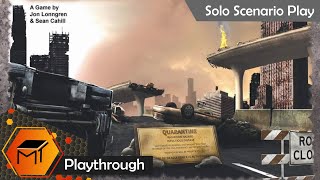
The feeling of playing Conquest of the Fallen Lands is one of constant near misses. Baren's solo run is a clear example. A leech attack killed one of Baren's characters outright, a legendary sword saved another from death, and several skill checks came down to a single success. BoardGameBollocks describes the same energy as a chaotic mess in which a player can end up with six or seven characters and a vehicle to manage at once. Reviewers do not present this as frustration so much as a source of excitement. The outcome of a mission often depends on a single die roll, and the uncertainty is part of why they keep coming back.
An Epic Sandbox Adventure
Reviewers consistently describe the game as an epic adventure in which the story emerges from the table. Daniel values the sense of exploring a vast post-apocalyptic landscape, filled with hundreds of random encounters that each tell an interesting story. Baren echoes this, noting that the second edition offers so many cards and scenarios that a player can keep finding new experiences. The result is an open-ended feeling that makes each session feel like a chapter in a larger tale rather than a board game with a fixed endpoint.
What Makes Conquest of the Fallen Lands Stand Out
Encounters That Read Like Stories
BoardGameBollocks singles out the writing as the game's signature strength. The channel notes that the designers wrote each encounter card to be distinct from the others, and that the result is one of the most hilarious and memorable stories a board game can deliver. The reviewer's examples include a player who accidentally destroyed a nuclear power station and another whose character was eliminated by an AI-generated robot. Reviewers who enjoy narrative play regard these moments as the game's greatest reward, because they turn a bad dice roll into a tale worth retelling.
A Deep Pool of Pop-Culture Gear
Meet Me At The Table highlights the way the item cards reward attentive players. Baren delights in finding a Conan the Barbarian sword in the spoils deck, and in noticing a Louisville Slugger autographed bat, both of which boost Baren's combat checks. Many of the items carry references that longtime fans will recognize. Reviewers regard the sheer size of the card pool as a reason the game stays fresh, since each new deck of spoils can change how a character is equipped and how a party approaches its next mission.
Potential Drawbacks
Rules That Can Feel Messy
The most consistent criticism comes from BoardGameBollocks, which concedes that the second edition can be a little bit messy and that its rules are somewhat strange. The channel nonetheless considers the game worth learning, because the core loop of drawing cards and seeing what happens is so entertaining. Players who prefer tidy, carefully balanced rulebooks may find the rough edges more frustrating than the reviewers do, so it is worth reviewing the rules with a group before committing to a full campaign.
Setup and Sorting Take Time
Baren notes that the setup requires digging through a very large collection of cards, including multiple spoils decks that must be shuffled and sorted. Baren describes the hunt for three medical equipment cards as a long search through the deck, while regarding the abundance of material as part of the appeal. Play length is also a factor. Baren estimates that a solo game of this kind runs about an hour per player, and that a two-player game can take roughly two hours. Groups that want a quick session may need to plan their scenarios carefully.
If You Enjoy Conquest of the Fallen Lands
Players who enjoy the second edition's Town Event system and its large, varied card pool will find a natural companion in First Edition Fallen Lands. Baren has also covered the first edition on Meet Me At The Table, so that earlier video is a useful way to see how the game's core ideas evolved. Players who value the feeling of a hex-based survival campaign with unpredictable events will find the same satisfaction in the first edition's foundation, while those who want the expanded content of the Descendants expansion can build on it from there.
What Reviewers Are Saying
"I never read the bottoms until after I performed the skill check so I'm like okay well I just need four and five."
— Baren, Meet Me At The Table
"Second edition can be a little bit messy. The rules are a little bit weird, but get over that and it is one of the best Chuck dice, draw a card, see what happens games out there."
— BoardGameBollocks
"This is an absolutely brilliant game where you are hex crawling across a post-apocalyptic North America, and you're putting together a squad of survivors. You have a settlement that you need to protect."
— Daniel, The Dungeon Dive