/pic4521267.png)
Under a blazing sun in 4th century BCE, traders come from all corners of the Mediterranean Sea to Corinth to sell their goods; Persian carpets, Cretan olive oil, Roman grapes, and Egyptian spices are highly prized by traders. Players have a few weeks to secure their place in Corinthian lore as its most savvy trader!
Corinth is a roll-and-write game akin to a dice-only version of the board game Yspahan. At the start of a turn, the active player rolls nine dice, then places all the dice with the highest value on the gold space at the top of the chart, then starts placing dice from the bottom of the chart up, with each value of dice being on a separate level.
The active player takes all the dice on one level, then the action associated with that level. The top level gives the player as many gold as the number of dice they took; the bottom level gives goats instead of gold; and the middle levels allow a player to deliver goods to a number of market stalls on their personal player sheet equal to the dice claimed. (You have four colors of market stalls, and once you start marking off, say, rugs in one of the blue areas, you have to finish marking off all the rugs in that area before you can start marking off another blue area.)
The active player can spend gold to roll up to three extra yellow dice and thereby increase the odds of getting to take a desired level; if the active player doesn't take any of these yellow dice, they are removed from play, preventing others from benefitting at that player's expense.
Instead of marking off gold, goats, or goods, you can use the value of the die or dice claimed (1-6) to move the steward on your personal score sheet. The steward starts in the middle of a 5x5 grid on your sheet, and you must move it as many spaces as the number of pips on the die value claimed, not crossing over any line you've drawn previously. You can pay 1 gold to move the steward one more or one fewer space, and you can pay as much gold as you want to do this. You can receive gold, goats, or goods from where the steward stops, but beyond that, you can earn points. When the steward stops on a corner space of this grid, you count the number of spaces circled to this point, with some spaces counting twice, then you write down that number, scoring that many points at game's end. If you stop in another corner later, you do the same thing again, which compounds the value of all your previous movement.
You can spend gold or goats to construct buildings that give you bonus powers, such as collecting two additional gold whenever you collect any gold or moving the steward up to two spaces more or less without paying.
After 16 turns (with four players) or 18 turns (with two or three players), the game ends and you tally points for goods delivered, spaces visited by the steward, buildings constructed, and goats and gold still on hand.


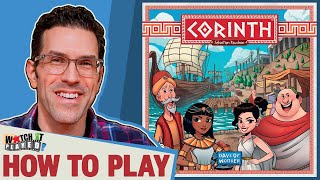
Corinth - How To Play
- More complexity than basic roll-and-writes
- Interesting strategic choices with peddler movement.
- Quicksand
- Imperial Settlers: Roll & Build
Mechanics (from transcript analysis)
- action selection — Players choose actions, with a key element being the management of the peddler's movement.
- Roll and Write — The game involves rolling dice and marking actions on a board.
Video topics + discussion points
Quotes (from this video)
- This is gonna be one of my games of 2019
- The resources expire over time so the body parts go bad they decay
- China refused to release this because they said Taiwan's never been a free country we've owned this country and they said it's just fiction it's not real it's not historical
- If you like Twilight Struggle this has that feel in less than an hour
- I don't consider just flipping pages in a rule book I expect them to be there
- Leviathans is a game that they originally came out with...
- The mechanics of the combat and everything was one of the best things I've ever seen done with like a 12-sided die.
- This is a war war two themed game where one person places Germans one person places Americans and you have a scenario book that each game is gonna be based on one of the scenarios with the netbook that scenario book contains a map that shows how to lay out the tiles that are included in the game that ladies are basically terrain each of you are gonna put tokens on the board as described by the scenario and that's the units that you use during the game this is basically a deck builder which Tony and I really like as the scenario at the beginning of game says you're going to build your deck by putting in two scouts or maybe two riflemen or maybe two machine gunners and the squad leader stuff you build your deck like that and then all those guys are available in supply at that point each of you draw four cards each card has an initiative number on the top you're gonna bid to see who gets to go first guess what the best card has the highest number but once you bid on that using that card you can't use it for the rest of the term at that point you're gonna play all three cars like a regular deck builder in each of the cards have multiple functions like there's the Scout card which allows you to move into an area and Scout to an area that you haven't been before but when you do you have to take fog of war which is a card that clogs up your hand or you can have the rifleman who's maybe good at attacking or maybe taking over control points which is the ultimate goal each side has a certain number of control points that you're trying to take over when you do combat you roll dice and you resolve based on the dice roll and if you can exceed their armor and the distance they are from you you take damage and this is one of the really cool parts when you take damage the token doesn't come off the board first what you do is you go through your hand or your discard pile of your deck trying to find a copy of that card and it comes out of the game if your deck contains nothing of that card then that chip comes off the board and the only way to get it back is by using a bolster action which you actually also use to add cards to your deck so you're building the deck over time you're playing a regular deck builder head-to-head matchup World War two theme loved it and I would re-emphasize that love it part that's right in my wheelhouse on theme I love the world war two I enjoyed the aspect of a deck builder I enjoy the strategy of it positioning of it various tiles provided various defense is very important for you to keep them play as you're building this game out and trying to achieve your ultimate objective based on the scenario the fog of war adding the crud to your hand and how you have to get rid of that all that's an important aspect it's got that deck builder mentality for me Marty the initiative was a huge Pro I like that part of any of those types of games of use it's been in other games I've played where the better cards have the higher number so you really need to know do I want to get rid of that hey wait I'm not going to do anything with this guy yeah I can do it initiative was a key Proform and so what's really cool is each of the cards have like I said different units have different actions they can do so when you play a card you got to decide which one of the actions you want to do and then there's two different squads which is cool - it's for like say for example there's a scout and there's a a squad and a B Squad there's a squad leader for each one of those so when you play a squad leader like a and he does a bolster he can only add the a type cards to your deck the squad leader B can only add B type cards to your deck but there's a token for each on the board it is very tactical I think Tony way more tactical than war chest is because you have you these different scenarios that you're trying to achieve the terrain matters like you said some of them have heals if you can get positioned on a hill where you're firing down on somebody you actually have an advantage and every scenario is different and based on actual historical things that happen because come to find out David Thompson's grandfather was in Normandy and he actually has a card of his grandfather in this deck he's one of the platoon sergeants oh very interesting now one thing I'm going to say about the negative of the dice some people say I don't want to roll the dice get over it did you know that that bullet may get struck or lodged in the gun or get deflected you don't know quite that with just normal you know just firing a gun you weren't that gray it was the war it was the rush the adrenaline for me this is gonna be one of my games of 2019 we loved war chest and I didn't think I can find thing else like it debated cuz I love the tokens and everything but man this this actually might be it because the theme is is so on point of what it's trying to do and yeah some people may not like the dice combat you're you're right but see here's the thing there are some units that are better at shooting than others there are some that you can roll multiple dice the scouts you canola or one died positioning matters the closer you can get the better chance you have to hit a hit someone and here's the thing Tony David said hey if this system takes off we have plans for other maybe the Eastern Front who knows maybe bringing in other items and units and machinery the system itself is solid it could be expanded to a lot of different things Tony could they actually win another squirrely for a two-player game of the year I don't know you have to let me play it some more
- This is gonna be one of my games of 2019.
- If you liked war chest you owe it to yourself to check this out
- Southern Fried Gaming Expo is going to be July 12 through 14
- If you go out to their website Southern Fried gaming expo com they have a list of all the pinball machines and arcade machines
- I am excited to be a special guest at one of the best name gaming conventions in the United States the southern-fried Gaming Expo
References (from this video)
Mechanics (from transcript analysis)
Video topics + discussion points
Quotes (from this video)
- so the first thing I wanted to mention was that my friends over the Sirica ball gaming podcast we're having their annual fundraiser
- so if you'd like to support them up with a link in the description below and that will take you to the pod pledge page and you can donate like on an annual basis monthly just do a one-time amount whatever you like and also check it out because there's a variety of fun perks there as well they have a very modest goal of $5,000 let's help them get there
- so the first Edmonton Games field this is the first time this conventions being run I'm gonna be there teaching and playing games with people and so you can register in the link that will put in the description below for the event and you can also sign up for a variety of these different game sessions that I'll be running now spaces are filling up for those but I have spots left for Hadera Nach DeLuca Corinth and journeys in middle-earth
- okay I think that's enough news now let's have a contest to give away this copy of Istanbul the dice game from AEG
- well the rolling days of taking these podcasts has two hosts Marty and the other guy I want the first name of the other guy that's your code word
References (from this video)

- engaging dice drafting with a tactile steward mechanic
- compact implementation of a dice-heavy euro feel
- quick to teach and play with good player interaction
- some players may miss how all the moving parts interact without a second reading
- the game can feel a bit dense for a first-time teach
- dice drafting and resource management with a competitive market and building
- Avenue
Mechanics (from transcript analysis)
- coin/goat-based resource economy and building construction — Coins and goats are spent to acquire buildings and other bonuses; these upgrade your tableau and scoring potential.
- crossing off goods on a personal board — Selected dice determine which goods you can cross off on your board, driving scoring opportunities.
- Dice Drafting — Roll a batch of dice each turn; active player selects a bundle and both players choose from it, then activate effects.
- dice drafting and sorting — Roll a batch of dice each turn; active player selects a bundle and both players choose from it, then activate effects.
- end-of-round scoring tied to completed goods bundles — Crossing off bundles triggers end-of-round scoring; strategy revolves around completing types efficiently without leaking points.
- Resource Management — Coins and goats are spent to acquire buildings and other bonuses; these upgrade your tableau and scoring potential.
- steward movement around a market grid — A snake-like movement of a steward token around a grid; movement is determined by the pips on drafted dice and grants bonuses.
Video topics + discussion points
Quotes (from this video)
- this game is all about trying to put money into these companies so that they can invest in their future and flourish but then also pull money out of them
- man I'm doing really well for my first 18xx game
- the scores were bonkers at the end I came in second with a score of around 8200
- I am NOT going to go into all of the minutiae because well it takes a while to teach these games
- on your turn all you do is place a token down onto the board
- this is a super competitive abstract style game
- it's a very simple on your turn; you always have to place next to something you already have out on the board
- this game is all about cultivating that deck while also upgrading your tavern
- I really enjoyed Kokura; it was quick, breezy, and very engageable
- space base is an awesome way to inject new content into a game and to inject new enthusiasm into playing that game over and over again
References (from this video)
- Rolls many dice
- Interesting building aspect
- Early buildings are more helpful
- Neat mechanic for actions based on dice count
- Thematic integration
- Includes a maze element
- Plays quickly
- Trading and making money
- Town of Corinth
Mechanics (from transcript analysis)
- Building Construction — There are four buildings players can construct to gain advantages.
- Dice Placement — Dice are placed on a board with six spaces, ordered from highest to lowest, determining the number of actions available in that space.
- Dice Rolling — Players roll a large number of dice (up to 12 or 13) including white and optional yellow dice.
- Maze element — The game includes a maze that players can navigate for bonuses.
- Resource Management — Players spend resources to build buildings.
Video topics + discussion points
Quotes (from this video)
- This is probably one of the most unique roll and writes I think I've ever played.
- It's got a lot of challenging things in it and it's not a simple roll and write.
- You're taking tiles out of this central area, you're drafting tiles, and then you're placing those tiles into your grid on your paper.
- And then the scoring is based on sets of symbols.
- It uses very minimal components, just a pencil and paper.
- We're doing a giveaway.
- We'll be talking about the two games that we're being we'll be giving away actually today so if you're looking to win a copy of silver and gold or sonara then make sure you comment down below and check out our other videos to get even more.
References (from this video)

- Nice artwork on the box
- Simple rules
- Dice drafting slows down the game
- Lack of deep strategy
- Doesn't feel as exciting as other roll-and-writes
- Doesn't have the depth of games like Welcome To
- Welcome To
- Gans and Clever
Mechanics (from transcript analysis)
- action selection — Players can choose to take resources, move a character on a track, or buy powers.
- Dice Drafting — Players take turns selecting dice from a central pool.
- Resource Management — Players collect gold and goats, and cross off wares in shops.
- Roll and Write — Players roll dice, place them on a board by number, and then draft dice.
- Set Collection — Players collect points by crossing off items in shops and potentially completing objectives on a track.
Video topics + discussion points
Quotes (from this video)
- It has all of that frustration and decision-making that you get with other Tetris games because you'll get shapes and you're not sure which one to go for or where to put it.
- It just reminds me too much of a style of Euro game that was out sort of 10 or more years ago and I feel like a lot of companies and publishers have passed that and Isle of Skye still seems like it has one foot in the past a little bit.
- For me Blue Moon City is a good game but not a great game. It feels a little bit pedestrian.
- It doesn't have that kind of push your luck or excitement that some roll and write games have and it doesn't have the depth of something like welcome to or the awesome like comboing of Gans and clever it's just sort of somewhere in the middle and and yeah just didn't really hit the spot for me.
- I have got a lot of respect for Stone Age I think it's a really well-designed game that is almost the perfect introduction to work or placement games.
References (from this video)
- Gaining extra gold from the store.
- The stable allows for more flexible steward movement.
- The warehouse provides free additional symbol deliveries.
- The temple grants immediate points and points for built buildings.
- The game offers a unique way to score points through steward movement.
- It's possible to take dice that result in no usable action if neither the regular action nor steward movement is possible.
- If it becomes impossible to move the steward, that action choice is lost.
- The first player might not get to use the dice they paid for in the two-player variant's second turn for that player.
- being the best merchant
- ancient world
Mechanics (from transcript analysis)
- Dice Drafting — Players choose a row of dice from the board to collect and resolve its action.
- Dice Rolling — Players roll dice at the start of each round, and the results determine available actions.
- Engine Building — Players can construct buildings that provide ongoing benefits throughout the game.
- Press Your Luck — The steward movement can be risky as players cannot land on or move through already occupied spaces.
- Set Collection — Players collect goods symbols from specific districts to fulfill deliveries and score points.
- Worker Placement — Players move a steward on their personal player board to take specific actions.
Video topics + discussion points
Quotes (from this video)
- in the ancient world you want to be known as the best merchant and there's no better way to do that than to sell a variety of goods and goats apparently yeah sounds about right
- if all the dice you've rolled showed the exact same value well then you just automatically win the game and not just that game but every game of Corinth you would ever sit down to play in the future so you may as well just take a picture share it on social media and give your copy to somebody else and I'm not kidding that's actually in the rules
- if you have any questions about anything you saw here feel free to put them in the comments below and I'll gladly answer them as soon as I get a chance
References (from this video)

- Accessible free print-and-play option
- Official physical version may exist; print-and-play might differ
- Spatial placement and polyomino-style filling
- Print-and-play version of a Roland right title
- Minimalist, puzzle-focused
Mechanics (from transcript analysis)
- roll-and-write — Dice results guide placement on a grid
Video topics + discussion points
Quotes (from this video)
- I am a huge fan of Roland rights
- these print and plays that I'll be showing you today are all like roll and write print in place
- lamination for your print in place is like the best thing ever because you only have to print out one of that specific sheet and you can use it over and over again
- I am so excited to dive into all of these and just have them here in this book
- these are three dollars you get three different rolling rights for three dollars which is fantastic
- I will say I do have all the rules on my computer so I will just open that file on my computer
References (from this video)

- strong tactical depth with multiple scoring routes
- high variability due to multiple scoring rules (12 potential rules)
- prototype stage may mean balance and clarity are still evolving
- learning curve associated with abstract engine-building
- engine-building through dice control and spatial placement
- space, nomadic dice-placement with an abstract engine-building core
- abstract, strategic
Mechanics (from transcript analysis)
- Compound Scoring — randomly chosen end-game scoring elements add variability to each play.
- Dice Placement — move and place dice to influence the path-to-mountain mechanic, driving resource collection and scoring opportunities.
- dice-placement — move and place dice to influence the path-to-mountain mechanic, driving resource collection and scoring opportunities.
- Set Collection — tiles accumulate or collect based on a defined rule set, creating cascading scoring potential.
- tile-collection — tiles accumulate or collect based on a defined rule set, creating cascading scoring potential.
- variable scoring — randomly chosen end-game scoring elements add variability to each play.
Video topics + discussion points
Quotes (from this video)
- this is boardgame Brodie I hope you enjoyed this video stick around and check out some other board game reviews
- this is our most recent release, a nice placement engine
- on a turnin burrito you have the path and you have the mountain
- the more you have of an element, the more you can collect an element
- we all have your debt together
- loads of five players in just about an hour
References (from this video)

Mechanics (from transcript analysis)
Video topics + discussion points
Quotes (from this video)
- I've really liked it my many plays of this game over the years.
- it's probably better to move it on.
- I don't think I'd be sad to never play Kalimala again.
- This has been on my mind for a couple of months now honestly.
- we are planning on doing something ... playing games with my friends that also turns into play-throughs that people can enjoy.
- there's a lot of kinks that we're trying to work through.