



Council of Shadows Deep Dive
What the Community Thinks About Council of Shadows
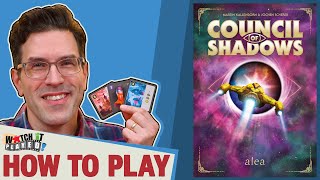
Coverage of Council of Shadows is still thin, and it comes from two Watch It Played segments and a short preview on John Gets Games. Rodney Smith's full rules walkthrough on Watch It Played is the only source that shows the game being set up and played. Rodney presents it as a civilization-style race for a seat on a mysterious council, where players gather gemstones, upgrade personal boards, and compete over galaxies. The pacing of the walkthrough is patient and sequenced, which suggests the game rewards learning its layers one at a time.
The Watch It Played news segment, presented by Matthew, is openly enthusiastic. Matthew describes four civilizations competing to supply the most energy each turn while securing strong actions, controlling key areas, and being first to make three "Quantum leaps." John Gets Games takes a more cautious approach. John notes how little information about the game exists on BoardGameGeek, and is drawn in mainly by the box art and a description of a mid-weight Euro game. Overall the feeling is curiosity and anticipation, with the most detailed view coming from the one walkthrough.
Core Mechanics That Define Council of Shadows
Energy and Consumption
The central engine is a pair of tracks. Gaining energy moves a player's energy marker forward, while the cards placed on a player's board add to a consumption marker each round. When energy reaches or passes consumption, the player levels up, donates the energy to the council, and resets down the track. Rodney stresses that appeasing the council is a core objective, since it happens whenever energy matches or exceeds consumption. The goal is to build energy quickly without generating too much consumption along the way.
Buy Phase and Board Upgrades
Each turn allows up to three purchase actions, which can be spent on Artificial Intelligence cards or on upgrades to the player's board across thirteen areas. Costs are paid in gemstones, and the walkthrough shows a useful substitution rule: gold can stand in for coal, and crystal can stand in for either. Rodney also notes that overpayment gives no change, which makes the choice of which gemstones to spend a real decision.
Simultaneous Planning and Turn Order
Each round opens with a secret planning phase. Players hide their boards behind screens and fill their action spaces with cards, and the total consumption those cards generate determines the next turn order. The player who created the most consumption that round takes the first turn token, with ties settled by position on the energy track. This ties planning, timing, and tempo together in a way that rewards reading the table.
Actions, Planets and Galaxy Assessment
Cards resolve from left to right. Actions can collect gemstones, place colony cubes on planets within the parsec ranges a player has unlocked, discover new solar systems, or gather resources from existing colonies. The assessment step is where area control matters most. In each galaxy where a player has a colony, that player compares their cube count against every other player individually. The player with the most cubes earns the larger reward, which includes a light bonus card, while tying or trailing earns a smaller one. A cube is then removed from that galaxy.
Dark Tech, the Throne and Final Scoring
Leveling up grants a choice of Dark Tech cards, and reaching the third level earns the Throne. Final scoring turns leftover gemstones into energy, with coal worth one, gold two, and crystal three, and adds energy for each AI card purchased and for each light and dark bonus. Ties are broken first by the highest level, then by energy, then by colony cubes on the board. This end-of-game accounting gives the planning and long-term collecting real weight.
The Council of Shadows Experience
A Planning Puzzle Under Pressure
From the walkthrough, the game feels like a sequence of connected decisions rather than a single big choice. Players buy and upgrade in one phase, commit to a board layout in secret, and then watch those choices resolve in order. Because the next round's turn order depends on consumption, every placement carries a second consequence beyond what the card does on its own.
Head-to-Head Galaxy Contests
The galaxy comparisons create direct confrontation. Players are not simply accumulating points; they are measured against each opponent individually in every galaxy they share. Rodney's example of a two-player galaxy and a three-player galaxy shows how falling short of even one rival costs the better reward, which keeps the table watching one another.
A Space Opera Atmosphere
The theme is vivid in both sources. Matthew describes a year 2200 setting at the edge of the known universe, with civilizations racing toward a council, and the art is praised by John as attractive. The game's names for galaxies, planets, parsecs, and Quantum leaps reinforce a cosmic feel, while the civilization framing gives it an economic core.
What Makes Council of Shadows Stand Out
Balancing Growth Against Consumption
The most distinctive idea shown is that progress is not simply about gaining more. A player who grows energy too aggressively increases consumption and can stall, so the walkthrough presents the path to the council as a measured climb. Rodney highlights this tension as the thread that connects nearly every system in the game.
Layered Scoring Across the Game
Points and advancement come from several places: galaxy majorities, dark tech, board upgrades, AI card purchases, and final bonus cards. Because much of the value converts to energy at the end, the game rewards players who keep an eye on several scoring routes at once rather than focusing on a single one.
Extra Content Built In
Rodney points out that the box includes two expansions that add space stations and leaders with unique starting values and ongoing abilities, along with solo play components. The walkthrough covers only the base game, which means there is more depth available to players who want it.
Potential Drawbacks
Reviewers raise few direct criticisms of Council of Shadows, and the ones that come up are mostly about how much there is to absorb rather than about quality.
A Dense Rule Set
Rodney's walkthrough is long and interlocking, covering setup, three phases, parsec access, galaxy assessments, level rewards, and final scoring. Rodney also leaves Dark Tech details to the rulebook glossary and sets aside the expansions and solo mode, which suggests a game that takes real study to play smoothly.
Limited Public Information
John's main reservation is that there was little beyond box art and a generic description to judge the game by at the time. John did not read the rulebook, so their interest is based on the theme and publisher reputation rather than on play experience.
If You Enjoy Council of Shadows
Reviewers don't name a direct comparison title for Council of Shadows, framing it instead as a mid-weight Euro civilization game with a play time of roughly 60 to 90 minutes. It is likely to appeal to players who enjoy long-term planning, secret simultaneous choices, and direct competition for majority control of shared areas, especially those who like to balance growth against a hidden cost.
What Reviewers Are Saying
"One of the objectives of the game is to appease the Council of Shadows, which happens anytime your energy marker is the same value or higher than your consumption marker, so you want to gain a lot of energy but not too much consumption. We'll talk more about that later, but just keep in mind this is a core objective of the game."
— Watch It Played
"It's the year 2200 and you are the edge of the known universe, and you need to race for a seat on the mighty Council of Shadows. But with four civilizations vying for admission, only those who provide more energy to the council each turn and outdo themselves will be successful."
— Watch It Played
"The things that called out to me about this one is the fact that it's a 60 to 90 minute game that appears to be a mid-weight Euro civilization style game."
— John Gets Games