/pic4045405.jpg)
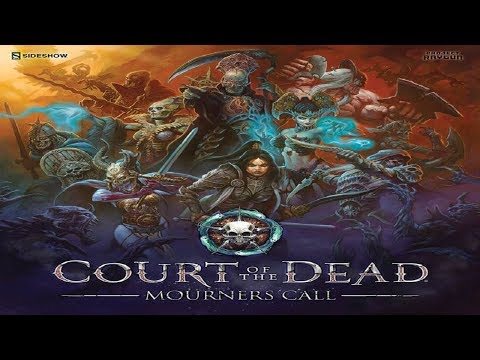
Everyone is already dead in the Underworld. It's time to join the factions of Bone, Flesh and Spirit as they work to achieve the goal of the Underworld: to gather enough forces to take on the celestials of Heaven and Hell to end their ceaseless war. If the players work diplomatically in Court of the Dead: Mourners Call to maintain a balance, they can ensure the Underworld survives long enough for them to also complete their collective and hidden individual objectives. The player who best contributes to these goals will earn Death's favor and a place among the elite of the Underworld.
You are a Mourner — an allegiant of Death — dedicated to realizing his noble ambition to end the celestial war and restore balance to the universe. However, Death's purpose includes your own ulterior motives. You and your fellow Mourners must unite and rise, or fall together. But only one Mourner will achieve their particular vision of the Underworld united. Your task will not be easy. While the Underworld is united in its purpose, it is divided in its strategy to achieve that aim. There are three factions in the Land of the Dead: Bone, Flesh, Spirit. Each is a unique path to rise up against Heaven and Hell.
You will need to strategically manipulate your influence within these factions, their strongholds and guilds, and within the Court of the Dead if you wish to achieve your ends. But beware: The power within mortal souls — known as Etherea — is a perilous substance. Use it carelessly, and you risk invoking the Dreadsgrip - a destructive force within every Mourner that consumes all it touches, including its former master. Failing to satiate the celestials’ war need, or triggering the Dreadsgrip, has dire consequences for all Mourners. Are you strong enough to achieve your own ambitions and be the champion for the uniting force for which all Mourners Call?
—description from the publisher

Court Of The Dead - How To Play

Court of the Dead - Mourners Call Runthrough
- Awesome production quality and aesthetic.
- Fantastic artwork.
- Simple but deep gameplay.
- Player-determined game length works well.
- Engaging semi-cooperative element.
- Concise scoring system.
- Awesome rulebook.
- Interesting faction abilities.
- Game plays well at 3-5 players.
- Tracks might matter more with more players.
- Wish there were more unique cards (mourner cards, court cards).
- The luck of the draw with wallow cards can be a bit much.
- The game is about factions within the Underworld fighting for influence and power.
- Inis
Mechanics (from transcript analysis)
- Area Control — Players compete for control over different areas on the board.
- Card Drafting — Players draft cards that determine their actions or provide benefits.
- Set Collection — Collecting sets of cards or tokens to gain benefits or points.
- Track Advancement — Tracks advance based on player actions, influencing game events or end conditions.
- Variable player powers — Each player can utilize special player powers, allowing for flexibility in faction choice.
Video topics + discussion points
Quotes (from this video)
- The game is simple but has a lot of depth to it.
- I'd like to game so much I want more of it.
- The artwork for the game is fantastic.
- The game is super simple concise.
- It's very simple, very pretty and and still has enough strategic depth and does a really good job in its its time management.
References (from this video)
- Amazing artwork
- Thematic connection to personality (peaceful, not wanting to fight too much).
- Interesting card drafting mechanics.
- No round tracker mentioned.
- Some card text can be confusing (e.g., commas vs. colons).
- The game is about factions (Bones, Flesh, Spirit) vying for influence.
Mechanics (from transcript analysis)
- action selection — Players choose actions from a limited set each turn.
- Area Control — Players compete for control of locations to gain benefits.
- Card Drafting — Players select cards from a limited pool.
- Resource Management — Players manage 'atheria' and 'influence' as key resources.
- Set Collection — Players collect sets of faction types or achieve specific conditions for points.
- Worker Placement — Players place figures on locations to take actions or gain resources.
Video topics + discussion points
Quotes (from this video)
- The artwork is just amazing.
- Viewer discretion is advised.
- I hate.
- I think I win either way.
- You know what they say is you just gotta smack some ass and make some allies.
- He's not you're like whoa cat you're never a threat so your mouth.
- I knew as soon as I said if I had death I would have picked it first.
- This card drafting is probably the hardest part.
- I really like the free-flowing nature of calcul.
- My ulterior motive a faction of bone a rigid spine will bear the greatest burden recruit mourners through the dearth Forge as well as Calvin ha Rose gained 4 points for each mortar bone mourner car that haven't liked 16 yeah so well my secret one is gained two points for each unity instead of one yeah I got 14 points from that
References (from this video)

- High rating on BGG
- Intriguing theme
- Mourners dedicated to Death's ambition to end the celestial war and restore balance to the universe
- Underworld
Mechanics (from transcript analysis)
- Cooperative (implied) — Mourners must unite and rise, or they will all fall together.
- Strategic Division — The underworld is united in its purpose but divided in strategy.
Video topics + discussion points
Quotes (from this video)
- The court that surrounds him and contains subjects who seek power and so each player represents a family that will vie for control over the different subjects of the land.
- Seven different victory conditions so the path to victory may shift as you play and you gain more information about each subject's motives during the game.
- Usurp the King does sound interesting enough that I'm really looking forward to giving this one a try.
- Players are aspiring vinyl collectors, you know vinyl those big flat black LPS that my daughter wouldn't recognize if I waved one in front of her face.
- Players then will acquire morsels of information and that information will lead them to different vinyl bins where they will select albums to add and expand their collection.
- Inventory is limited and the other customers may be targeting the very same vinyl gems as you.
- There's there's there's something about this game that scene very very familiar.
- Players take turns being the focus of an intervention by drawing a problem card with a nonsensical problem like uncontrollable interpretive dance or neurotic inability to turn right.
- Friends will give obscure clues and hints at what the problem is without giving it away completely and the sooner the intervened it can guess what their problem is well if the more points they'll score.
- It's also one of those games that I don't know how often I will find the need to play it after playing it once but sounds interesting enough.
- Players take on the role of foxes trying to steal as many chickens as they can from the henhouse and then cook them up into delicious fried chicken dinners.
- Each character's Fox that they play has a unique ability that can be used once throughout the game giving them a little bit of player asymmetry.
- Rolling poorly too many times he might scare the chickens out of your bag which would end the game and no chicken dinner for you sorry.
- I love a good word game.
- In this game all players create words simultaneously from their letter pieces that they're going to have on the table out in front of them.
- There's a thrilling little challenge of word discovery that starts to happen.
- You score more points the fewer pieces that you lose.
References (from this video)

- Absolutely stunning artwork.
- Fantastic miniatures.
- Epic theme of fighting Heaven and Hell.
- Gathering soul energy and gaining affinity of factions to raise an army against Heaven and Hell.
- The Underworld (Court of the Dead)
Mechanics (from transcript analysis)
- Area Control — It is an area control game.
- Faction alignment — Gain the affinity of engine factions: spirit, bone, and flesh.
- Resource Management — Gathering soul energy.
Video topics + discussion points
Quotes (from this video)
- and we are continuing or 2019 Gen Con show here
- this year we're celebrating our 25 year anniversary
- our big game we have going on is diehard
- so this game is available in stores right now
- so we're showing off our new Harry Potter Hogwarts battle Defense Against the Dark Arts
- it's a very quick paced game okay it's very fun
- we've got our new geek out Disney
- this is coming out late in the fall
- we have our new preview for Toy Story obstacles and adventures
- this is a gift for a younger audience but at the same time they're like we all go over to a story
- for our talisman Kingdom Hearts this looks absolutely gorgeous
- this is our first time previous game ever
- we got another game here I see already a court of the Dead
- mourners call so this game is a are keys harder Edition
- it is a game by Sideshow Collectibles IP
- it's an area control game where death has hired you as mourners in the court of the dead to help and raise an army to fight against heaven in hell
- all this looks absolutely stunning
- that is absolutely stunning
- there you have it a lot of cool stuff here at the booth
References (from this video)
- Provides a detailed step-by-step setup and playthrough
- Explains many mechanics and phases of the game
- Mentions differences between Kickstarter and retail editions
- Does not exhaustively cover every card type or every rule; indicates 'we won't go through all of these'
- Complex rules may require consulting the rulebook or BGG for clarification
- Endless war between good and evil, corruption and ambition among mourners seeking power, and the pursuit of unity among factions.
- A mythic underworld setting where Death forms a secret court to unite the living and the dead and end an endless celestial battle.
- Lore-heavy fantasy backdrop explained by the host during a structured setup and playthrough.
Mechanics (from transcript analysis)
- Court card actions (colon/pay-cost) — Playing a court card triggers one of two actions, often requiring paying a cost to gain the item on the card; some actions alter faction influence.
- Court drafting phase — Court cards are drafted in multiple rounds; players pass cards around the table according to a chart, with draft one, draft two, etc.
- Dread script and dread's grip — A dread script track increases and can cause penalties or board-wide effects; reaching extremes can penalize players.
- Endgame scoring and tiebreakers — Final scoring aggregates unity tokens and influence, with tie-breakers involving atheria and mourner cards.
- Ethereal distribution (atherea) — At the start of a round, players roll dice to generate atheria and divide it into piles; players may take a pile or pass to gain influence.
- Guild tracks and influence — Gaining figures updates guild tracks; influencing costs are paid to move markers; exceeding limits triggers effects.
- Influence Points — Gaining figures updates guild tracks; influencing costs are paid to move markers; exceeding limits triggers effects.
- Recruiting guild figures and mourners — Players may recruit guild figures or recruit mourner cards by paying atheria; recruited items attach to bases and affect tracks.
- Resolving locations and guilds phase — Locations on the board grant bonuses based on control, resolved left-to-right; guild tracks are resolved in order.
- Unity tokens and celestial tithe — Players contribute unity tokens to the celestial tithe; highest contributor gains unity tokens; if quota is not met, consequences occur.
- Wollows and rakers — Wallow cards are dealt and resolved as quests; some wallows require fighting a raker with a guild figure to complete the quest.
Video topics + discussion points
Quotes (from this video)
- Court of the Dead mourners call designed by Pat Marino and published by Project Ray Gun
- the game is played over a series of rounds and each round is broken into eight phases
- you must keep this a secret from the other players as it will reveal additional ways that you can score points at the end of the game
- the oldest player collects the all taker figure making them the first player
- the player with the most points wins
References (from this video)

- rich mythology and thematic depth
- spectacular miniatures and production quality
- mythology, ambition, and intrigue
- underworld with powerful mourners vying for balance
- mythic fantasy with a grand design
Mechanics (from transcript analysis)
- miniatures and narrative-driven objectives — players pursue ambitious goals within an allegiant system.
- mortal souls resource mechanic — souls act as a resource with dread-related consequences.
Video topics + discussion points
Quotes (from this video)
- GenCon is right around the corner and literally hundreds of new games will be coming out there
- this is a hidden movement deduction and combat game for two to four players
- it's also a social deduction micro game
- fast and engaging gameplay as well as beautiful artwork
- I picked this up at BGG Spring and I love this game