
Cowboy Bebop: Space Serenade is a competitive deck-building game with 2 to 4 players in which you play one of the four members of the famous Bebop crew.
Each player tries to prove that he is the best bounty hunter by getting the most reputation points at the end of the game. To do so, they will have to capture the criminals wanted by the ISSP, in a spirit of limited collaboration.
During the game, players will be able to buy cards that will allow them to improve their personal deck, in order to better manage the resources necessary for their victory. They will also be able to move from planet to planet with gas or use their special abilities and even those of other players if they have in the same place as them.
The game ends when the terrible Vicious is captured or has fled.
—description from publisher

Images


- Very solid deck building game
- Very unique
- Interesting team up mechanics
- Works well as a 2-player game
- Some aspects of the game can be ignored.
- Team-up mechanics are less incentivized with more players.
- Bounty hunting
- Space, different planets
- Based on the Cowboy Bebop anime IP.
Mechanics (from transcript analysis)
- Cooperative elements — Team-up mechanics encourage players to work together.
- Deck Building — Players build and utilize decks of cards.
- Movement — Players travel to different locations using collected gas.
- Variable player powers — Each player controls a character with unique abilities.
Video topics + discussion points
Quotes (from this video)
- Seven out of these 10 games are fighting games.
- I'm very, very stingy with how I give my ratings out.
- It's a one versus many gameplay.
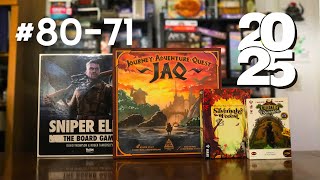
- I don't know why why they use the video game IP on this because truly it's just a World War II um strategy game, but that's like sniper game.
- Fate of the Fellowship, it is Pandemic's version of the Lord of the Rings style game.
- instead of being viruses they are armies of Mordor
- it is actually a lot easier to trade cards in this version.
- The game's absolutely beautiful.
- Welcome to the Dungeon. I I would love to have designed the game.
- it's a push your luck dungeon crawl
- if you don't want to go down the dungeon, you say, 'I'm out.'
- it gets to an unwinable state sometimes.
- it's a great $15, $10 game um with a super high replay value
References (from this video)
- Huge fan of Cowboy Bebop
- Absolutely fantastic
- Super thematic
- A lot of fun
- One you really should try out
- Cowboy Bebop
Mechanics (from transcript analysis)
- Deck Building — Cowboy Bebop space serenade I have a huge fan of Cowboy Bebop I think it's absolutely fantastic and this is a deck building game.
- Mission resolution — Where you go to the different planets doing different missions collecting bounties but also you've got to fight the big main boss at the end of it.
- Resource Management — You've got to make sure you've got resources in in the different currencies not only with fuel to get to different places but money and of course attacking power.
Video topics + discussion points
Quotes (from this video)
- The first thing I'm sacrificing is not a rule book which we spoke about last month inserts for board games get rid of them get them gone they're mostly bad
- I think about the fancy flight insert they're kind of like cardboard and the trough the cardboard little thing therefore throwing away it's a shipping insert so that all the contents of the game doesn't go wildly around the Box during Transit it's not going to be kept
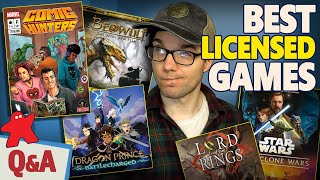
- The reason this was an incredibly difficult list for me to write is because there are hundreds of games with massive franchises plastered all over them some of which are fantastic so I am told but I'm just not really a big fan of almost any of the big IPS that there's classically lots of games about
- It's a lot of bluffing and strategy and just fun stand-up moments
- So that's my list of 10 games that have IPS on I really really love
- Short answer to that is no
- I get emotionally manipulated by media a lot of the time so I stay clear of anything that's gonna really bummed me out make me feel bad because I feel bad enough and I don't need my hobby to make me feel bad as well
- I have never seen it being possible in board games I wouldn't say it's not possible in board games but it's also not where I want to go with the board game hobby personally although I'm happy that I exists for other people
- The community it's that it's playing it's having fun with friends that type of thing
References (from this video)

- Strong thematic tie-in with Cowboy Bebop (pictures and scenes referenced).
- Slight cooperative element adds teamwork in pursuit of points.
- Accessible, light to medium complexity.
- Diverse character options (Spike Spiegel, Jet Black, Faye Valentine, Edward Wong).
- Deck-dilution risk due to damage cards obtained from fights.
- defeating criminals across planets
- space setting aboard the spaceship bebop visiting planets
- references to Cowboy Bebop TV series; boss battles; chase sequences
Mechanics (from transcript analysis)
- Area Movement — Move between planets as you progress toward objectives.
- Boss Battler — Boss battle style triggers provide a climactic confrontation.
- boss_battles — Boss battle style triggers provide a climactic confrontation.
- combat_with_criminals — Defeat criminals to gain points; stronger enemies yield more points.
- Combat: Deck/Hand — Criminals appear from a criminal deck; bosses trigger at certain moments.
- Compound Scoring — Points determine the winner; defeating criminals and boss encounters contribute to score.
- criminal_deck — Criminals appear from a criminal deck; bosses trigger at certain moments.
- Deck Building — Actions on the cards you draw on your turn; you draw, improve your deck, and remove weaker cards.
- deck-building — Actions on the cards you draw on your turn; you draw, improve your deck, and remove weaker cards.
- point_based_scoring — Points determine the winner; defeating criminals and boss encounters contribute to score.
- Resource Management — Collect fuel to travel and convert fuel to money or other benefits; discard damaged cards obtained from fights.
- resource_management — Collect fuel to travel and convert fuel to money or other benefits; discard damaged cards obtained from fights.
Video topics + discussion points
Quotes (from this video)
- the game plays two to four players with mechanics such as tech building area movement and resource management
- the game is of light to medium complexity in the game play
- slight cooperative element of trying to defeat the criminals together
- pictures and scenes from the TV series that is thematic to the game
- you'll get to play as spike Spiegel jet black Valentine and Edward Wong
- defeating criminals that keep popping out of the criminal deck
- boss battle style triggers
References (from this video)

- Light and accessible deck-building makes it approachable for newcomers
- Strong thematic alignment with Cowboy Bebop, enhancing immersion
- Color synergy provides meaningful decisions without heavy complexity
- Cooperative final boss encounter creates a satisfying shared objective
- Compact playtime suits quick sessions and casual pickup games
- Niche theme may not land for players unfamiliar with Cowboy Bebop
- Balance and pacing details are not described in the transcript, leaving questions about how the final boss scales
- Bounty hunting, crew collaboration, risk versus reward, and a narrative arc culminating in a climactic confrontation.
- Cowboy Bebop-inspired bounty hunting set in space noir, featuring iconic crew dynamics and a shared threat.
- Episodic-to-arc progression: each bounty hunt advances the story until the final boss confrontation with The Vicious.
Mechanics (from transcript analysis)
- Boss Battler — When the notorious Vicious is revealed, players must coordinate to defeat a shared threat, creating a climactic cooperative moment.
- color-based synergy — Certain cards have a color; synergy abilities activate only when a player has at least one card of that color in hand, guiding composition and timing.
- cooperative boss encounter — When the notorious Vicious is revealed, players must coordinate to defeat a shared threat, creating a climactic cooperative moment.
- Deck Building — Players start with a 10-card deck and acquire new cards to strengthen their deck over the course of the game, creating evolving strategies.
- deck-building — Players start with a 10-card deck and acquire new cards to strengthen their deck over the course of the game, creating evolving strategies.
- Hand Management — On a turn, players play five cards from their hand, balancing actions, resources, and potential synergy triggers.
- Resource economy — Coins are earned to buy cards from a market to improve the deck; fuel is spent to travel to planets and execute attacks.
- Resource Management — Coins are earned to buy cards from a market to improve the deck; fuel is spent to travel to planets and execute attacks.
- scoring and victory condition — Renown points are tallied after the final boss encounter; the player with the most points wins, reinforcing risk-reward choices throughout.
- space-bounty progression — Bounties are added over the course of play, driving pressure to pursue targets and manage risk as the pool grows.
Video topics + discussion points
Quotes (from this video)
- this game is a light deck builder
- you'll get a starting deck of 10 cards
- you can also gain coins which will help you buy carts in the market
- bounties will continue to be added until the notorious vicious is revealed
- if you do then you win the game
- you're chasing bounties with one of the four main characters from the cowboy bebop series
- once this happens you'll have to drop everything and work together in order to defeat him
References (from this video)

- Licensed game with excellent theme integration
- Semi-cooperative mechanics match anime themes
- Thematic bounty system matches show dynamics
- Individual motives alongside team cooperation
- Cowboy Bebop anime universe
- Space bounty hunting
- Thematic bounty-hunting narrative
Mechanics (from transcript analysis)
- Bounty hunting — Players hunt bounties with cards and mechanics
- Semi-Cooperative — Team working together with individual motives
- Thematic integration — Theme deeply integrated into gameplay
Video topics + discussion points
Quotes (from this video)
- I play Qwirkle every morning - it's a perfect way to start my day
- The art is just beautiful and I'm really proud to own and show off to people when they come over
- The game is whatever you create it to be
- This game blew my mind
- It feels like you can do anything and because of that I was just blown away
- You can play a hundred different ways and you could probably still win
- This is not gonna get old - we may not play it a ton but when we do play it it's always a blast
References (from this video)

- Strong thematic alignment for Cowboy Bebop fans.
- Distinct character identities create varied strategic paths.
- Solid intro deck-builder with interesting synergies.
- Licensed theme may be niche for some players.
- Theme quality depends on player care about the source material.
- Bounty hunting, space noir with character-driven missions.
- The Bebop crew's adventures in space, pursuing bounty targets and facing threats across galaxy-frontier settings.
- Character-driven, semi-cooperative with individual goals and show-inspired flavor.
Mechanics (from transcript analysis)
- character_synergy — Each character has unique abilities that steer strategy and interactions.
- deck_building — Cards are acquired and combined to defeat enemies and complete objectives.
- Drafting — Players draft cards to build their deck and synergy with their chosen character.
Video topics + discussion points
Quotes (from this video)
- it's such a classic and i would highly recommend it even if you're not into anime
- this game is what a push your luck game should be in my opinion
- i love this game i love the tension that it brings with such a simple concept
- semi-cooperative games and this one is a great example of the semi cooperative genre
- the mind is a super simple cooperative card game for two to four players where all you're trying to do is place your cards in ascending order
- between two castles is semi-cooperative because that means that it's really easy to teach new players