/pic3326341.png)










CrossTalk Deep Dive
What the Community Thinks About CrossTalk
CrossTalk has earned recognition as a clever and rewarding party game that stands apart from mainstream titles like Codenames. Channels like Actualol and Adam in Wales consistently praise its cerebral, quieter design and the creative mental chess between clue-givers. The game has found particular favor with groups who appreciate wordplay puzzles and strategic communication challenges, though reactions vary on whether it will become a long-term classic or remain a beloved niche favorite.
Core Mechanics That Define CrossTalk
The Hidden Word and Secret Clues
At its heart, CrossTalk is a team guessing game where both clue-givers know a shared keyword they must guide their teams to guess. The critical twist is that each clue-giver also writes a private one-word clue that only their own team sees. This hidden information creates asymmetry: the opposing team might be working with a completely different context, so the verbal clues given afterward can seem to make no sense to them. Designed by Christopher Chung and published by Stronghold Games, it builds its entire tension on that hidden context.
The Public Clue and the Steal Mechanic
After clue-givers each write their secret clues, they take turns giving public, one-word clues that both teams can hear. The catch is that immediately after each public clue, the opposing team gets the first chance to guess. This forces clue-givers into a careful balance, giving enough information to help their team without handing an easy win to the competition. The alternating structure means clue-givers must think strategically about what they reveal and when, often delivering deliberately cryptic clues to avoid a steal.
The CrossTalk Experience
Accessibility and Depth
The game is remarkably easy to teach. Players learn the core concept within minutes, yet depth emerges through repeated plays. As teams become familiar with one another, they develop shorthand and inside jokes, allowing clue-givers to leave increasingly subtle hints. The whiteboards teams use to quietly share their thoughts add a layer of silent collaboration absent in louder party games, creating a more measured, cerebral atmosphere than typical word-guessing games.
The Payoff Moment
What players consistently highlight is the satisfaction of the breakthrough. When guessers are completely lost, staring at seemingly disconnected verbal clues, that sudden click as the pieces fall into place delivers a genuine rush. Reviewers mention the joy of watching their teammates have that eureka moment, when disparate clues suddenly reveal the connection that leads to the correct guess. The whiteboards make that journey visible, as teammates scribble guesses, cross them out, and slowly converge on the answer together. That shared deliberation turns each correct guess into a collective victory rather than a single player's flash of insight.
What Makes CrossTalk Stand Out
The Secret Clue Layer
Unlike Codenames, where all clues are public and symmetrical, CrossTalk's hidden word creates a genuine informational advantage. Teams that know their own secret clue can interpret public clues in context; the opposing team cannot. This asymmetry is where the game's tension lives, requiring clue-givers to consider not just what helps their team, but what might be unhelpfully revealed to their opponents.
The Strategic Clue-Giving Challenge
Reviewers praise the intellectual challenge of crafting clues. The single-word limit forces creativity. Clue-givers must find words that relate to the keyword while staying cryptic enough that they do not jump out to the other team. As teams grow experienced, this challenge amplifies: clues become more clandestine and unintelligible to outsiders, with players deliberately choosing words that only their team, through shared history, will understand. The game rewards learning your teammates and building shorthand that deepens with each play.
Potential Drawbacks
Swings and Variance
The game is prone to dramatic swings in momentum. A single well-placed or poorly placed clue can decide a round quickly. Some rounds complete in seconds when the opening clues align too closely, while others extend as players probe increasingly obscure hints. Reviewers note this variance can feel unsatisfying at times, with some players wishing for more control over round pacing.
Component and Design Execution
While the gameplay is solid, some reviewers note that the component design and iconography could be stronger. The visual presentation does not always match the quality of the mechanics, and a few design choices feel slightly off-target in how information is communicated. These are minor quibbles that do not significantly impact play, but they are worth noting for players considering a purchase.
If You Enjoy CrossTalk
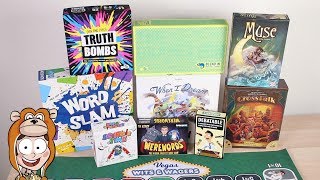
If CrossTalk clicks for you, you may also appreciate Codenames, the gold standard of modern word-cluing games with similar social-deduction elements. For a different take on team communication, Decrypto strips away theme to focus on abstract clue interpretation. Word Slam offers a faster, more chaotic energy if you want to stay in the word-guessing family, and Wavelength provides a different flavor of reading your teammates through positional guessing rather than verbal clues.
What Reviewers Are Saying
"I really enjoy CrossTalk. I've played it ten times now, and with a bunch of different numbers it worked well as a four-player game, but it really sings when you've got more people guessing, because they have whiteboards and can discuss their answer with their teammates and really think it through."
— Actualol
"CrossTalk is an interesting party game, and I think that's the best way to describe it. It's really interesting. It's not as accessible as some of the other party games like Codenames; it's quieter, it's more cerebral."
— Adam in Wales - Board Game Design
"I love the challenge of CrossTalk: how can you give information to your team while the other team listens to everything you say? The more you play, the more clandestine and unintelligible your clues become, as you're desperate not to give too much away."
— Actualol