/pic7415514.jpg)
Good times in the tiny kingdom of Emara: During the reign of King Thedorius the Wise, wars, uprisings, and other inconveniences became a thing of the past. Thedorius always cared more for the well-being of his subjects than for power or riches. Therefore, only the nobleman who is able to care for Emara's citizens as well as Thedorius himself did shall become Thedorius' successor and wear the Crown of Emara.
To test the skills of all aspirants, Thedorius and his counselors issue a challenge of practical use: Whoever can persuade the majority of the newly arrived citizens in the capital to support their claim shall become the future king of Emara. To achieve this, players have to cater to the citizens' needs and — most importantly — offer proper housing for everyone. This means that promoting the building activities in town will be one of the major tasks of the candidates.
Crown of Emara skillfully combines card actions with worker movement actions, allowing players to plan their turns carefully during their downtime. The two counselors available to every player move in two separate roundabouts, requiring players to optimize every move. Additionally, two scoring tracks lead to a multidimensional playstyle as only the lower score counts towards victory and thus both tracks have to be advanced equally.

Essen Plays - Oct 20, 2018

How to Set Up Crown of Emara


Mechanics (from transcript analysis)
- action movement programming; modular board; pick up and deliver; scoring on multiple tracks — voting/selection themed; citizens vote via housing and other mechanics
Video topics + discussion points
Quotes (from this video)
- it's an ongoing ripple effect of me changing the channel up and not making reviews any more
- I've been thinking about doing this for a while and I finally went about changing my audio setup in here
- thanks for watching
References (from this video)

- smitten from the start; wheelhouse for the reviewer
- clean combination of card play and rondelles; satisfying decisions
- high complexity; potential balance issues across player counts
- requires careful teaching; experienced players may enjoy more
- programming/engine-building Euro
- mythic kingdom with cards, rondelles and worker placement
- tableau/engine-building
Mechanics (from transcript analysis)
- citizen and housing scoring — scoring tracks and housing tokens; balance of citizens and houses affects final score
- nine-card set and three-card draft per round — each round you draw three of nine starting cards and must play all three
- planned sequencing — the order of card plays determines what actions are available when; many actions are linked and must be performed in order
- rondelles to activate spots — two rondelle boards; move a worker to activate a spot; one board provides resources, the other provides scoring/bonuses
Video topics + discussion points
Quotes (from this video)
- this is definitely a light style game
- I think it's actually easier to teach than the original Azul
- the randomness of the card draw is gonna be a turn-off for some people
- I am looking forward to exploring this one more
- this was the biggest disappointment of the convention for me
References (from this video)

- well balanced
- smooth play
- beautiful components/art
- feels like just another game
- resource generation and exchange with dual rondelles
- medieval/fantasy realm
Mechanics (from transcript analysis)
- double rondelle board — two rondelle boards for resource generation and resource exchange
- no hidden objectives — lacks hidden objectives or a stronger overtaking track
- resource generation and exchange — move on boards to generate resources and exchange them for points
- Rondel — two rondelle boards for resource generation and resource exchange
Video topics + discussion points
Quotes (from this video)
- the box itself is also a player aid on the inside it has the map that's also on the rulebook for what destinations are connected
- Neon is like SimCity meets Seven Wonders
- it's very well balanced it plays well and it's very pretty
- the harvesting cards seem to be very limited so I could plant a lot of tea but I can't really get that tea in order to fill the contracts
- I definitely recommend making sure that you're in a hotel that has space for playing games so that you can actually get in some games
References (from this video)
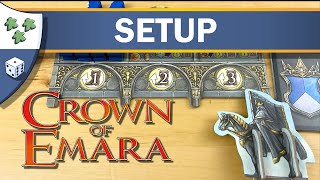
Mechanics (from transcript analysis)
- Card Drafting — Details separating advisors into decks A and B, shuffling, dealing cards, and drawing a starting hand.
- Player Count Adjustment — Explains how to adjust counter tokens for different player counts, specifically for a two-player game, rotating markers to two or the next number in sequence.
- Resource Management — Discusses placing four resources in their respective countryside quadrants and stacking bread near the grain.
- Track Advancement — Mentions assembling the score track and placing citizen and building markers on specific numbers.
- Worker Placement — Describes placing counselors on indicated spaces, going clockwise around circles.
Video topics + discussion points
Quotes (from this video)
- Here's how you set up Crown of Amara
- The boards are double-sided one has rich saturated artwork but it can be tough to see the relevant icons the other side is desaturated with popped out iconography the desaturated side might be a better bet for your first game
- The rulebook suggests putting your buildings on 35 for the first game to make it a little easier alternatively you can just start your buildings on the same mutually agreed upon space
- If you'd like to know more about how to play click the link at the end of this video or in the description below to watch my complete how to play video
References (from this video)
- The scoring mechanism requires balancing two tracks, making it engaging.
- The 'pull up the ladder' effect adds strategic depth to action selection.
- Multiple paths to victory through craftsmen, advisors, and rank improvement.
- Variable setup options for different player counts and preferences.
- The board artwork might be visually rich but difficult to discern icons.
- For a first game, the rulebook suggests placing building markers higher to make it easier.
- Vying for the crown upon the benevolent king's retirement.
- The Kingdom of King Theodorius
Mechanics (from transcript analysis)
- Deck Building — Players start with a small deck of cards, use them, then shuffle and repeat the process.
- event cards — An event card is revealed at the start of each round, changing the game's circumstances.
- Resource Management — Players collect and spend various resources (wood, stone, cloth, grain, gold, books, etc.) to achieve objectives.
- Rondel — Players move counselors around country and city circles, taking actions based on the space they land on.
- Set Collection — Players collect favor tokens and noble rank cards.
- Variable player powers — Advisors provide ongoing or one-time benefits to players.
- Worker Placement — Players place counselor pawns on location spaces to take actions.
Video topics + discussion points
Quotes (from this video)
- and this is crown of amara
- your score at the end of the game is the lower of these two totals
- the first person to pay for an action generally gets the highest benefit and then the law of diminishing returns applies for everyone who comes after
- The rulebook suggests putting your buildings on 35 for the first game to make it a little easier
- if you're still tied after that i don't know what to tell you i got other stuff i'd rather be doing
References (from this video)

Mechanics (from transcript analysis)
Video topics + discussion points
Quotes (from this video)
- i'm not actually shipping you these animals i'm not going to send them to you in crates or anything i'm just going to associate you each with an animal
- i love you all equally and you'll all get amazing animals
- if you have an internet handle and you have an employer who has a constitutionally indefensible social media policy and you just want to go by your handle that's fine i won't say your real name that's totally cool
- the medici level by the way that's the first level where we actually get voting rights
- in the real world there's really only room for one pope but on my patreon campaign they have as many popes as you want to as you want to put in there
- the whole they're absolutely wonderful people you will definitely find friends to play games with in this group
- if you'd like to support a died in the wool creative guy like me who has trouble getting along in the traditional workforce because he doesn't play well with others and refuses to wear pants then check out my patreon campaign
References (from this video)

- Cute birdies on the box art
- Interesting title 'Crown of Amara' invoking fantasy
- Board pieces that puzzle piece and notch together
- Rulebook has many pictures and seems light
- Nice production values and artwork
- Unique wooden pieces and meeples
- Fantasy theme may appeal to family
- Expects the crown itself to be just a token
- Cardboard thickness is slightly thinner than some recent games
- Score track pieces don't fit as nicely as the main board pieces
- crown of power
- fantasy kingdom
- Wingspan
- Concordia
- Village
- Minion
- Voyages of Marco Polo
- Monopoly
- Catan
Mechanics (from transcript analysis)
- Card Play — On each turn, a player spends one card, which is compared to Concordia's card-driven actions.
- Deck Building (Speculative) — Initially suggested due to multiple decks, but questioned because the card backs are not uniform, making it difficult to tell what is being drawn.
- Modular Board — The game board is made of interlocking pieces that form quadrants.
- Set Collection — Symbols on cards appear to be collected to gain points, similar to the Minion card deck.
- Worker Placement — Players use their 'counselors' in both the town and countryside areas, suggesting worker placement.
Video topics + discussion points
Quotes (from this video)
- This was on the shelf for a while what I had to do was go back and as you've seen in a couple of other videos the underwater cities ones I had to redub it kung fu style
- it's such a the things that probably the publisher didn't even consider
- look how adorable two cute little birdies oh my gosh well who wouldn't want a game but two cute little birdies
- the most ridiculous thing that got me really excited about crown of amara is that the board is in is in chunks that puzzle piece together
- if you have a box that makes a horribly filthy noise and would cause you to not invite it over for thanksgiving dinner ever again I would like you to film that and I would like you to send me the video
- I'm a visual learner and I think that picture examples are really important for teaching a game
- so yeah it looks i mean it looks pretty darn light and that's fine
- oh my gosh the illustration looks gorgeous it reminds me very much of village
- these wood pieces look very unique I've never seen anything like these before in any game that I own
- it looks like the chef boyardee meeple from what do we see the the voyages of marco polo
- insert socks look at that this uh it's the double well
References (from this video)
- card-driven rondelle with multiple tracks
- strong parallel to other card-driven rondelles
- requires careful deck management and planning
- Scorpius Freighter
- Vi Counts of the West Kingdom
Mechanics (from transcript analysis)
- Deck of three cards drawn per round — You place cards onto your board to activate actions; you can plan around the number above the card.
- Personal rondelles — Each player has two personal rondelles that can be advanced with cards to trigger different actions.
- Two rondelles with card-driven movement — Two central rondelles; cards in front of you drive movement and actions.
Video topics + discussion points
Quotes (from this video)
- I'm using pretty loose definitions of rondelle
- I cluster New York Zoo, Murano, and Scorpius Freighter because all of these have neutral pawns
- this is a mancala style game
- there are modular boards and looping action tracks
References (from this video)

- Heard of it
- Succession
- Kingdom
Mechanics (from transcript analysis)
- Succession gameplay — Win the crown and succeed the king of Amara
Video topics + discussion points
Quotes (from this video)
- We love trick taking games
- This game is so much freaking fun
- I adore GMT games, they are becoming one of my favorite game publishers
- If you remember Vast Crystal Caverns is in my top five games of all time
- We bloody love it
- We can't stop playing
- It's a blimp game not a train game
- That's just work
- I don't think I want to play it
- I'll get it eventually
References (from this video)
- Host has personal interest
Mechanics (from transcript analysis)
Video topics + discussion points
Quotes (from this video)
- I know the games I play. I know the games I love to play. And I know the games that I theoretically want to play but don't actually play.
- I need at least one of those two things in play - either high personal interest or good reputation
- Designers, reviewers, other people mentioned
- I'm going to be trying to be more mindful about reality as opposed to the desires that I have
- These tend to be less of a priority. Like occasionally I dive into an unplayed game that isn't a review copy, but more often than not if I'm diving into an unplayed game, review copies do take precedence
- I have so many euros I love and so many that I'm behind on
References (from this video)

- engaging rondell scoring system
- variety of resources and powers
- could have more player powers for depth
- resource collection and rondell mechanic
- ancient jewel-themed realm
- multi-category scoring via rondell system
Mechanics (from transcript analysis)
- Compound Scoring — spend and gain resources; scoring categories determine final score; two scoring tracks
- Rondell/resource cycling — spend and gain resources; scoring categories determine final score; two scoring tracks
Video topics + discussion points
Quotes (from this video)
- this is such a wonderful game
- I had a huge Monopoly on the money generating Viking
- it's such a great little programming game
- I like this little Jewel Rondell system
References (from this video)

- engaging rondell economy
- two scoring tracks add depth
- slightly light for upper tier of list
Mechanics (from transcript analysis)
- rondell resource drafting — Light to medium weight rondell mechanism involving resource collection and spending for scoring across two criteria.
Video topics + discussion points
Quotes (from this video)
- mind was a big hit for me in 2018
- this is the second Wolfgang Warsch game
- Gloomhaven really did blow me away
- absolutely genius mechanisms