/pic6740264.jpg)
Game Info
Year
2018
Players
2-4
Age
14+
Playtime
60 min
Collection
Ratings
Mechanic profile
Not enough video data yet
Vibe profile
Not enough video data yet
Description
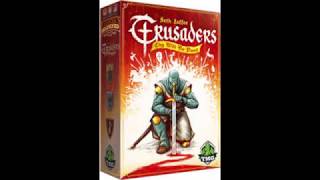
Move your knights, erect buildings, and go crusading to spread the influence of your Order. When the Orders get too strong, King Philip will become nervous and disband all Templar orders, ending the game.
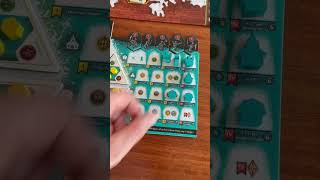
Crusaders: Thy Will Be Done uses a combination of rondel and mancala mechanisms. Each player has their own rondel, which they can upgrade over the course of the game, that controls their action choices during the game. Your faction gives you a special power to control your rondel, and the buildings you erect will help you form a strategy.
Featured Videos


Ask a Rules Question
All mentions
Browse transcript mentions, sentiments, pros/cons, mechanics, topics, quotes, and references.
Total mentions: 22
This page: 22
Sentiment:
pos 16 ·
mix 2 ·
neu 1 ·
neg 1
Showing 1–22 of 22
Video -2Un2pz6Mas
Top List at 5:56 sentiment: positive
video_pk 134311 · mention_pk 383082
Click to watch at 5:56 · YouTube ↗
Overall sentiment (raw)
positive
Pros
- Unique take on Malala mechanism
- Tight board near the end
- Expansion improves gameplay
- Influence action is more interesting with expansion
Cons
none
Thematic elements
- Knights orders, Crusades
- Medieval Europe
Comparison games
none
Mechanics (from transcript analysis)
- action selection — This is a small change but it does make a pretty big impact on the timing and how you want to set yourself up for your next turn.
- area influence — rather than just using the influence action to gain points you instead use it to claim influence tokens in different regions on the board and these tokens will give you points but they will also give you some sort of benefit as well.
- Worker placement (Malala mechanism) — this is another one of those rare games that uses the Malala mechanism the cool twist here is that most Malala games will give you actions based on where your where your tokens end Crusaders gives you the actions based on where you initially pick your tokens up from.
Video topics + discussion points
No key topics recorded for this video.
Quotes (from this video)
- Original Seven Wonders was already on my list at number 94 and like a lot of other folks I like this two-player version just a little bit better
- This is one of the most intense two-player games I think I've ever played because the entire time your opponent is taking their turn you are watching and waiting hoping that they do not take that one spot that you need to get that card you want.
- this is by far my favorite game of the North Sea Trilogy and very nearly my favorite of all of the Garfield trilogies
- 878 Vikings uses is a fairly quick and easy to understand dice rolling mechanism with custom dice to determine the outcome of these battles so the flow of the game isn't interrupted for too long when something exciting happens.
- this is another one of those rare games that uses the Malala mechanism the cool twist here is that most Malala games will give you actions based on where your where your tokens end Crusaders gives you the actions based on where you initially pick your tokens up from.
- this game is a bit of a trickster because the cover makes it look like an epic space game when in actuality it's a pretty dry Euro game.
- this is very much a push your luck card game on your turn you're going to flip over cards from a draw deck one at a time.
- this was one of the first citybuilding style games that I ever played and it's still my favorite.
- this game is great because it takes the idea of bidding and turns it on its head rather than seeing who can bid the most to take a card you are instead bidding to not take cards.
- paladins puts a cool Twist on the worker placement mechanism in this one you'll start each round by choosing a paladin card which will tell you which types of workers you'll get for the round as well as what special power you'll be able to use for that round.
- This one ranks up there among the crunchiest of the Garfield Trilogy games but again I have yet to play Scholars of the South Tigress which looks like it could take that title
- this is a classic bidding game that still comes out pretty regularly for us especially in social situations
- this game is great because it takes the idea of bidding and turns it on its head rather than seeing who can bid the most to take a card you are instead bidding to not take cards
- it's very easy to understand the rules and the game plays so fast that we usually end up playing three or four games of this in a row
- this is my highest ranked of the Garfield directional Trilogy games as of right now
- like most games in the west Kingdom Trilogy paladins puts a cool Twist on the worker placement mechanism
- everyone has their own board with worker placement spaces and really it's all about your using your workers the most effectively
- this one ranks up there among the crunchiest of the Garfield Trilogy games
References (from this video)
No references stored for this video.
Video JojY_atJZsI
BoardGameTeacher Rules Teach at 0:12 sentiment: neutral
video_pk 91800 · mention_pk 246437
Click to watch at 0:12 · YouTube ↗
Overall sentiment (raw)
neutral
Pros
none
Cons
none
Thematic elements
- Players take the role of a grandmaster of militaristic orders.
- the time of the Crusades
Comparison games
none
Mechanics (from transcript analysis)
- action selection — Players resolve actions by choosing wedges in their Rondo with action tokens and performing the action, then distributing tokens clockwise.
- Area Control — Players erect buildings and move Knights, implying control over areas on the board.
- Area Movement — Players move their Knights across Europe, and movement is determined by action tokens.
- Resource Management — Players manage action tokens and influence tokens throughout the game.
- Rondel — Players use action tokens on rondelle wedges to perform actions or upgrade their rondelle.
- Set Collection — Majority award tiles are awarded to players who defeated specific enemies the most.
- Worker Placement — Action tokens are placed on rondelle wedges to take actions.
Video topics + discussion points
No key topics recorded for this video.
Quotes (from this video)
- when in doubt, err toward omission. A null field is always better than a wrong field.
References (from this video)
No references stored for this video.
Video ysgnnBGrJUY
Getting Games Discussion at 7:59 sentiment: positive
video_pk 91737 · mention_pk 246233

Click to watch at 7:59 · YouTube ↗
Overall sentiment (raw)
positive
Pros
none
Cons
none
Thematic elements
Comparison games
none
Mechanics (from transcript analysis)
Mechanics unknown.
Video topics + discussion points
No key topics recorded for this video.
Quotes (from this video)
- there's big explosive turns of combo tastic scoring going on in between two castles of Mad King Ludwig
- Tetris II polyomino type things are fun
- I quite enjoyed Vindication
References (from this video)
No references stored for this video.
Video ng_gEBldjgw
Getting Games Discussion at 6:26 sentiment: negative
video_pk 89748 · mention_pk 238861
Click to watch at 6:26 · YouTube ↗
Overall sentiment (raw)
negative
Pros
- Enjoyed playing Crusaders in the past for a long time.
Cons
- Considering moving it on; not pursuing the new expansion; feeling done with the game.
Thematic elements
Comparison games
none
Mechanics (from transcript analysis)
Mechanics unknown.
Video topics + discussion points
No key topics recorded for this video.
Quotes (from this video)
- I think I might be kind of done with it
- the best solution for us right now is my iphone
- we filmed two more playthroughs and those realistically should be the first ones that go public
- I really can't wait to hear what people think
- we're hoping to put out the gallerist later this month
References (from this video)
No references stored for this video.
Video 76Gn3so-jzg
Watch It Played Analysis at 1:45 sentiment: positive
video_pk 89365 · mention_pk 237180
Click to watch at 1:45 · YouTube ↗
Overall sentiment (raw)
positive
Pros
none
Cons
none
Thematic elements
Comparison games
none
Mechanics (from transcript analysis)
- Mancala — Host mentions this game has a Mancala mechanism and it's available on Board Game Arena.
Video topics + discussion points
No key topics recorded for this video.
Quotes (from this video)
- what mechanism isn't used enough what game mechanism what thing in the game do you really like that you think is awesome that isn't in enough games you just think why why aren't we why aren't we always doing this
- I love that mechanism there's a 167 games on Board Game Geek that list Mancala as a mechanism
- Mancala is the mechanism that is not used enough
- it's a doozy because it's one of your favorite games that you should hate one of those games that you think I love that game it's great but it does defy every part of my taste and everything about myself that I've known for the last however many years I've been on this Earth
- really really heavy Euros where it's like oh let's do this thing well you've got to trudge through a massive rule book and there's 65 million things to remember and learn
- really heavily story driven games I find it to be a lot of work you know I just have to read the whole paragraph now and I don't want to read a paragraph when I play a board game
- those surprises are very satisfying and a lot of fun to find out
- what are the games that you have to buy into to enjoy what he meant by that are what are the games that you really have to invest into what you're doing to actually enjoy the game
- when people are stood up excited want to win trying their best really invest in the game it's phenomenal Stand Out Stellar exciting fun
- those type of things really investing in the experience and that got us all riled up they'll get everyone playing excited and anxious and nervous
- I think games are better when people invest in them
References (from this video)
No references stored for this video.
Video bIrT4A-GxYo
Watch It Played Discussion at 15:24 sentiment: positive
video_pk 89003 · mention_pk 235733

Click to watch at 15:24 · YouTube ↗
Overall sentiment (raw)
positive
Pros
- Fantastic
- Really really good
Cons
- Got destroyed by Chris Yee
Thematic elements
- Crusading, spreading across Europe
- Europe
Comparison games
none
Mechanics (from transcript analysis)
- Area Control — Spreading across Europe.
- Mancala — Build up your Mancala board by upgrading it.
Video topics + discussion points
No key topics recorded for this video.
Quotes (from this video)
- I hated doing it so much it took I'll be honest it took a bit of the joy out of playing board games for me
- I need to cull some board games I am surrounded I am on all fronts there everywhere I need to get rid of some games I cannot go on like this
- The fact that if someone else I know owns the game I can get rid of it a bit easier a bit easier not just my friend Sean owns you know Shakespeare so I don't need Shakespeare of course I need it well if I want to play it
- What were the surprises what were the games that no one was expecting that creeped up on you and went I'm brilliant
- It made you feel like a genius because it rewarded you for playing the game it gave you those drips of endorphins as it went on
- It's got one of the best tokens I've ever seen in the game which is a respect token that when your opponent does something amazing you give them this respect token.
References (from this video)
No references stored for this video.
Video qgcRDiCzVeM
Getting Games Analysis sentiment: mixed
video_pk 87723 · mention_pk 314175

Overall sentiment (raw)
mixed
Pros
none
Cons
none
Thematic elements
Comparison games
none
Mechanics (from transcript analysis)
Mechanics unknown.
Video topics + discussion points
No key topics recorded for this video.
Quotes (from this video)
- This has been such a fun thing I hope we keep doing it and get to episode 58
- it's been two and a half years honestly
- I love this game
References (from this video)
No references stored for this video.
Video xz5KZ7PigUk
Watch It Played Top 10 List at 0:42 sentiment: positive
video_pk 85921 · mention_pk 221159

Click to watch at 0:42 · YouTube ↗
Overall sentiment (raw)
positive
Pros
- Fantastic rondell based action
- love this game
Cons
- Out of print, difficult to obtain
Thematic elements
- strategy game for noble knights
Comparison games
none
Mechanics (from transcript analysis)
- Rondel — Players manage their own personal rondelle which determines available actions and can be upgraded. Factions have special powers to control their rondelle.
Video topics + discussion points
No key topics recorded for this video.
Quotes (from this video)
- These are games on our radar.
- I really love this game. I think this might become a grail game situation for me because I think it's out of print and I really want my own copy and I don't know how to get it.
- Is this the greatest board game box cover of all time? It's got to be close.
- I like it better than a Zul.
- I don't know what a card dancing game is, but I'm very excited to find out.
- The decisions feel meaningful and interesting and I find myself just really happy to play it over and over and over again honestly.
References (from this video)
No references stored for this video.
Video LXnh-ZgpgT4
UndeadVikingVideos Discussion at 2:05:59 sentiment: positive
video_pk 85661 · mention_pk 220147

Click to watch at 2:05:59 · YouTube ↗
Overall sentiment (raw)
positive
Pros
- slick design
- very straightforward and good
- nice essentialized experience
- super solid game
Cons
none
Thematic elements
- Crusades
Comparison games
- Joan of Arc
Mechanics (from transcript analysis)
- Area Control — And then there was this whole aspect of the the crusading stuff and like area control and and with the different types of buildings
Video topics + discussion points
No key topics recorded for this video.
Quotes (from this video)
- I liked Heat Pedal to the Metal more than I have previously.
- Texas Showdown was surprisingly fun.
- Cockroach Poker was of course still awesome.
- And Hacker Lackin is great.
- the one that I have played in the past but played again that just reiterated to me like how slick I like just how much I enjoy the design was Crusaders. Thy will be done.
- It's a super solid game, too.
- I don't envy publishers right now trying to figure out what the heck to do.
- My favorite part about 51st state was you you you'd hire you'd hire a leader and your leader would give you bonuses or whatever and do your things. That's not in the new version.
- I like the original much more than the new one.
- The guy just felt the need to come back in every three or four minutes and talk about quite literally [ __ ] nothing.
- Small talk is just my kryptonite.
- I don't know how to make small talk. I only make big talk.
- My wife hates bugs. Which is why I'm trying to make the camper nicer.
- It's just like, Oh, you got your camper nice and like you could charge 50 bucks a night. It's lakefront.
- I will be the president of the Sparta Conservation Society bookmark one day.
- My dad might get to prison.
- I just hope I can make money off of it.
- Don't knock until you try it, man.
- It's a good chunk of voting power.
- My son is 13 and he wears size 13 wide shoes.
- He's just like, 'Oh, can I do it too, Dad?'
- I'm going to name it. I'm naming that chunk of road.
- It's just exciting when your parents be like, 'Oh, which way are you going to go?'
- It's just like, 'Oh, yeah, we got the robot. The robot broke down.'
- My daughter still enjoys going out there and summer's starting soon.
- Yeah, but you could just have the Airbnb and be like, 'All right, I'm going to be here what four weekends out of the summer?'
- It's just like, 'Oh, yeah, dad might get to prison.'
- I was like, 'Okay.' Just went back to playing Marvel Rivals.
References (from this video)
No references stored for this video.
Video NOlZ2ps1bO0
UndeadVikingVideos Discussion at 20:17
video_pk 85498 · mention_pk 219208

Click to watch at 20:17 · YouTube ↗
Pros
- Host contributed to background information in rulebook
- Host's suggestions were incorporated into the game
Cons
- Host's historical information was deemed too bloody by the publisher
Thematic elements
Comparison games
none
Mechanics (from transcript analysis)
Mechanics unknown.
Video topics + discussion points
No key topics recorded for this video.
Quotes (from this video)
- And then and then um you know, could I get some bacon? And she's like, of course you can get some bacon now. But I'm I with the bacon, if you could if you could make it really rare, like really rare, like very I mean like raw if possible, if that's possible, if I get get that. And she's looking at him like, 'What do you'
- It is the greatest game. Every single group of people that I've introduced that game to that I've seen people immediately take out their phone and buy it.
- He's like, 'It's raining outside. this this this guy standing next to me with a with a Viking sweatshirt on and and he's with with with Crocs with Ver Crocs and and uh and and gym shorts screaming at me that I yelled at this kid a couple of You know what? I'm just going to throw my cigarette away and get back on my bus and drive away.
- I'll fight it and send it to you.
- And the thing is like she's got like 20,000 subscribers and it's just she just doesn't care. She's just like yeah I'm going to do this. This is this is what I'm going to do. I'm just going to talk about every episode of Columbbo and I just god bless her heart you know.
References (from this video)
No references stored for this video.
Video ylbJh1Tiy-Q
Watch It Played Discussion at 13:39 sentiment: positive
video_pk 85428 · mention_pk 218864
Click to watch at 13:39 · YouTube ↗
Overall sentiment (raw)
positive
Pros
- Listed among beloved Mancala/flicking style games
Cons
none
Thematic elements
Comparison games
none
Mechanics (from transcript analysis)
Mechanics unknown.
Video topics + discussion points
No key topics recorded for this video.
Quotes (from this video)
- The most expensive game that I own is frankly a huge anomaly in my board game collection because that's Foundations of Rome.
- It's a showstopping game. It does something fantastic, which is it's a huge box, but it doesn't make the setup any longer to be bloodily long to set up.
- To me, that one game was an investment that I'll have probably for the rest of my life and I'll be able to play and enjoy.
- Is $200 worth of components and value and craft in this game? Maybe.
- The price per evening at that point gets lower and lower until you're thinking, 'Wow, this game gave me a month's worth of Nights Out, but spent in playing the game for $5 a pop.'
- Foundations of Rome is in my top 10 games of all time.
References (from this video)
No references stored for this video.
Video _sPo1quW4IM
BoardGameCo News And Weekend Review at 11:03 sentiment: mixed
video_pk 81837 · mention_pk 204649
Click to watch at 11:03 · YouTube ↗
Overall sentiment (raw)
mixed
Pros
none
Cons
none
Thematic elements
Comparison games
none
Mechanics (from transcript analysis)
Mechanics unknown.
Video topics + discussion points
No key topics recorded for this video.
Quotes (from this video)
- It sucks.
- Not sustainable.
- Longer conversation, effectively big box productions are more viable via crowdfunding than they are via traditional retail models.
- I like the Unstoppable system.
- I hope you have a better week than I'm going to have.
References (from this video)
No references stored for this video.
Video 2kXjIN23B9w
The Dice Tower Top 10 List at 16:30 sentiment: positive
video_pk 81711 · mention_pk 204126
Click to watch at 16:30 · YouTube ↗
Overall sentiment (raw)
positive
Pros
- Fast turns
- High map competition and presence
Cons
- May require more teaching with emerging players
Thematic elements
- area control with fast turns
- medieval crusades/joint knighting on a map
- strategy-driven with moderate table talk
Comparison games
- Austria
- Trajan
Mechanics (from transcript analysis)
- Area Control — compete for control across regions with knights/soldiers.
- area control on a map — compete for control across regions with knights/soldiers.
- fast turns and map competition — compact turns keep the game moving with high interaction.
Video topics + discussion points
No key topics recorded for this video.
Quotes (from this video)
- Four players is what we're talking about today.
- Four is the sweet spot.
- This is the classic board and dice game, Teayotiwakan.
- This is a four-player game to me.
- World Order nudged out Root from the number one spot because I thought, 'this is the four-player game'.
References (from this video)
No references stored for this video.
Video FQYn6l56t-o
Update Vlog at 31:29
video_pk 67053 · mention_pk 163045

Click to watch at 31:29 · YouTube ↗
Pros
none
Cons
none
Thematic elements
Comparison games
none
Mechanics (from transcript analysis)
Mechanics unknown.
Video topics + discussion points
No key topics recorded for this video.
Quotes (from this video)
- variety is the spice of life
- i live inside boxes my brain has a hard time getting out of them
References (from this video)
No references stored for this video.
Video XOV-3-6MYSU
john gets games Analysis at 27:20 sentiment: positive
video_pk 66413 · mention_pk 161710
Click to watch at 27:20 · YouTube ↗
Overall sentiment (raw)
positive
Pros
- interesting inverted mancala approach
- clear tactile action flow
- adds tension through end-state considerations
Cons
- can be hard to teach due to Mancala inversion
Thematic elements
Comparison games
- Trajan
Mechanics (from transcript analysis)
- Asymmetric turn mechanics — One player can have an advantage to move counterclockwise as an alternative to clockwise.
- Drop-based action activation — The action activated is determined by where you end up after sowing tokens.
- mancala-style action selection — On your turn you pick a pile of tokens, sow them around, and perform the action at the last dropped spot.
Video topics + discussion points
No key topics recorded for this video.
Quotes (from this video)
- I'm using pretty loose definitions of rondelle
- I cluster New York Zoo, Murano, and Scorpius Freighter because all of these have neutral pawns
- this is a mancala style game
- there are modular boards and looping action tracks
References (from this video)
No references stored for this video.
Video AukZKcUkFg4
watch it played Rules Teach at 0:11 sentiment: positive
video_pk 64945 · mention_pk 158550

Click to watch at 0:11 · YouTube ↗
Overall sentiment (raw)
positive
Pros
- You'll never be directly fighting with the other players because you're all part of the same army.
- Bonuses revealed add together.
- Level 4 buildings provide additional points at the end of the game.
- Designer offered a tie-breaking rule if players are unhappy rejoicing in a shared victory.
Cons
- If a space you are leaving contains an enemy token, it will cost you two points to leave.
- Saracen tokens always have a strength of six.
- In case of ties, if there isn't a tie for first place but there is a tie for second, the tied players each gain only one influence point.
Thematic elements
- As the leader of an order of knights, conquer enemies, erect buildings, fund your army, and spread your influence to impress the King.
Comparison games
none
Mechanics (from transcript analysis)
- Action Point Allowance — To resolve an action you pick a wedge and then count the number of these action tokens on it. That value indicates the starting strength of that action. After an action has been resolved, you collect all the tokens from its wedge and distribute them one at a time clockwise around your action wheel starting with the very next one.
- action selection — On your turn you'll pick one of two options to perform: either you'll resolve an action or upgrade a wedge.
- Area Control — Building can only be constructed per region and only in a region with one of your Knights that doesn't also have a circular enemy token there.
- Card Drafting — Players shuffle and deal two knight order tiles to each player, have them pick one to keep.
- Modular Board — Wedges are arranged around an action wheel, and these are double-sided. Building bonus tiles are randomly placed in matching spaces.
- Set Collection — At the end of the game, players check to see who has the most of each type of enemy token and those players collect the appropriate reward. Players also gain points for each unique set of enemy tokens they have.
- Variable action strength — As some of these different pieces are removed from the board, they can boost the strength of certain actions. These bonuses are cumulative.
- Worker Placement — Each player places their unused Knight piece onto an empty starting region.
Video topics + discussion points
No key topics recorded for this video.
Quotes (from this video)
- Welcome to Watch It Played my name is Rodney Smith and in this video we're going to learn the two four player game Crusaders designed by Seth Jaffe and published by tasty minstrel games who helped sponsor this video.
- As the leader of an order of knights it's not enough to just conquer your enemies you also have to erect buildings fund your army and spread your influence.
- On your turn you'll pick one of two options to perform as shown here on your board: either you'll resolve an action or upgrade a wedge.
- You'll win by having the most influence at the end of the game.
- You may even find you get so many action tokens on a wedge that when you go to distribute them after completing that action they wrap all the way around and just keep going and that's fine just continue to place your tokens one space at a time without skipping any.
- In a game with more than two players where there isn't a tie for first place but there is a tie for second you will instead flip this second-place tile over where each tied player will gain one influence point.
- The player with the most points wins and in the case of a tie the tied players share the victory.
References (from this video)
No references stored for this video.
Video kErI_i1wQWo
Meeple Mountain Review at 0:00 sentiment: positive
video_pk 39265 · mention_pk 118225
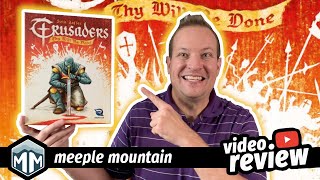
Click to watch at 0:00 · YouTube ↗
Overall sentiment (raw)
positive
Pros
- Rondelle provides deep planning with multiple viable choices per turn
- Asymmetric knights add variety and enable different strategies per player
- Accessible rules with substantial strategic depth
- Balanced non-direct conflict with meaningful competition for tiles and influence
- Expansions and future board variants promise continued engagement
Cons
- Endgame scoring can become token-heavy and slow to tally
- Indirect combat may feel tame for players who crave direct clashes
- Verbose interaction can become fiddly when many bonuses apply
- Balance of early choices can depend on player count and setup
Thematic elements
- Crusade-era influence, religious orders, and territorial dominance
- Medieval crusades across a modular map featuring knights, buildings, and land control
- historical strategy with modular map and rondelle-driven actions
Comparison games
none
Mechanics (from transcript analysis)
- building placement and rewards — Placing buildings on the map yields immediate bonuses and reveals additional rewards under the tile that can affect future turns.
- Influence Points — Influence is drawn from supply equal to action values and bonuses; the endgame triggers when influence tokens are depleted, prompting points-based scoring.
- influence token economy and end game — Influence is drawn from supply equal to action values and bonuses; the endgame triggers when influence tokens are depleted, prompting points-based scoring.
- knight movement and pressure — Knights move across hexes; movement equals calculated strength; more knights allow expanded reach; opposing knights influence pace and position.
- muster and crusade actions — Muster flips lowest level flag; Crusade allows removing enemy tokens and gaining influence; combat requires matching or exceeding enemy strength with a track-based calculation.
- Rondel — Each player uses a personal rondelle; upgrading wedges reveals more icons; actions are resolved by counting markers on the chosen wedge plus bonuses.
- rondelle action selection — Each player uses a personal rondelle; upgrading wedges reveals more icons; actions are resolved by counting markers on the chosen wedge plus bonuses.
- Tile Placement — Placing buildings on the map yields immediate bonuses and reveals additional rewards under the tile that can affect future turns.
- upgrade wedges and dual-action options — Upgrading a wedge reveals two action icons; players may split markers between the two actions on upgraded wedges and perform both, in order.
Video topics + discussion points
No key topics recorded for this video.
Quotes (from this video)
- the rondelle is the hero for me in this game
- it's one of those great straightforward easy to teach easy to learn games with a lot of strategy packed in it
- I’m a big fan of the travel Crusade action as you progress through the game
References (from this video)
No references stored for this video.
Video SmV27eSrUq4
Board Game Dad Top 10 List at 15:11 sentiment: positive
video_pk 37575 · mention_pk 235985
Click to watch at 15:11 · YouTube ↗
Overall sentiment (raw)
positive
Pros
- well-themed for Crusades topic
- dense yet rewarding
Cons
- meaty, complex; not ideal for younger kids
Thematic elements
- medieval religious and military campaigns
- Crusades-era Europe with orders of knights
- educational with thematic depth
Comparison games
- Imperial
- History of the World
Mechanics (from transcript analysis)
- area influence / action points — placing knights and spreading influence using action points
Video topics + discussion points
No key topics recorded for this video.
Quotes (from this video)
- the objective of the game is to collect animal cards by making an attractive planet for them
- it's cooperative which is why I think this game can play well with younger players
- the Spill says it's for ages 10 and up I do think you could play it with younger players
- this is an excellent game if you want your children to memorize the dates of specific events
- Risk if Risk was designed to be educational basically what's happening
- it's called Memoir 44 and in Memoir 44 it is a two-player game
- I cannot recommend Twilight Struggle because it is just too complex
References (from this video)
No references stored for this video.
Video cZ_kwmuHzHU
Stonemaier Games Playthrough at 1:36 sentiment: positive
video_pk 32581 · mention_pk 207054
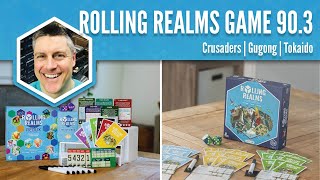
Click to watch at 1:36 · YouTube ↗
Overall sentiment (raw)
positive
Pros
- Fast to complete stars
- Clear wedge mechanics
Cons
- Wedge rules can be fiddly in places
Thematic elements
Comparison games
- Gong
- Tokaido
Mechanics (from transcript analysis)
- Dice Placement — Place dice to gain coins and hearts; complete wedges for benefits.
- dice placement in wedges — Place dice to gain coins and hearts; complete wedges for benefits.
- Set Collection — Completing wedges unlocks stars and resources.
- set/collection via wedges — Completing wedges unlocks stars and resources.
Video topics + discussion points
No key topics recorded for this video.
Quotes (from this video)
- We'll do it live.
- Wow. Completed crusaders early for all six stars.
- I would not recommend the show, but the book is one of my all-time favorites. The show really did not do the book justice, unfortunately.
- This pen is dying on camera in real time.
- Stumble. All right.
- Game 90. Great job, Mark, choosing these realms.
References (from this video)
No references stored for this video.
Video hYT_s4FdvA0
Board Game Dad Analysis at 15:12 sentiment: positive
video_pk 31378 · mention_pk 92432
Click to watch at 15:12 · YouTube ↗
Overall sentiment (raw)
positive
Pros
- Interesting action economy and strategic planning
- Progressive action strength growth
Cons
- Complex to teach
Thematic elements
- knightly conquest and route-based actions
- medieval Europe and Crusades
- historical thematic
Comparison games
none
Mechanics (from transcript analysis)
- Mancala-based Rondell — any action performed has a point value; subsequent actions increase in strength as markers advance around the rondelle
Video topics + discussion points
No key topics recorded for this video.
Quotes (from this video)
- five board games with a perfect mechanic score
- the four factors to consider so let's describe what each of them means
- I personally really enjoy simultaneous action selection and I dis like Press Your Luck but that's just me
References (from this video)
No references stored for this video.
Video CtMUfv8BdtY
Board Game Dad Review at 0:00 sentiment: positive
video_pk 29570 · mention_pk 86853
Click to watch at 0:00 · YouTube ↗
Overall sentiment (raw)
positive
Pros
- Elegant and satisfying core mechanic in the action rondelle and the mancala-inspired scoring system
- Strong replayability due to variable setup and diverse player powers
- Clear escalation of rewards as stages of the game unfold
- Tension and strategic depth are amplified by region control and endgame scoring
Cons
- Not explicitly criticized in the transcript; potential complexity for new players and beginners
- Balance between different powers is not analyzed in the transcript, leaving some questions about symmetry
- Downtime could increase with higher player counts depending on interaction frequency
Thematic elements
- area control and conquest, resource management and mobility across a shifting map
- medieval Europe during a period of crusades-era power struggles, with regional dominance as a proxy for influence
- historical-feel, game-mechanic-driven with elegant abstraction, focusing on strategic positioning and timing
Comparison games
none
Mechanics (from transcript analysis)
- action rondelle — A rotating action track where players select actions by advancing along a circular sequence, integrating planning and tempo.
- Area Control — Players place buildings to claim regions and gain bonuses from held territories, contributing to a wider strategic map dynamic.
- area control / region conquest — Players place buildings to claim regions and gain bonuses from held territories, contributing to a wider strategic map dynamic.
- building bonuses — Buildings removed during play provide ongoing point bonuses for future actions, increasing strategic depth and decision tradeoffs.
- End Game Bonuses — The game ends when the last influence token is taken, after which majorities and building bonuses are tallied to determine the winner.
- endgame trigger via influence tokens — The game ends when the last influence token is taken, after which majorities and building bonuses are tallied to determine the winner.
- Mancala-like scoring — On a player's turn, points are picked up and dropped off around the board, creating a growing sense of momentum and increasing value of future actions.
- Rondel — A rotating action track where players select actions by advancing along a circular sequence, integrating planning and tempo.
- variable player powers / setup — Different starting powers and board setups enhance replayability by altering early options and strategic emphasis.
Video topics + discussion points
No key topics recorded for this video.
Quotes (from this video)
- Crusaders is remarkable because of this satisfying and elegant mechanic while the variable setup and player powers make for exceptional replayability
- the game focuses on one mechanic and action rondelle with a mancala-like point system
References (from this video)
No references stored for this video.
Video jugOgD17cXA
The Dice Tower Top List at 31:11 sentiment: positive
video_pk 12365 · mention_pk 36091
Click to watch at 31:11 · YouTube ↗
Overall sentiment (raw)
positive
Pros
- fast, thematic, strategic depth in a shorter package
Cons
- complex to master; learns need a table presence
Thematic elements
- rondelle-style action planning with simultaneous play
- medieval crusades map traversal
- fast-paced, but with strategic planning ahead
Comparison games
- AIA
- A Feast for Odin
Mechanics (from transcript analysis)
- mega-turn planning — players stack turns in anticipation of a big payoff
- monala/rondelle-like mechanic — quick, planned turns with multi-step strategies
Video topics + discussion points
No key topics recorded for this video.
Quotes (from this video)
- Number 50 for me is a Vital Lerta game. A big cool thematic experience about what happens after a heist. This is Escape Plan.
- Invincible is my number 50.
- San Juan's one of my favorites; I love how those buildings synergize with crops and selling them.
- Spectral is one of those deduction games where you're just trying to avoid the curse and getting gems out there.
- This is one of those classic polyomino games. My favorite in the genre. This is Baron Park.
- Twilight Inscription is infinitely expandable.
- Adrenaline is a bit of everything: euro, shooter vibe, and tense last-hits moments.
- Robinson Crusoe—cooperative survival with fantastic stories.
References (from this video)
No references stored for this video.
Transcript Navigation
Showing 1–22 of 22