/pic3090929.jpg)
Game Info
Year
2016
Players
2-4
Age
10+
Playtime
120 min
Collection
Ratings
Creator Score
Mechanic profile
Not enough video data yet
Vibe profile
How this game feels to play
Description
Cry Havoc is a card-driven, asymmetric, area control war game set in a brutal science fiction setting. Each player commands one of four unique factions with varying abilities and units. The game includes 54 custom miniatures, a large format board, and over one hundred unique cards, all with stunning new artwork.
Featured Videos
Review
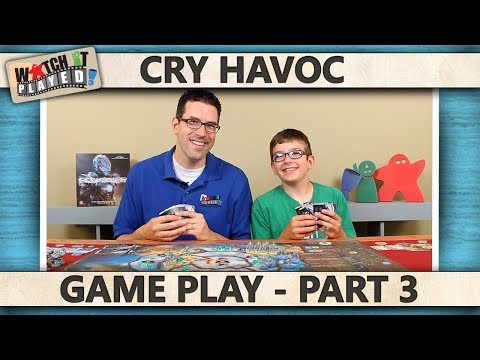
Cry Havoc - Game Play 3
Rules Teach

Cry Havoc - Game Play 1.5
Playthrough

Cry Havoc - Game Play 4
Ask a Rules Question
All mentions
Browse transcript mentions, sentiments, pros/cons, mechanics, topics, quotes, and references.
Total mentions: 23
This page: 23
Sentiment:
pos 7 ·
mix 4 ·
neu 4 ·
neg 1
Showing 1–23 of 23
Video 2-hZn9edJ7Q
Board Games UnLocked Review at 2:46 sentiment: neutral
video_pk 116858 · mention_pk 330358
Click to watch at 2:46 · YouTube ↗
Overall sentiment (raw)
neutral
Pros
none
Cons
- Factions can feel targeted if they spread too quickly.
Thematic elements
- Conflict and territorial control
- Planet with indigenous species
Comparison games
none
Mechanics (from transcript analysis)
- Area Control — Players vie for control of territories on the board.
- asymmetrical factions — Players control distinct factions with unique abilities.
Video topics + discussion points
No key topics recorded for this video.
Quotes (from this video)
- This game is phenomenal.
- The artwork is amazing.
- The themes are so mature.
- The expansion is a must.
- It's very cutthroat.
- The cards are the critical key to the game.
References (from this video)
No references stored for this video.
Video PNL07Bzs6Tg
Rolling Dice & Taking Names Other at 3:52 sentiment: neutral
video_pk 94955 · mention_pk 260558

Click to watch at 3:52 · YouTube ↗
Overall sentiment (raw)
neutral
Pros
- Considered to have a good theme.
Cons
- Described as not being a Euro-style game, which the host prefers.
Thematic elements
- Fantasy conflict
Comparison games
none
Mechanics (from transcript analysis)
- Area Control — Players compete for control of territories.
- Combat — Features combat between factions.
Video topics + discussion points
No key topics recorded for this video.
Quotes (from this video)
- it's gonna be a standalone game for the original game stronghold but it's gonna be published by stronghold games
- we are proud and thrilled to announce a new line of expansion for you for detective written and designed by the best storytellers in the industry robbed of you pandemic legacy and Mike's a linker Pathfinder this will be a standalone case is a one case you can save your friends not campaign not something you have to devote the whole crew for that some of the weeks
- I love the name of this I love it Imperial settlers rolling right it leaves nothing to the imagination you know exactly what the theme is you know exactly the time for game of it it is it's like so blunt that it's perfect
- the fact that you can sit down and this this is true the example that they use with monolith arena is a fantastic idea because I can totally see sitting there and and asking a question hey how does this unit work and I'll explain to you how that unit works so I think that's a fantastic idea
- I personally I like it when publishers put out less games cuz you could put more focus on those games
- I was honestly surprised honestly surprised that he didn't have a video montage I may be looking at a portal through the years some games they released early on pictures of them early in the year so I'm really surprised that he didn't put that that together maybe on his youtube channel maybe the eventually he'll do that in the future
References (from this video)
No references stored for this video.
Video 296gxzZrlPQ
Rolling Dice & Taking Names Analysis at 2:57 sentiment: positive
video_pk 93552 · mention_pk 253973
Click to watch at 2:57 · YouTube ↗
Overall sentiment (raw)
positive
Pros
- great games with just basic components
- nice miniatures just made the experience so much better
Cons
none
Thematic elements
Comparison games
none
Mechanics (from transcript analysis)
Mechanics unknown.
Video topics + discussion points
No key topics recorded for this video.
Quotes (from this video)
- what is it about miniatures and more games they get people excited
- for me it helps when I can see a 3d representation of the world that I'm playing in some ice the art on the car door in the rules and actual physical form a helps me get more engaged with them
- also I love toys and ever since I was a kid I enjoy playing with toy figures
- well now I can play with my toy figures in the board games which just helps spark imagination
- classic board game components such as meeples and cubes just can't create that same experience
- don't be thinking miniatures make a game good while more and more games are incorporating miniatures that doesn't make the gameplay better
- adding nice miniatures to a game just makes it look more exciting on the table they add a tactile and visual element to the game that you don't get with meeples or cubes and helps open up your imagination to the world that you're playing in
References (from this video)
No references stored for this video.
Video ZEBBoql-ufw
Rolling Dice & Taking Names Review at 3:56 sentiment: positive
video_pk 93563 · mention_pk 254008
Click to watch at 3:56 · YouTube ↗
Overall sentiment (raw)
positive
Pros
- Gorgeous game with sturdy miniatures.
- Interesting tactics.
- Players get better the more they play.
- Crazy havoc will be created from this game.
Cons
none
Thematic elements
Comparison games
none
Mechanics (from transcript analysis)
- Area Control — The game involves area control as a key mechanism.
- Deck Building — Players utilize deck building as part of their strategy.
- Scoring points — Players score points as part of the game's objectives.
Video topics + discussion points
No key topics recorded for this video.
Quotes (from this video)
- It's a cooperative game where it's kind of hard to cooperate.
- The walkers are more like environmental hazards in this game.
- Designing is cutting like you have at the very beginning have many many ideas and then you just cutting cutting cutting until it's done.
- I love the dice tower network.
- I'll just say it's a 16 by 16, so I hope you got bolted to the wall.
References (from this video)
No references stored for this video.
Video uvBOyOk0bn4
Rolling Dice & Taking Names Review at 1:19:56
video_pk 93565 · mention_pk 254024
Click to watch at 1:19:56 · YouTube ↗
Pros
none
Cons
none
Thematic elements
none
Comparison games
none
Mechanics (from transcript analysis)
Mechanics unknown.
Video topics + discussion points
No key topics recorded for this video.
Quotes (from this video)
- It's Indiana Jones in the age of sail.
- The players going crazy - that's a nice little spin on it.
- I want to be a designer, I want someone else to figure this all out.
- The United States spent less time in World War Two than I spent on Sea Fall.
References (from this video)
No references stored for this video.
Video cbBFm3Wk_iY
Watch It Played Discussion at 32:57 sentiment: neutral
video_pk 92188 · mention_pk 247601

Click to watch at 32:57 · YouTube ↗
Overall sentiment (raw)
Neutral
Pros
none
Cons
none
Thematic elements
Comparison games
none
Mechanics (from transcript analysis)
Mechanics unknown.
Video topics + discussion points
No key topics recorded for this video.
Quotes (from this video)
- Pap, you still haven't received your Tekkaido that you backed at a pretty high amount because you got your own character in the game.
- It's funny. We we talked about that at some point. Just like the humor, like the humor of doing something like a pep talks where I would talk about, you know, like some advice for particular games and it's something I like that. I like that. I love that idea of a pep talk.
- Rebel Mage here uh, left a message just said, "Pep, just want to say you're a great co-host for watching play. Keep up the good work."
- For me, it's probably going to be Star Realms. Star Realms is very high on here as well for me. Um, but I kind of want to skip that just because of how repeatable Star Realms is anyway. And I'm going to go to Sheriff of Nottingham.
- Uh, this is self- serving, but I would dress up as a Mounty and be my character from the Dead of Winter promo that's in the fundraiser.
- I'd want to find something I already look like and kind of like I wouldn't just go as my favorite character. I'd go as a character that I think I that I could that I could best look even kind of naturally almost, right?
- Yes, we talk about it somewhat frequently actually. Like, oh, we should probably cover some of the old older classics. Yeah, cuz there are still people today who pick up those games and and want to uh learn how to play them, right?
- Every game. But the one that always comes to mind for me is uh Pathfinder and any game that's kind of trying to do what the Pathfinder adventure card game is doing because in that game whenever you level up and complete missions, you get like draw a random item out of the box or do this or do that.
- Like Seall has something similar to that. They have an emnity thing. If you attack someone then they remember that other players remember that in in the game's mechanics and then that comes back to haunt you later or whatever.
- The whole idea of under Mountain is like it's constantly shifting and like it's the surroundings are changing. So every time you go down, things will be a little different anyway. So it' be really cool to make like a legacy style dungeon exploring thing around the end of that naturally.
References (from this video)
No references stored for this video.
Video Fmke7pZ6R94
Watch It Played Live Qa at 34:33 sentiment: positive
video_pk 92179 · mention_pk 247560
Click to watch at 34:33 · YouTube ↗
Overall sentiment (raw)
positive
Pros
none
Cons
none
Thematic elements
Comparison games
- Kemet
Mechanics (from transcript analysis)
Mechanics unknown.
Video topics + discussion points
No key topics recorded for this video.
Quotes (from this video)
- I don't think that was quite the watch it played intro
- I always come over here in a flustered mess
- we are wildly unprepared
- I don't know how I'm always prepared
- you don't usually bring a level
- pretty flat yeah usually pretty even keel yeah unlike your basement
- all they can't hear us chewing
- you're no longer locked up pep you're now I actually haven't updated the website to show that but you have been unlocked
- I can commit to you yes I can pay you next year
- pep will be working on watch of played next year with with me full-time which is fantastic
- it's not a cheap thing so so these kind of donations really help make that a bearable cost for sure
- I I won't bore you to tears with more and more thanks and gratitude
- you would have to order directly from the I think the the publisher themselves they don quite the retail system
- we ended up playing it you and I just on our own and we when we were done we were like oh this is um this deck builder but it's a little different
- question mark question mark question mark question mark
- do you have him in blonde
- I don't think they could join us
- I do not like this box but we're not here to play The Box we're here to play the game components however the tray and everything's really nice just that that box yeah it's a it's a decent tray yeah
- the most common problem faced by cavemen that's right your family getting eaten right of course
- rubber family no matter what happens while you're gone this family will always bounce back
- what if your family might try to rute a shred it's a legitimate threat
- meat fashion yeah yes because you have two problems you're hungry and you don't have any clothes
- you will become someone else's meat fashion
- well that was an experience that was many years ago
- I really felt like I was the only person playing board games in my area and certainly I was the only one obsessed with them that's for sure
- don't go to a publisher and say hey I'm going to start doing reviews can I have some free review copies because they get inundated with people asking for free stuff
- Fantasy Flight Games initially rejected Rodney's request for collaboration
- my face is essentially saying yeah I pulled that off
- we should always have Boggle on the table I think it'll Boggle their minds Bogle their minds
- I always like it's hard to pick a favorite cuz I I like different ones for different reasons but I'll try not to cop out on this one
- I think my basement is actually pretty nice it's just unfinished
- we're not going back to that we'll have to talk we're not changing the set in that direction I'm sorry
References (from this video)
No references stored for this video.
Video cbBFm3Wk_iY
Watch It Played Discussion at 1:27:54 sentiment: other
video_pk 92188 · mention_pk 247641
Click to watch at 1:27:54 · YouTube ↗
Overall sentiment (raw)
Upcoming gameplay video mentioned.
Pros
none
Cons
none
Thematic elements
Comparison games
none
Mechanics (from transcript analysis)
Mechanics unknown.
Video topics + discussion points
No key topics recorded for this video.
Quotes (from this video)
- Pap, you still haven't received your Tekkaido that you backed at a pretty high amount because you got your own character in the game.
- It's funny. We we talked about that at some point. Just like the humor, like the humor of doing something like a pep talks where I would talk about, you know, like some advice for particular games and it's something I like that. I like that. I love that idea of a pep talk.
- Rebel Mage here uh, left a message just said, "Pep, just want to say you're a great co-host for watching play. Keep up the good work."
- For me, it's probably going to be Star Realms. Star Realms is very high on here as well for me. Um, but I kind of want to skip that just because of how repeatable Star Realms is anyway. And I'm going to go to Sheriff of Nottingham.
- Uh, this is self- serving, but I would dress up as a Mounty and be my character from the Dead of Winter promo that's in the fundraiser.
- I'd want to find something I already look like and kind of like I wouldn't just go as my favorite character. I'd go as a character that I think I that I could that I could best look even kind of naturally almost, right?
- Yes, we talk about it somewhat frequently actually. Like, oh, we should probably cover some of the old older classics. Yeah, cuz there are still people today who pick up those games and and want to uh learn how to play them, right?
- Every game. But the one that always comes to mind for me is uh Pathfinder and any game that's kind of trying to do what the Pathfinder adventure card game is doing because in that game whenever you level up and complete missions, you get like draw a random item out of the box or do this or do that.
- Like Seall has something similar to that. They have an emnity thing. If you attack someone then they remember that other players remember that in in the game's mechanics and then that comes back to haunt you later or whatever.
- The whole idea of under Mountain is like it's constantly shifting and like it's the surroundings are changing. So every time you go down, things will be a little different anyway. So it' be really cool to make like a legacy style dungeon exploring thing around the end of that naturally.
References (from this video)
No references stored for this video.
Video 5R0FRPD03YQ
Meeple Mountain Top 10 List at 1:20 sentiment: positive
video_pk 92112 · mention_pk 247340

Click to watch at 1:20 · YouTube ↗
Overall sentiment (raw)
positive
Pros
- rich, asymmetric design
- immersive theme with clear identity for each faction
Cons
- learning curve and potential complexity
- rules can be dense
Thematic elements
- asymmetric area control and warfare
- futuristic conflict on a contested planet with multiple alien factions
- tactical confrontation with distinct faction identities
Comparison games
none
Mechanics (from transcript analysis)
- Area Control — factions vie for control of locations on a shared board
- Asymmetric play — each faction has unique powers and victory conditions
- Hand Management — players manage a hand of cards to perform actions
Video topics + discussion points
No key topics recorded for this video.
Quotes (from this video)
- it's a big game not only in its physical size but also in its ambition
- this game was huge all over the place and I really loved it
- this brain burner of a game has amazing cubes great cardboard
- the colors are fantastic I love that JLS kevin has picked different and unique colors
- it's tons of fun to play with a group
- this is a great area control kind of game
References (from this video)
No references stored for this video.
Video 09rjzzAImCM
The Dice Tower News at 19:33 sentiment: neutral
video_pk 81467 · mention_pk 202475
Click to watch at 19:33 · YouTube ↗
Overall sentiment (raw)
Neutral
Pros
none
Cons
- The campaign page lacks sufficient information for newcomers to the game.
Thematic elements
- War
Comparison games
none
Mechanics (from transcript analysis)
- Hex and counter — Mentioned as a style of the original edition.
Video topics + discussion points
No key topics recorded for this video.
Quotes (from this video)
- So, all of the wood components in this game are being locally sourced from Hokkaido where the publisher, not Mighty Boards to be clear, the original publisher and the designers of the game are based.
- This is the first real-time two-way pet translator.
- My thoughts are dark. I would I have never wanted to hack into something more in my life.
- I'm going to say 3,612 are Twitch streamers, right? Oh, I agree 100%. This is This ain't going IN THIS AIN'T GOING in your your foyer, right?
- I look, I I can't imagine this has any actual science Did you ever see The Far Side where the guy invents He goes, 'I can finally find out what dogs are saying.'
References (from this video)
No references stored for this video.
Video QZe5hnwgxOg
Review at 0:11 sentiment: negative
video_pk 69688 · mention_pk 166329
Click to watch at 0:11 · YouTube ↗
Overall sentiment (raw)
negative
Pros
- The multi-use cards are a standout feature.
- Works best as a three-player game.
- The combat system was incredibly novel for its time.
Cons
- Still feels unbalanced in favor of the humans.
- There are no miniatures for the structures, making the board cluttered.
- The game is aesthetically repulsive with a washed-out color scheme and a brutal geometric design.
Thematic elements
- area control
Comparison games
- Rising Sun
- Blood Rage
- Inis
- El Grande
Mechanics (from transcript analysis)
- Area Control — The core mechanic involves taking control of different areas on the map to gain victory points.
- Combat — A unique combat system where players assign units to different objectives on a battle board (region control, capture prisoners, attrition).
- Deck Building — Players draw cards from their own decks to take actions.
- Dudes on a map — Players move their miniatures around the map to control territories.
- Multi-Use Cards — Cards can be used for various actions like moving troops, recruiting, building structures, or for battle-specific effects.
- Set Collection — Gems in controlled areas provide victory points.
- Variable player powers — Each faction has different structures to build.
Video topics + discussion points
No key topics recorded for this video.
Quotes (from this video)
- So Cry Havoc how to play this game so Cry Havoc is a dudes on the map area control game.
- So do you like but Cry Havoc so the first thing that we really like about this game is the multi-use cards.
- So the second thing that we really like about caboc is that it works best as a three player game.
- So the final thing that we like about cry a is that the combat system was incredibly novel for its time.
- What don't we like about Cry Havoc so the first thing that we don't like about this game is that I still feel as though this game is unbalanced in favor of the humans.
- So the second thing second thing we don't like about Cry Havoc is there's no minis for these structures and this sucks big time.
- So the final thing that we don't like about Cry Havoc is this game is aesthetically repulsive to me.
- So to summarize is Cry Havoc still worth your time and bother 8 years after it first released so we are going to say No.
References (from this video)
No references stored for this video.
Video ist5CnBQjZ8
Watch It Played Playthrough
video_pk 68647 · mention_pk 164927

Pros
none
Cons
none
Thematic elements
none
Comparison games
none
Mechanics (from transcript analysis)
Mechanics unknown.
Video topics + discussion points
No key topics recorded for this video.
Quotes (from this video)
- hey everyone welcome back to watch it played my name is Rodney Smith and this is Luke Smith and we're here watch me win Cry Havoc spoiler alert just being honest here that's probably what we're going to watch
- My aerification here is going to give me some suggestions here but what I should actually do for this turn and it might help the main thing mayor cerification wants me to do is to try to lock down these two regions where Luke has all of his units he has none in reserve right now.
- This Airfield allows Luke to take control of an adjacent unoccupied region.
- My penalty for leaving the area undefended and I could see this threat because of the Airfield he built here and that's why I'm thinking these guys are now going to have to go to locations like this one that I wasn't planning on going to just so I can hang on to what is rightfully mine.
- I'm going to be scoring 1 two three four five six seven seven points that should move you down to 40 look we're neck and neck side by side.
- I'm thinking I'll just try to get at least one more Point by putting both of these into attrition.
- Luke will win majority gaining two points he will prisoner FY and take one of these then I'll get to attrition and he'll get to attrition so I'll take two points and Luke will gain two points as well.
- well no question Luke was the Victor in this game congrat Luke well well played you were a good sport well thank you I appreciate the compliment
- portal can release an expansion uh the White Flag Rodney expansion exactly I can just should be a promo card it should be a promo card the white flag of retreat
References (from this video)
No references stored for this video.
Video pAPlaOltvTo
Watch It Played Review
video_pk 68648 · mention_pk 164928

Pros
none
Cons
none
Thematic elements
none
Comparison games
none
Mechanics (from transcript analysis)
Mechanics unknown.
Video topics + discussion points
No key topics recorded for this video.
Quotes (from this video)
- You've really been steamrolling uh through this game.
- I've dug myself into a hole too deep.
- tokens representing figures like the power extraction or Luke's artillery battery, as another example, cannot be targeted by effects, killed, or taken prisoner.
- This is the absolute worst that I could have gotten in that region.
- Even when he's not attacking, he's just collecting points.
- tokens cannot be targeted by attrition.
- Luke currently controls a scary amount of crystals.
- It's going to be tricky because you've very wisely placed out these battery tokens which are going to give you extra help in the battles to come.
- I feel confident we might be able to hold on to all the regions we currently have and not allow him to spread out further.
References (from this video)
No references stored for this video.
Video xYS1eHYYJbk
Watch It Played Playthrough
video_pk 68649 · mention_pk 164929

Pros
none
Cons
none
Thematic elements
none
Comparison games
none
Mechanics (from transcript analysis)
Mechanics unknown.
Video topics + discussion points
No key topics recorded for this video.
Quotes (from this video)
- Apparently I'm terrible at this game.
- He's like a human disease that spreads across the map.
- You're doing very good at losing, Dad.
- This is the best losing I've done so far.
References (from this video)
No references stored for this video.
Video ist5CnBQjZ8
Watch It Played Playthrough at 0:30 sentiment: mixed
video_pk 68647 · mention_pk 247578
Click to watch at 0:30 · YouTube ↗
Overall sentiment (raw)
mixed
Pros
- The game can lead to strategic territory control and area control competition.
- Combat resolution can be intense with card play influencing outcomes.
- The game involves resource management conflict over valuable regions.
- Potential for asymmetric faction abilities adds strategic depth.
Cons
- Rodney Smith felt his actions were sometimes desperate.
- The game can punish players for leaving areas undefended, as seen with the Airfield's threat.
- A player might feel they are playing 'underdogs' or struggling to catch up.
Thematic elements
Comparison games
none
Mechanics (from transcript analysis)
- Area Control — Players attempt to lock down and control regions on the map.
- Card Play — Cards are used to activate abilities, influence battles, and score points.
- Combat — Battles occur in regions, resolved through attrition and prisoner-taking, influenced by card play.
- Construction — Players can build structures like Airfields, which grant control of adjacent unoccupied regions.
- recruitment — Players recruit units and move them into regions.
- scoring — Points are scored through region control, taking prisoners, and final scoring based on controlled crystals.
- Set Collection — The game involves collecting crystals from controlled regions for final scoring.
Video topics + discussion points
No key topics recorded for this video.
Quotes (from this video)
- hey everyone welcome back to watch it played my name is Rodney Smith and this is Luke Smith and we're here watch me win Cry Havoc spoiler alert just being honest here that's probably what we're going to watch
- My aerification here is going to give me some suggestions here but what I should actually do for this turn and it might help the main thing mayor cerification wants me to do is to try to lock down these two regions where Luke has all of his units he has none in reserve right now.
- This Airfield allows Luke to take control of an adjacent unoccupied region.
- My penalty for leaving the area undefended and I could see this threat because of the Airfield he built here and that's why I'm thinking these guys are now going to have to go to locations like this one that I wasn't planning on going to just so I can hang on to what is rightfully mine.
- I'm going to be scoring 1 two three four five six seven seven points that should move you down to 40 look we're neck and neck side by side.
- I'm thinking I'll just try to get at least one more Point by putting both of these into attrition.
- Luke will win majority gaining two points he will prisoner FY and take one of these then I'll get to attrition and he'll get to attrition so I'll take two points and Luke will gain two points as well.
- well no question Luke was the Victor in this game congrat Luke well well played you were a good sport well thank you I appreciate the compliment
- portal can release an expansion uh the White Flag Rodney expansion exactly I can just should be a promo card it should be a promo card the white flag of retreat
References (from this video)
No references stored for this video.
Video xYS1eHYYJbk
Watch It Played Playthrough at 0:45 sentiment: mixed
video_pk 68649 · mention_pk 247644
Click to watch at 0:45 · YouTube ↗
Overall sentiment (raw)
mixed
Pros
- Fast-paced movement and spread of human faction
- Card draw mechanics for pilgrims help replenish hand
- Interesting structure abilities like the harvester
- Trog units add resistance and strategic challenges
Cons
- Host's poor performance and zero wins against son
- Complexity in tracking scores and battle objectives
- Mistakes in setup (e.g., missing Trog token, upside-down tokens) highlighted by the guest
Thematic elements
- a planet
Comparison games
none
Mechanics (from transcript analysis)
- action selection — Players take a set number of actions per round, choosing from various options like movement, deploying units, building structures, and playing cards.
- Area Control — Gaining control of territories by occupying them and placing control tokens. Players gain points for controlled regions.
- Card Drafting — Players draw cards from their decks or specific 'Terrain Tactics' decks to gain abilities and advantages.
- Combat — Battles occur in regions, resolved by placing figures on a battle board with objectives like majority, attrition, or prisoner. Players can play cards to influence outcomes.
- exploration — Flipping over exploration tokens reveals events such as placing crystals, drawing cards, or spawning Trog units.
- Resource Management — Crystals are a resource used for scoring and potentially for other game effects. Players manage a personal crystal pool.
- Set Collection — Drawing specific 'Terrain Tactics' cards that match terrain types seems to be beneficial for certain actions or abilities.
- Variable player powers — Different factions (humans and pilgrims) have distinct abilities and playstyles, such as the humans spreading quickly and pilgrims replenishing their hand.
Video topics + discussion points
No key topics recorded for this video.
Quotes (from this video)
- Apparently I'm terrible at this game.
- He's like a human disease that spreads across the map.
- You're doing very good at losing, Dad.
- This is the best losing I've done so far.
References (from this video)
No references stored for this video.
Video uqLopRjY36M
John gets games Discussion at 4:26 sentiment: mixed
video_pk 66242 · mention_pk 161115

Click to watch at 4:26 · YouTube ↗
Overall sentiment (raw)
mixed
Pros
- intriguing blend of euro mechanics with a war theme
- hand management
- asymmetric factions
- astonishing art
Cons
- combat resolution relies on randomness
- may not appeal to players who dislike randomness in battles
Thematic elements
Comparison games
none
Mechanics (from transcript analysis)
- Area control / territory influence — battles for territories with victory points.
- asymmetric factions — factions with different abilities; one faction may be NPC/native in some configurations.
- combat resolution — combat outcomes described as a unique mechanic driven by card play (some randomness).
- deck-building / card draw from multiple decks — draw from a main deck and four terrain-specific decks to influence combat and actions.
- Hand Management — multi-use cards that can move units, build, or activate effects; hand management and deck-building aspects.
Video topics + discussion points
No key topics recorded for this video.
Quotes (from this video)
- I am planning on recording a full playthrough of Scythe tomorrow
- I believe I'm going to be getting a review copy of the game so I hope to be able to try it pretty soon and I will be sure to let you guys know what I think about it
- I love seeing how different mechanics mesh together in new and interesting ways
- it's got some stuff that I really like in games has some stuff that I'm not usually crazy about
- it has astonishing art
- I ended up playing this twice ... nuclear war ... I lost both
References (from this video)
No references stored for this video.
Video XB3o9byXqY4
watch it played Discussion at 0:16
video_pk 65139 · mention_pk 158763

Click to watch at 0:16 · YouTube ↗
Pros
none
Cons
none
Thematic elements
Comparison games
none
Mechanics (from transcript analysis)
Mechanics unknown.
Video topics + discussion points
No key topics recorded for this video.
Quotes (from this video)
No quotes stored for this video.
References (from this video)
No references stored for this video.
Video x7KS4ijLh14
Watch It Played Rules Teach at 0:29 sentiment: positive
video_pk 65140 · mention_pk 158764

Click to watch at 0:29 · YouTube ↗
Overall sentiment (raw)
positive
Pros
- The game involves maneuvering units to control areas, build structures, and grow armies for advantages.
- Players can attack, take prisoners, and destroy enemies to gain victory points.
- The game offers distinct factions with unique components.
- Special rules for different player counts and specific factions (Trog) are noted.
Cons
none
Thematic elements
- claiming resources from an unexplored planet while fighting indigenous species and other armies
- an unexplored planet
Comparison games
none
Mechanics (from transcript analysis)
- Action Point Allowance System — Each player takes a set number of actions per round, following an initiative order.
- Area Control — Players maneuver units to control key areas of the board and place control tokens to signify control.
- Combat — Battles occur in specific regions, resolved using a battle board with objectives. Players assign units and play cards to determine outcomes like region control, prisoner capture, and unit attrition.
- Deck building / hand management — Players draw cards from personal decks, manage their hands, and discard cards to perform actions. Discarded cards can be shuffled to form a new draw deck.
- Resource Management — Crystals of varying values are collected and placed on the board, contributing to scoring.
- Set Collection — Collecting prisoners and potentially reclaiming them in subsequent rounds.
- Variable player powers — Each faction has unique structure options and tactic cards.
Video topics + discussion points
No key topics recorded for this video.
Quotes (from this video)
- If you have any questions at all, don't hesitate to put them in the comments below and I'll gladly answer them as soon as I get a chance.
- But until the next episode, thanks for watching.
References (from this video)
No references stored for this video.
Video VB6EkbjEAeE
watch it played Rules Teach at 0:30 sentiment: mixed
video_pk 65137 · mention_pk 158761
Click to watch at 0:30 · YouTube ↗
Overall sentiment (raw)
mixed
Pros
- The possibility of rushing figures to create a battle zone to prevent opponent expansion.
- Using a power orb to recruit a pilgrim into a battle zone to even the odds.
- Using power extraction skill to increase unit count in a battle region.
Cons
- Mistakes made in previous gameplay regarding card count and unit retreat.
- The opponent potentially building an Airfield to gain control of an adjacent unoccupied region.
- Limited units in a battle might not be enough to win.
- Risky to enable scoring if the opponent might end up with more regions and crystals.
Thematic elements
Comparison games
none
Mechanics (from transcript analysis)
- Activating abilities — The host discusses activating abilities of structures like the Airfield and power orb to gain strategic advantages.
- Area Control — The host talks about controlling regions on the map and the potential for an opponent to establish control through structures like an Airfield.
- Battle Zone — The host explains that creating a Battle Zone by moving figures into a location prevents opponents from building structures there and can trap units.
- building structures — The host mentions the possibility of building structures, specifically an Airfield and a power orb, and their strategic implications.
- discarding cards — The host mentions having to discard cards from hand, indicating a hand limit or a specific game rule related to cards.
- Movement — The host discusses spending cards to gain movement points to move figures across the board.
- Recruiting units — The host mentions the possibility of an opponent recruiting units and potentially moving them into locations.
- Retreating units — The host discusses the rules for retreating units after a battle, specifically who controls their destination and the restrictions on movement.
- scoring — The host discusses using an 'enable scoring' card and the timing of using it in relation to opponent's actions and game progress.
Video topics + discussion points
No key topics recorded for this video.
Quotes (from this video)
- hi everyone welcome back to watch it played my name is Rodney Smith
- there were a couple of mistakes that I just wanted to bring to your attention
- I haven't actually won a game of Cry Havoc against Luke yet so I'm probably the wrong person to be masterminding this strategy but I do have experience on my side and that hopefully counts for something
- please do put your thoughts in the comments below
References (from this video)
No references stored for this video.
Video ScSB0mtTobQ
Getting Games Playthrough at 0:02 sentiment: positive
video_pk 63605 · mention_pk 157079
Click to watch at 0:02 · YouTube ↗
Overall sentiment (raw)
positive
Pros
- Asymmetric factions with unique play styles
- Deep tactical depth and balance of macro/micro decisions
- Powerful, interdependent buildings (Harvesters, Extractors) and resource pools
- Dynamic battle system with multiple objectives and scoring opportunities
Cons
- High complexity with many interacting systems
- Pilgrim player's deck was large and unwieldy in this run
- Initial dominance by the machine faction can create intense pressure for other players
Thematic elements
- Crystal collection and territorial control through combat
- Planet with three attacking factions and natives (trogs) on the board
- Live playthrough narration
Comparison games
none
Mechanics (from transcript analysis)
- Airfield and power orb — Airfield places a control token on an adjacent unoccupied region; Power Orb pulls a unit from reserve into an adjacent battle region.
- Building restrictions — You cannot build in your starting headquarters and you cannot build in a region you do not control or that has battles.
- Card action economy — There are five action options; three of those involve playing cards from your hand.
- Card symbols — Cards show three symbol types in the top-left corner: move, enlist, and wrench (build/activate).
- Crystals and scoring — Crystals exist in multiple colors with values Greens = 1, Yellow = 3, Red = 5; crystals are placed on the map and contribute to scoring.
- Harvesters/Extractors/Crystal pool — Harvesters generate crystals from the supply into a region pool; Extractors place crystals; pilgrims maintain a Crystal Pool that drives scoring and special abilities.
- Initiative and Recon — Turn order can be adjusted by Recon forces; initiative is tracked and can be changed via cards with exclamation marks.
- Multi-Use Cards — There are five action options; three of those involve playing cards from your hand.
- Natives and battles — Natives (trogs) are placed on the map; battles occur in battle regions with three objectives (region control, prisoners, attrition) and are resolved by moving units and playing battle cards.
- Nest tokens and retreat — Defeated trog units generate nest tokens; nest tokens are used to replenish trogs elsewhere; retreating units must move to an uncontrolled region or one without a battle.
- Turn Order: Variable — Turn order can be adjusted by Recon forces; initiative is tracked and can be changed via cards with exclamation marks.
- Turn structure — Each turn begins with revealing the next event token, followed by three action rounds where players take actions in sequence.
Video topics + discussion points
No key topics recorded for this video.
Quotes (from this video)
- we're playing as the yellow humans over here
- this region is now locked as I just mentioned
References (from this video)
No references stored for this video.
Video UU9r2QZnqNk
Getting Games Discussion at 17:49 sentiment: positive
video_pk 63604 · mention_pk 157068

Click to watch at 17:49 · YouTube ↗
Overall sentiment (raw)
positive
Pros
- asymmetry and variety of mechanics
- engine-building elements with thematic cohesion
Cons
- not a game that blew the reviewer away
- could be too asymmetric or heavy for some players
Thematic elements
- planetary domination with unique races and buildings
- fantasy/science-fantasy world with four asymmetric races
Comparison games
none
Mechanics (from transcript analysis)
- asymmetric races with deck-building elements — each race has its own deck and unique buildings to activate actions
Video topics + discussion points
No key topics recorded for this video.
Quotes (from this video)
- I'm excited to try playing those Patchwork style gameplay mechanics in a larger Euro experience
- the most asymmetric game I've ever played
- it's not a crazy frantic game; it's methodical
- I spent a humongous amount of money on it but I have no regrets about having this game
References (from this video)
No references stored for this video.
Video cpanFunKl48
Watch It Played Playthrough
video_pk 36540 · mention_pk 164821

Pros
none
Cons
none
Thematic elements
none
Comparison games
none
Mechanics (from transcript analysis)
Mechanics unknown.
Video topics + discussion points
No key topics recorded for this video.
Quotes (from this video)
- I'm going to build one of these power orbs for two
- this allows me to add one of my pilgrims for my reserves into a region where I have a pilgrim that's in a battle
- you did gain majority here yes as a Defender you win on ties
- I get double cuz I have two control
References (from this video)
No references stored for this video.
Transcript Navigation
Showing 1–23 of 23