








Cuphead: Fast Rolling Dice Game Deep Dive
What the Community Thinks About Cuphead: Fast Rolling Dice Game
Reviewers agree on the core identity of this game: it is a faithful, deliberately punishing translation of the boss battles from the Cuphead video game. Channels that covered it, including Before You Play, Good Time Society, Meeple University, and Foster the Meeple, keep returning to the source material when they explain the boss decks, the Parry tokens that let teammates recover from knockout, and the Pork Rinds Emporium where coins are spent between fights. The praise is concentrated on two points. The first is that the rules are light enough to learn quickly, and the second is that the game captures the feel of its parent franchise without requiring players to know the video game first.
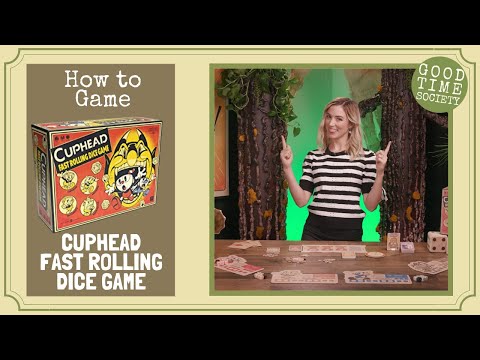
Where opinions diverge is on pressure. Good Time Society's Becca Scott walks through setup and the five-step round structure in a calm, rules-first way that makes the box sound approachable. The Before You Play hosts, by contrast, lost their first campaign encounter and described how quickly a round can collapse once a single defensive symbol is missed. Meeple University's Terence and Stella came away impressed by the design but unconvinced that it suits every table, noting that the real-time format is a clear dividing line between players who enjoy it and players who do not.
Core Mechanics That Define Cuphead: Fast Rolling Dice Game
Dice Rolling
Dice rolling is the center of the design, and reviewers spend most of their time explaining how it works under a clock. At the start of each round, the group reveals three attack cards from the boss deck, adds a fourth card when a Wallop icon appears, and starts a timer set to 10, 15, or 20 seconds. Each player then rolls six action dice, five white and one black, and assigns them to the slots on their player board. Assignment is strictly left to right, and once a die is placed it cannot be changed. Before You Play's hosts highlighted the cost of this rule: a player who skips ahead to a later card to chase a different symbol gives up the earlier defense for good. Meeple University's Terence and Stella pointed out that the only rule players truly need to master before play is the left to right fill order, since everything else can be settled between rounds.
The design deliberately levels the field. In the abstract, dice rolling injects variance so that outcomes are not decided by planning alone, which means a newcomer and an experienced player face the same unpredictable roll. Reviewers consistently describe that randomness as a source of tension rather than frustration. Every re-roll is a gamble, and the choice between committing a die to a shot or to a defense is made under real time pressure.
Cooperative Game
The game is built so that the whole table wins or loses together. Designed by Pat Moreno and published by The Op, Cuphead: Fast Rolling Dice Game gives every player their own health tokens, but a single player running out of health is a shared problem. Good Time Society explains that a knocked-out player can only be revived by a teammate spending a Parry token, and if nobody can do that, the entire group loses. Good Time Society adds that players do not refill their health between a boss's phases, although they keep their Parry tokens and Wallop cards, so resources spent early in a fight shape how the group survives the later phases.
The Cuphead: Fast Rolling Dice Game Experience
Real-Time Tension
The defining feeling is controlled panic. Meeple University described the game as slightly stressful in a good way, and that phrase captures how reviewers talk about the timer. A few seconds of silence in a round can turn a clean defense into a missed symbol, and the group's energy rises as the clock runs down. Foster the Meeple's reviewers found the difficulty surprising even on the easiest timer setting, and the sense of pressure carries through the whole campaign.
Chaotic, Table-Wide Fun
Reviewers also describe a noisy, social atmosphere that feels closer to a party game than a strategy game. Meeple University called it a fun, even chaotic game in which people yell across the table while dice fly everywhere, and they joked about needing a dice tray to keep the rolls contained. The mood shifts quickly as players celebrate a successful double feet defense, groan at a missed symbol, and then argue about who should spend the last Parry token. Before You Play's hosts laughed through their losses and promised to try the intermediate timer next time.
What Makes Cuphead: Fast Rolling Dice Game Stand Out
Faithful Source Material
Reviewers repeatedly praise how closely the board game follows the video game. Meeple University argued that the game draws very heavily from the original, borrowing its characters, enemies, and the way players level up their weapons between boss battles. Boss decks escalate in the same way the video game does, and later decks introduce new symbol rules, such as the airplane deck where jump and duck replace the usual symbols. Good Time Society also points out that the knockout card rewards the group with coins that can be spent on weapons, charms, and eventually super arts, which keeps the campaign loop familiar to fans of the original.
Simple Rules Under Pressure
Terence and Stella of Meeple University singled out rule simplicity as one of the main strengths of a real-time game. Their point is that a real-time game falls apart when players cannot pause to explain a rule, and Cuphead avoids that problem by reducing its core demands to a few simple checks. Good Time Society's setup walkthrough supports the point, since most of the extra material sits in the boss cards, upgrades, and super art envelopes rather than in the core dice rules. That separation keeps the game approachable for newcomers while leaving depth for groups that want to keep playing.
Potential Drawbacks
Punishing Difficulty and Harsh Grading
The most common complaint is that the game is unforgiving. Meeple University's live playthrough noted that the grading system is severe, with a player able to fight through a level on normal mode and still receive a low letter grade because of a single lost health token. Before You Play's hosts lost their first campaign attempt and joked that the scoring felt like the toughest school they had attended. Reviewers agree the difficulty is part of the appeal for fans of the video game, but they also acknowledge that players who are not comfortable with failure may find the scoring discouraging.
A Repetitive Soundtrack
Meeple University's Terence and Stella both pointed to the soundtrack as the game's weakest element. The music is tied to the timer, and it speeds up as the round approaches its end, which creates tension but also grows wearisome over a long session. They suggested that a second track or more variety in the music would make the game easier to sustain across multiple boss decks. Their criticism is mild and balanced by their overall enjoyment, but it is a fair note for groups planning a full eight-deck campaign.
If You Enjoy Cuphead: Fast Rolling Dice Game
Players who enjoy Cuphead: Fast Rolling Dice Game's real-time pressure will find similar satisfaction in the Dark Souls dice variants, where a single roll decides whether a fight continues or ends in a costly loss. Players who enjoy quick, light card play with a group can look to Sushi Go for a faster, lower-pressure game that still rewards careful choices. For fans of the video game who want the bosses and art style without the timer, the original Cuphead video game remains the best companion, since it shares the same characters, the same pattern-based combat, and the same sense of hard-earned victory.
What Reviewers Are Saying
"The thing about it is you have to assign your dice from left to right which means if you don't roll these two feet right away and you're kind of running out of time and you're rolling these other symbols instead. Like with me for example I don't have two feet symbols I can skip that first card go to the next one."
— Before You Play
"One of the things I find myself saying in every real time game review is that they have this huge barrier that everyone has to know every rule otherwise the whole thing falls apart. The fact that this is broken down into 20-second bite-sized chunks really overcomes that inherent issue with real-time game."
— Meeple University
"We played at 20 seconds which is like the easiest mode and it was still like wow this isn't easy. Yeah I'm really looking forward to playing more of this and if you die it's very easy to die."
— Foster the Meeple