/pic5478785.jpg)













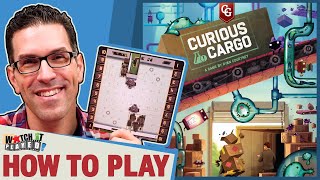











Curious Cargo Deep Dive
What the Community Thinks About Curious Cargo
Curious Cargo has emerged as a distinctive two-player experience that divides the board gaming community in fascinating ways. Reviewers consistently praise its innovative design and brain-burning puzzle nature, though many note it demands significant mental effort. The game earned a spot on kovray's top 10 two-player games list, and reviews across multiple channels highlight both its unique appeal and its challenging complexity. While some players find it instantly gratifying, others need a second play to truly appreciate its intricate systems.
Core Mechanics That Define Curious Cargo
Pipe Placement and Network Building
The heart of Curious Cargo revolves around tile placement where players build networks of colored pipes across their manufacturing plants. Each player places conveyor tiles from their hand or draws additional tiles during the construction phase, creating connections between their machines and shipping docks. The tiles are double-sided, and players can even overbuilt existing tiles by using scaffolding tokens to create more complex networks. Active connections form when continuous lines of the same color link a machine to a numbered dock, and tracking these connections determines a player's position on the turn order track. This mechanic creates a satisfying puzzle experience where spatial planning becomes crucial to success.
Truck Placement and Pick-up Deliver
Once players establish their pipe networks, the trucking phase begins. Players spend action points from truck cards to place vehicles on either their own shipping side or their opponent's side, introducing a crucial push-your-luck element. When trucks enter the board, they slide forward and push existing trucks ahead, potentially sending them to the opponent's receiving area. Goods automatically load and unload based on completed connections, creating a dynamic system where players must anticipate not just their own board state but also what their opponent might be able to receive. This mechanic generates moments of both satisfaction and frustration as perfectly laid plans can be disrupted by incoming trucks.
The Curious Cargo Experience
Brain-Burning Puzzle Satisfaction
Players describe Curious Cargo as a deeply satisfying puzzle game with what reviewers call puzzly complexity. Unlike traditional rolling and writing games, this is purely about spatial reasoning and network connectivity. The act of connecting pipes creates tangible moments of victory, and reviewers note that overbuilding tiles with scaffolding adds a layer of creative problem-solving. However, this puzzle-focused nature comes with a caveat: the first play can feel laborious and overwhelming as players internalize the systems. Once that initial game concludes, many players report the experience becomes significantly smoother and more enjoyable on subsequent plays.
Dynamic Head-to-Head Tension
The true innovation lies in how the game pits players directly against each other. By placing trucks on an opponent's shipping side, players create receiving opportunities for their rival. This means success depends not just on personal planning but on reading what networks your opponent might construct. The asymmetrical nature of each player's board (different colored pipes benefit different players more heavily) adds another layer of strategic depth. Reviewers consistently mention the interactive, dynamic feel this creates, transforming what could be a solo puzzle experience into a genuine head-to-head battle of logistics and foresight.
What Makes Curious Cargo Stand Out
Unique Two-Player Design
In a landscape of two-player games, Curious Cargo occupies a distinctive niche. It plays exclusively at two players and delivers an experience that feels substantially different from most two-player offerings. The designer Ryan Courtney (known for Pipeline) has created a game where player interaction feels organic rather than bolted on. Reviewers appreciate that blocking and hindering opponents happens naturally through standard play rather than requiring dedicated mean-spirited actions. The game feels both intimate and competitive, occupying middle ground between cooperative puzzles and cut-throat area control games.
Clever Risk and Timing Mechanics
The truck card economy creates fascinating decision points throughout play. Players must decide not just when to place trucks but on which side of the board, weighing immediate benefits against setting up opponent opportunities. Construction tokens and trucking tokens can be exchanged for additional actions or powerful splitters, creating paths to victory that aren't obvious on first inspection. The multiple ways the game can end (through shipping nine cargo, reaching ten active connections, filling a receiving row, or exhausting the tile bag) mean players must constantly adapt their strategy. This adaptability prevents the game from feeling rote and keeps both players engaged throughout.
Potential Drawbacks
Overwhelming Complexity and Rule Overhead
Curious Cargo's greatest weakness is also its strength. The interplay between pipes, trucks, construction phases, and trucking phases creates a dense ruleset that many find genuinely confusing on first play. Reviewers consistently note that games can feel bogged down as players laboriously work through multiple phases and track various tokens. The visual complexity of two boards filled with overlapping pipes, scaffolding, and truck positions can seem chaotic to newcomers. Several reviewers specifically mention that understanding the game's flow transforms the experience significantly, but that learning curve represents a real barrier to entry for casual players.
Frustration and Volatility
The nature of Curious Cargo means that beautiful pipe networks can be disrupted by incoming trucks in ways players didn't anticipate. While this creates tension, it can also feel deeply frustrating when carefully planned strategies collapse. The mandatory loading and unloading of cargo means players often cannot prevent their opponent from receiving goods they've shipped. Multiple reviewers mention the game occasionally feels "messy" when boards become cluttered with overlapping networks and confusing connections. The heavy reliance on the tile draw bag also introduces randomness that, while manageable for experienced players, can leave newer players feeling at the mercy of luck rather than able to execute their strategies.
If You Enjoy Curious Cargo
Players who love Curious Cargo should explore Pipeline, the earlier Courtney design with similar spatial reasoning, and consider other network-building games like Tapestry, which shares the civilization-building and engine-creation elements. For those drawn to the two-player competitive aspect, Patchwork and Seven Wonders Duel offer different but equally engaging head-to-head experiences. The puzzle-focused nature suggests compatibility with games like Azul and Carcassonne, though Curious Cargo delivers substantially more brain-burning intensity than those titles.
What Reviewers Are Saying
"This one is a different feel and it feels quite big...a really brain burny game and lots of things conflicting with each other but for a strictly two-player game this one has a different feel and it feels quite big."
— Chairman of the Board
"It really did go down a lot better felt so smooth and I really enjoyed this one...Once you get that first game out your system then you really do understand how it works and the feel of the game and that really helped for my second play."
— Chairman of the Board
"The pipe playing is tricky and puzzly and I really really like that part and then you're basically just going back and forth until like the end game is triggered...it's a pretty brain crunchy game."
— kovray