


















Daitoshi Deep Dive
What the Community Thinks About Daitoshi
Reviewers who have played Daitoshi mostly describe it as a dense, rewarding engine builder that rewards close attention. The strongest praise goes to how much the board and tiles change from one game to the next. Board Gaming Ramblings scored it an 8.5 and called it a great game, saying it gives them a real feeling of joy even when they lose.
The most common reservation is length. Several reviewers feel the game outstays its welcome for what it offers, and the early turns can feel slow while the engine is still being built.
Core Mechanics That Define Daitoshi
The Rondel
Daitoshi is built around a rondel. Each space on the rondel asks players to make several decisions at once: where to land, where to place workers, whether to pay to put them to work, and which action to take. Landing on a space at the right time with the right workers can set up a multi-action combo turn.
Production and the Factory Engine
A player's factory is a set of inventions slotted onto a dual-layer player board. When production runs, every invention that matches a check mark produces resources. Upgrading inventions makes them more productive, so the engine grows steadily over the course of a game.
The Daitoshi Experience
Exploitation and the Yo-kai Spirits
Exploiting nature tiles provides immediate resources, but it angers the Yo-kai spirits that are said to have lived there for thousands of years. Angry spirits make production more expensive or take parts of a player's board offline. Players can ease the conflict by moving the problem elsewhere or by investing in temples.
A Shared, Interlocking Board
A typical turn is a sequence of small, interlocking choices. One player's action can open an opportunity for another, and that player's action can open one in return. The game ends once one of the nature tracks, such as rivers, forests, or mountains, is largely blighted, so the pacing depends on how aggressively the table exploits the land.
What Makes Daitoshi Stand Out
Setup That Changes Every Game
City tiles and the Mega Machine project are drawn at random, so no two games set up the same way. Rahdo Runs Through called it a very good implementation of variability, where the strategy is never simply which track to climb, because the random setup changes what is worth pursuing without making any single path feel arbitrary.
Interaction Between Players
Because one player's action often makes another player's action stronger, Daitoshi can feel like a shared engine. Players piggyback on each other's electrified districts, new buildings, and deliveries, which keeps the table feeling active even when it is not a player's own turn.
A Shared Fictional Universe
Man vs Meeple pointed out that Daitoshi's setting connects to the publisher's other releases. The worms from Silk, the spirits from Dooku, and the yo-kai creatures from Yo-Kai Watch all appear worked into the art and theme, placing Daitoshi inside the same "Sand" universe as those games. Reviewers familiar with the other titles said the artwork and world-building feel consistent across the line, which rewards players who have tried the publisher's earlier games.
Potential Drawbacks
Length
Reviewers consistently say the game runs long for what it delivers, especially in the early and middle game. Heavy Cardboard put it plainly, describing a play that felt like it went on for an extra orbit around the table longer than it needed to.
Setup and Bookkeeping
Tracking steam, workers, inventions, and Yo-kai positions takes concentration, and the learning curve is steep for a first game. Two-player tables also see fewer opportunities to act off-turn, which reduces some of the interaction that makes the design shine at a fuller table.
Trying to Do Too Much
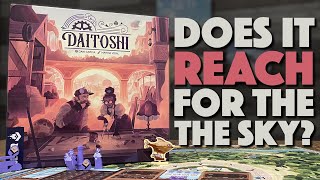
Man vs Meeple raised a concern that comes up with several recent big-box designs: the game packs in so many systems that it can feel like it is reaching for everything at once rather than committing to a smaller set of ideas done well. That reviewer questioned whether every system in the box is pulling its weight, or whether players are simply working through a long list of procedures without each one adding proportional depth.
If You Enjoy Daitoshi
Players who like rondels with layered decisions, engine building that grows visibly across a game, and interaction that comes from sharing a board should look at Brass, which reviewers mention as a point of comparison for its interlocking economy. Those who enjoyed the teaching complexity of Lerta on Mars may find Daitoshi's pacing familiar but heavier. Anyone who wants a shorter, lighter game will likely find this one too demanding.
What Reviewers Are Saying
"it's too long for what it is"
— Heavy Cardboard
"going to give this an 8.5"
— Board Gaming Ramblings
"satisfying very solid two-player design"
— Rahdo Runs Through