/pic5733939.png)
Beyond the last continent on the remote island Windbark, diving is an ancestral tradition. During a rite of passage celebrated at the summer solstice, divers compete to retrieve the sacred stone of the village. The elder throws it from the top of the cliff, and the stone leads the contenders for the title of "hero" down to the depths of the ocean, aided in their quest by friendly sea turtles and manta rays.
However, to retrieve the stone, they will need to avoid upsetting the sharks that inhabit the ocean...
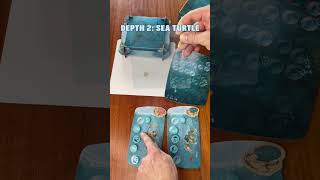
Dive plays simultaneously for all player divers, who start the game facing a shuffled stack of 36 transparent "ocean" cards. You have your own diver board and a set of five air tokens that are numbered 1-5 on both sides, with a shark on one side of each token.
Dive explores the notion of perception, the ability of the divers to observe the ocean through a deck of transparent cards and to benefit from their observations. At the start of each round, you look into the "waters" before you to see how far you want to dive, with five levels being the maximum you can go (since you have five tokens). You then place the tokens on your board:
If you think a shark is at a certain level, you need any tokens on this level to be shark side up — and if you goof, calling "shark" when no shark is present or vice versa, then you remove all tokens from your diver board at this level and at deeper levels. You're done for the round.
If you think a certain level has a sea turtle or a manta ray, you might want to stack tokens on this level because whoever places the highest sum advances 1-2 spaces on the descent board (for a sea turtle) or moves onto the player token directly in below them on the descent board (for a manta ray).
If you've finished evaluating a level for sharks, sea turtles, and manta rays, and anyone still has an air token on their board, you explore the next level. Once no one has any air tokens for the next level, the round ends, and everyone advances on the descent board equal to the number of levels that they successfully dove. Once you reach space #16 on the descent board, you can't use a manta ray to catch up to anyone, and if you fail the shark/no shark question for a level, you don't advance at all during that round, regardless of how many levels you first dove through successfully.
Dive includes rules for solitaire play in which you compete against the village chief, and you can optionally play a competitive game with animal companions that give you a one-time bonus.


- Diving to see how far you can go without running into sharks
Mechanics (from transcript analysis)
- Programming — Programming dives down through clear plastic sheets.
Video topics + discussion points
Quotes (from this video)
- push your luck is one of our favorite things and we have gotten a big collection of push-your-luck.
- Ticket to Ride is listed as push your luck. Yeah, I get it, but it's not These are push your luck game. Like these are really you are pushing your luck where you're where you're doing.
References (from this video)

- Enjoy Danny Garcia's games.
- Good interaction.
- Catalonian dance festival
- Catalonia
- Voyick Puzzle
- Abora
- Barcelona
Mechanics (from transcript analysis)
- area influence — Points come from a central board, implying area control or influence.
- Resource Management — Managing resources to take actions.
- worker movement — Moving dancers and characters on a personal board.
Video topics + discussion points
Quotes (from this video)
- Hi everyone, Stella here from Mele University and that's Tarant and we are doing our Gen Con anticipated games which are the games that we are anticipating and wanting to play or de buy a demo and we haven't played them yet.
- So um, again, we're going to talk about these 10 games in no particular order. And game number one is called Falling.
- So, that makes for an interesting point of decision tension.
- And it is beige. So, it's going to be a good game, right? A good Euro game.
- And if that doesn't sound like a classic Euro theme we say with nothing else
- So, this is for demo and it's recently on crowdfunding. So, I think just finished.
- Yes. Well- loved game and given a redo. Yeah, must be a a reason I mean people there want to be a demand for this game right like container they redo that and a few other games these days is more of a trend
- So those are our 10 anticipated games genon if you see me please say hello even even though I'm in a meeting that's okay you can just I'm happy for people to interrupt me no problems and hopefully I'll see you there soon.
References (from this video)
- Mainstream appeal.
- May not appeal to hobby gamers seeking deeper mechanics.
Mechanics (from transcript analysis)
Video topics + discussion points
Quotes (from this video)
- it's a popularity contest
- those are your gateway games that will eventually lead to the pandemics
- I'm not gonna begrudge anybody to sit and play Monopoly that that's all they know man
- if you like monopoly you might like and then suggest something else
- I will play Monopoly with you anytime as long as we play by the rules
- there's the problem everybody has a slight what do you play with this particular rule no there's no house rules play by the real rules
- I think that's a natural step and I think people could easily go from monopoly to ticket to ride
References (from this video)
Mechanics (from transcript analysis)
Video topics + discussion points
Quotes (from this video)
- oh that's a no-brainer that's gonna be awesome moana's also awesome yeah
- I'm willing to give Lilo and Stitch a try
- just by picking Superman at four
- did anybody even see Indescribable me for Despicable Me Despicable Indescribable wow Indescribable no I haven't and it's funny because for a movie that actually apparently made a lot of money I haven't heard any body say anything about it
- I did see my sleeper pick the um Moon movie about to the Moon flying to the Moon you saw that yeah and how was it I enjoyed it
- it's a romcom
- you didn't like Fall Guy
- I know Barbie was was amazing
- I did not like La La Land
- he was really good at new Blade Runner
- it is a fantastic movie it is also like the soundtrack is superb um it is a tight tight thing
- The Notebook
- the new unmatched the teenage M Ninja because we did talk to Justin Jacobson of Restoration Games on the last episode
- I love unmatched
- Milkman has been getting out to everybody
- the overwhelming response has been positive
References (from this video)

Mechanics (from transcript analysis)
Video topics + discussion points
Quotes (from this video)
- you do it simultaneously with your friends
- it's such a great game
- the great split is one I'm gonna
- it's from Horrible Guild
References (from this video)
- Gorgeous art
- Meaty gameplay for a card game
- Nice introductory delving game
- Strategic card play
- Can be very difficult
- dungeon crawling
- dungeon
- Kinfire Chronicles
Mechanics (from transcript analysis)
- boss battle — At the bottom of the dungeon there's like a final boss battle that you have to get through.
- Card Play — It uses that mechanic from Kinfire Chronicles of the cards the color. It impacts how you're able to uh like attack and Tackle things that are showing up.
- cooperative play — You and another player so me and Ilya would be playing through this Dungeon Crawler.
- Dungeon Crawler — It's a Dungeon Crawler and you and another player so me and Ilya would be playing through this Dungeon Crawler by selecting a character and basically battling our way through the dungeon.
- Puzzle solving — You'll work your way through solving these different types of puzzles.
Video topics + discussion points
Quotes (from this video)
- next up is that Cosmo octopus
- it's such a unique theme yes and the gameplay is really fun it is it's great it's a great game
- If you liked like King Domino this is like almost a step up in my opinion in terms of like uh you're building a three-dimensional pyramid.
- it tickles your brain in such a unique way.
- Six player fit to print is some of the best experience that you can possibly have.
- The art in this game is absolutely gorgeous. There's a capybara that's a unicorn.
- it's a very nice introductory uh well delving game.
- It's also super clever how they did the dice and you have to combine them in their grade in the grade and it creates the space that you have to play.
- This is a fantastic kind of filler gamer conversationalist game.
- you get to make waffles
References (from this video)
Mechanics (from transcript analysis)
Video topics + discussion points
Quotes (from this video)
- The essence of this operation was about disinformation, right? So, I needed something that could operate at the level of a metaphor that could be about disinformation.
- It's just about, can you get the information that you that you need?
- The mechanics ought to be ought to operate as as a metaphor.
- simulation through abstraction
- What kind of experience do you want your players to to feel?
- Complexity and level of detail is not necessarily the best representation of a situation.
- Sometimes it's better to be less accurate in order to convey a feeling that that's far more pertinent to your design agenda.
References (from this video)

- Beautiful tropical artwork and premium components
- Easy setup and quick play
- Clear, well-written rulebook with good examples
- Engaging push-your-luck mechanic with strategic depth
- Multiple variants and modes (companion, flashlight, solo)
- Plastic stands can be fiddly and may fall out
- Deeper rounds increase complexity and can be punishing
- Hidden information can be tricky to manage
- undersea exploration and treasure hunting
- tropical sea exploration; diving to reach treasure
- adventure/puzzle-like with hidden information and bluff elements
- Canvas
Mechanics (from transcript analysis)
- Compound Scoring — Advancing on the dive board yields points; turtles/manta rays affect movement.
- hidden programming — Each round players secretly program up to five dive levels behind a screen.
- holes and visibility — Holes in dive cards affect what is visible and how sharks are revealed.
- Push Your Luck — Players program dives and risk outcomes to progress on the dive board.
- push-your-luck — Players program dives and risk outcomes to progress on the dive board.
- scoring via progress — Advancing on the dive board yields points; turtles/manta rays affect movement.
- shark bluff mechanic — Deciding 'shark' vs 'no shark' labels influences outcomes and risk.
- Simultaneous Play — All players reveal their dive programs and resolve them together.
Video topics + discussion points
Quotes (from this video)
- this is absolutely gorgeous
- the artwork on this is very cute
- it's a push your luck game
- setup is very easy
- this is gorgeous and an amazing game
References (from this video)
- highly unique mechanic
- offers varied modes and solo play
- visual complexity may challenge some players or require bifocals
- hidden information; sharks and holes in sheets
- ocean depths; programming a dive
- abstract, puzzle-like with real-time tension
Mechanics (from transcript analysis)
- Hidden Information — you program blind to others' intentions; sharks are revealed via a shark/non-shark side
- hole/shark risk management — holes and sea-life elements create uncertainty about depth
- Programming — you program a sequence of moves using stacked pieces that are visible later
- programming dive — you program a sequence of moves using stacked pieces that are visible later
- Risk Management — holes and sea-life elements create uncertainty about depth
Video topics + discussion points
Quotes (from this video)
- I think this is really interesting and so much fun.
- This game is so unique and so much fun.
- The push your luck aspect in this comes in determining what you're going to do with your disc.
References (from this video)

- Preview of a new release.
Mechanics (from transcript analysis)
- N/A — Not specified.
Video topics + discussion points
Quotes (from this video)
- UKGE is 47 days away and there are some games coming out that I am really excited to see.
- Forest Shuffle Dartmore. This is like a reskin of Forest Shuffle.
- Come Sail Away is available in Canada but if I can manage to with that combo get come sail away for less than 23 British pounds.
References (from this video)
- highly unique mechanic with visual appeal
- easy to show non-gamers
- might require a specific table setup to maximize glow/visibility effects
- marine life and depth guessing
- underwater exploration
- abstract/dairying mystery
Mechanics (from transcript analysis)
- betting/estimation — Players bet on how far down a creature is and score on accuracy.
- Hidden Information — Transparent cards with holes create uncertainty and bluff opportunities.
Video topics + discussion points
Quotes (from this video)
- Blob Party is a blast. I think this one is a hilarious, wonderful party game.
- In cover your assets, you are very you are trying to collect sets and lay down pairs of the same asset, but you can steal from people.
- Ticket to Ride... a game we can play with family and we can play with mom because she has a copy.
- Skull King is a trick taking game. You are just trying to win the trick by getting the highest value.
- Beacon Patrol is a really fun tile-lane game where you are moving through the ocean.
- The card dancing mechanism, which is something that I've never seen before. And what this is is each one of the cards you play onto your player board has two different abilities.
References (from this video)
- fast setup
- artistry and thematic feel
- multiple play variants
- identifying sea creatures while diving
- underwater ocean
- push-your-luck / puzzle
Mechanics (from transcript analysis)
- bonus encounters — manta rays and sea turtles grant bonuses when encountered.
- End Game Bonuses — manta rays and sea turtles grant bonuses when encountered.
- holes and depth guessing — holes on the board create uncertainty about depth; overlapping holes add complexity.
- Push Your Luck — program diving moves and decide how far to dive; risk sharks.
- push-your-luck / depth progression — program diving moves and decide how far to dive; risk sharks.
Video topics + discussion points
Quotes (from this video)
- Wanderlust, Discover the World by Pectus Studios.
- This is a fun, delightful game.
- I really like this one.
- Emberleaf, amazing game.
- The artwork is highly controversial. I like this.
- I love push your luck games.
References (from this video)

- Cool deal
- Oceanic view
Mechanics (from transcript analysis)
- Stacking sheets — You essentially have to like look into these cool little plasticky sheets that you stack on top of each other and it creates like this oceanlike view and you have to see how many different animals there are there.
Video topics + discussion points
Quotes (from this video)
- Ohoy there, YouTube. I'm back again for some more board game content.
- It is December 9th, 2025, and I'm going to go over 60 games under $30 right now on Amazon that I can recommend to you because I already know they're good to great.
- This game is incredibly difficult, that's why it's down here. It feels borderline impossible.
- People are gonna be yelling at each other and you're gonna be really stumped, but in a good way.
- This is Forbidden Island. This is a fantastic familyweight cooperative game. It's a great gateway cooperative game.
- It comes in this big metal tin which most most of the time a lot of people aren't a fan of
References (from this video)

- dungeon crawl
Mechanics (from transcript analysis)
- Dungeon Crawl — It is an excellent dungeon crawl game.
Video topics + discussion points
Quotes (from this video)
- I think sometimes that gets pushed aside for all these Kickstarters with all these different type of minis and expansions and bigger and flashier and we all get sucked into it and the gameplay just isn't there.
- it's it's one of those things where a print and play games are really really more important now than than ever.
- I mean, you could probably get all these games for what you would pay for maybe, you know, you know, maybe 60 60 bucks.
- And each booklet has a different story with a a a great final boss and a lot of fun and and very very very cheap and affordable.
- If it could go wrong, it'll go wrong.
- I have gotten my butt kicked by this game a million times.
- And just absolute fun.
- And I think it's a time, you know, when when people want to make things tougher that you we should be leaning to our print and plays and just have fun because there's a lot of brilliant, brilliant people out there making brilliant and wonderful games.
- So, uh, definitely check out the videos for them and check them out.
- if you're looking for the new year for some good fun and you want to save some money, these are the games that you will have hours and hours of just great fun with.
- So much fun. So much fun.
- And for you sci-fi nuts like myself, it is one that you will absolutely love and just have a blast with.
- Saving a buck and having fun, that's what gaming's about.
References (from this video)

- clever hidden programming mechanic
- varied modules and solo mode
- visually appealing components
- solo mode may feel more complete with additional support
- programming the dive path and collecting treasures
- Underwater exploration
- puzzle-ish, modular undersea adventure
Mechanics (from transcript analysis)
- Hidden Information — cards are stacked and revealed progressively to determine safe dives
- Push Your Luck — program the diver's descent with stacked discs
- push-your-luck — program the diver's descent with stacked discs
Video topics + discussion points
Quotes (from this video)
- our top 10 new to us games that came out before 2025
- the cover is gorgeous; I love the cover
- I really like this game; it's cozy and quick to teach
References (from this video)

Mechanics (from transcript analysis)
Video topics + discussion points
Quotes (from this video)
- I'm not an image guy.
- Oh, my God, me and I look so freaking young.
- We're innovators.
- I don't know how to like talk about the game without like It's It's incredibly complicated.
- I don't know how to win that game.
- The raw and write is really good. Which is and it's really simple.
- It's a trading card game where the sizzle is more than the steak there.
- Harvest now, decrypt later.
- I feel like I've talked about it for a long time.
- You got to watch The Blues Brothers.
- He's the second coolest guy of all time.
- We're only on two We've only done two slides.
- This is a super super deep cut.
- I don't know what the name of this thing.
- This is a movie that was on HBO or Cinemax all the time when we were kids.
- My favorite movie of all time.
- You don't know what you're talking about, man.
- There's not that many laughs.
- This is a deep deep deep deep cut.
- We're trying to throw our goblins cuz like tossing goblins is the only thing I could think of.
- It's it's a little it's a little uh it's a little uh it's a little uh it's a little uh it's a little uh it's a little uh it's a little uh it's a little uh it's a little uh it's a little uh it's a little uh it's a little uh it's a little uh it's a little uh it's a little uh it's a little uh it's a little uh it's a little uh it's a little uh it's a little uh it's a little uh it's a little uh it's a little uh it's a little uh it's a little uh it's a little uh it's a little uh it's a little uh it's a little uh it's a little uh it's a little uh it's a little uh it's a little uh it's a little uh it's a little uh it's a little uh it's a little uh it's a little uh it's a little uh it's a little uh it's a little uh it's a little uh it's a little uh it's a little uh it's a little uh it's a little uh it's a little uh it's a little uh it's a little uh it's a little uh it's a little uh it's a little uh it's a little uh it's a little uh it's a little uh it's a little uh it's a little uh it's a little uh it's a little uh it's a little uh it's a little uh it's a little uh it's a little uh it's a little uh it's a little uh it's a little uh it's a little uh it's a little uh it's a little uh it's a little uh it's a little uh it's a little uh it's a little uh it's a little uh it's a little uh it's a little uh it's a little uh it's a little uh it's a little uh it's a little uh it's a little uh it's a little uh it's a little uh it's a little uh it's a little uh it's a little uh it's a little uh it's a little uh it's a little uh it's a little uh it's a little uh it's a little uh it's a little uh it's a little uh it's a little uh it's a little uh it's a little uh it's a little uh it's a little uh it's a little uh it's a little uh it's a little uh it's a little uh it's a little uh it's a little uh it's a little uh it's a little uh it's a little uh it's a little uh it's a little uh it's a little uh it's a little uh it's a little uh it's a little uh it's a little uh it's a little uh it's a little uh it's a little uh it's a little uh it's a little uh it's a little uh it's a little uh it's a little uh it's a little uh it's a little uh it's a little uh it's a little uh it's a little uh it's a little uh it's a little uh it's a little uh it's a little uh it's a little uh it's a little uh it's a little uh it's a little uh it's a little uh it's a little uh it's a little uh it's a little uh it's a little uh it's a little uh it's a little uh it's a little uh it's a little uh it's a little uh it's a little uh it's a little uh it's a little uh it's a little uh it's a little uh it's a little uh it's a little uh it's a little uh it's a little uh it's a little uh it's a little uh it's a little uh it's a little uh it's a little uh it's a little uh it's a little uh it's a little uh it's a little uh it's a little uh it's a little uh it's a little uh it's a little uh it's a little uh it's a little uh it's a little uh it's a little uh it's a little uh it's a little uh it's a little uh it's a little uh it's a little uh it's a little uh it's a little uh it's a little uh it's a little uh it's a little uh it's a little uh it's a little uh it's a little uh it's a little uh it's a little uh it's a little uh it's a little uh it's a little uh it's a little uh it's a little uh it's a little uh it's a little uh it's a little uh it's a little uh it's a little uh it's a little uh it's a little uh it's a little uh it's a little uh it's a little uh it's a little uh it's a little uh it's a little uh it's a little uh it's a little uh it's a little uh it's a little uh it's a little uh it's a little uh it's a little uh it's a little uh it's a little uh it's a little uh it's a little uh it's a little uh it's a little uh it's a little uh it's a little uh it's a little uh it's a little uh it's a little uh it's a little uh it's a little uh it's a little uh it's a little uh it's a little uh it's a little uh it's a little uh it's a little uh it's a little uh it's a little uh it's a little uh it's a little uh it's a little uh it's a little uh it's a little uh it's a little uh it's a little uh it's a little uh it's a little uh it's a little uh it's a little uh it's a little uh it's a little uh it's a little uh it's a little uh it's a little uh it's a little uh it's a little uh it's a little uh it's a little uh it's a little uh it's a little uh it's a little uh it's a little uh it's a little uh it's a little uh it's a little uh it's a little uh it's a little uh it's a little uh it's a little uh it's a little uh it's a little uh it's a little uh it's a little uh it's a little uh it's a little uh it's a little uh it's a little uh it's a little uh it's a little uh it's a little uh it's a little uh it's a little uh it's a little uh it's a little uh it's a little uh it's a little uh it's a little uh it's a little uh it's a little uh it's a little uh it's a little uh it's a little uh it's a little uh it's a little uh it's a little uh it's a little uh it's a little uh it's a little uh it's a little uh it's a little uh it's a little uh it's a little uh it's a little uh it's a little uh it's a little uh it's a little uh it's a little uh it's a little uh it's a little uh it's a little uh it's a little uh it's a little uh it's a little uh it's a little uh it's a little uh it's a little uh it's a little uh it's a little uh it's a little uh it's a little uh it's a little uh it's a little uh it's a little uh it's a little uh it's a little uh it's a little uh it's a little uh it's a little uh it's a little uh it's a little uh it's a little uh it's a little uh it's a little uh it's a little uh it's a little uh it's a little uh it's a little uh it's a little uh it's a little uh it's a little uh it's a little uh it's a little uh it's a little uh it's a little uh it's a little uh it's a little uh it's a little uh it's a little uh it's a little uh it's a little uh it's a little uh it's a little uh it's a little uh it's a little uh it's a little uh it's a little uh it's a little uh it's a little uh it's a little uh it's a little uh it's a little uh it's a little uh it's a little uh it's a little uh it's a little uh it's a little uh it's a little uh it's a little uh it's a little uh it's a little uh it's a little uh it's a little uh it's a little uh it's a little uh it's a little uh it's a little uh it's a little uh it's a little uh it's a little uh it's a little uh it's a little uh it's a little uh it's a little uh it's a little uh it's a little uh it's a little uh it's a little uh it's a little uh it's a little uh it's a little uh it's a little uh it's a little uh it's a little uh it's a little uh it's a little uh it's a little uh it's a little uh it's a little uh it's a little uh it's a little uh it's a little uh it's a little uh it's a little uh it's a little uh it's a little uh it's a little uh it's a little uh it's a little uh it's a little uh it's a little uh it's a little uh it's a little uh it's a little uh it's a little uh it's a little uh it's a little uh it's a little uh it's a little uh it's a little uh it's a little uh it's a little uh it's a little uh it's a little uh it's a little uh it's a little uh it's a little uh it's a little uh it's a little uh it's a little uh it's a little uh it's a little uh it's a little uh it's a little uh it's a little uh it's a little uh it's a little uh it's a little uh it's a little uh it's a little uh it's a little uh it's a little uh it's a little uh it's a little uh it's a little uh it's a little uh it's a little uh it's a little uh it's a little uh it's a little uh it's a little uh it's a little uh it's a little uh it's a little uh it's a little uh it's a little uh it's a little uh it's a little uh it's a little uh it's a little uh it's a little uh it's a little uh it's a little uh it's a little uh it's a little uh it's a little uh it's a little uh it's a little uh it's a little uh it's a little uh it's a little uh it's a little uh it's a little uh it's a little uh it's a little uh it's a little uh it's a little uh it's a little uh it's a little uh it's a little uh it's a little uh it's a little uh it's a little uh it's a little uh it's a little uh it's a little uh it's a little uh it's a little uh it's a little uh it's a little uh it's a little uh it's a little uh it's a little uh it's a little uh it's a little uh it's a little uh it's a little uh it's a little uh it's a little uh it's a little uh it's a little uh it's a little uh it's a little uh it's a little uh it's a little uh it's a little uh it's a little uh it's a little uh it's a little uh it's a little uh it's a little uh it's a little uh it's a little uh it's a little uh it's a little uh it's a little uh it's a little uh it's a little uh it's a little uh it's a little uh it's a little uh it's a little uh it's a little uh it's a little uh it's a little uh it's a little uh it's a little uh it's a little uh it's a little uh it's a little uh it's a little uh it's a little uh it's a little uh it's a little uh it's a little uh it's a little uh it's a little uh it's a little uh it's a little uh it's a little uh it's a little uh it's a little uh it's a little uh it's a little uh it's a little uh it's a little uh it's a little uh it's a little uh it's a little uh it's a little uh it's a little uh it's a little uh it's a little uh it's a little uh it's a little uh it's a little uh it's a little uh it's a little uh it's a little uh it's a little uh it's a little uh it's a little uh it's a little uh it's a little uh it's a little uh it's a little uh it's a little uh it's a little uh it's a little uh it's a little uh it's a little uh it's a little uh it's a little uh it's a little uh it's a little uh it's a little uh it's a little uh it's a little uh it's a little uh it's a little uh it's a little uh it's a little uh it's a little uh it's a little uh it's a little uh it's a little uh it's a little uh it's a little uh it's a little uh it's a little uh it's a little uh it's a little uh it's a little uh it's a little uh it's a little uh it's a little uh it's a little uh it's a little uh it's a little uh it's a little uh it's a little uh it's a little uh it's a little uh it's a little uh it's a little uh it's a little uh it's a little uh it's a little uh it's a little uh it's a little uh it's a little uh it's a little uh it's a little uh it's a little uh it's a little uh it's a little uh it's a little uh it's a little uh it's a little uh it's a little uh it's a little uh it's a little uh it's a little uh it's a little uh it's a little uh it's a little uh it's a little uh it's a little uh it's a little uh it's a little uh it's a little uh it's a little uh it's a little uh
References (from this video)
- Gorgeous components
- Neat concept
- Requires decent lighting
- Array
- Underwater exploration
- Descriptive praise of components
Mechanics (from transcript analysis)
Video topics + discussion points
Quotes (from this video)
- Twilight Struggle, amazing game.
- Ticket to Ride Marklin, which is my favorite Ticket to Ride.
- Five years ago, I reviewed Summoner Wars, which was absolutely amazing.
- Room 25 is kind of like that.
- Dive. Gorgeous game.
- Last year, I reviewed Box Monster, a game where you're for kids where you're sticking your hands inside a box to feel things out.
References (from this video)
- best game bought in the bring and buy
Mechanics (from transcript analysis)
Video topics + discussion points
Quotes (from this video)
- And then you can challenge each other.
- But it is like I like the fact that the game does that that it's hard.
- And when we played it, I was like, "Oh, I get it now." Cuz it's so hilariously funny.
- Mashy Meeples had said something about um like aircon feels like home cuz you're just with people who want to be there, want to play games.
- It's just a nice experience.
- And I think sometimes, you know, when we're just at home playing games, you're like, "Yeah, I love games." But there's something really special about a convention and being with people and meeting up with people that you don't always
- the buzz and the buzz of people enjoying themselves and having a good time.
- And then we drove to McDonald's. We drove to McDonald's with a view.
- And then this one, this service station happens to have a the adult supertore must be the biggest in the land.
References (from this video)

- The app works pretty well.
- Found something occasionally.
- No excitement.
- Game was not interesting.
- Long chunks of text were not interesting.
- Disappointing discoveries.
- Lack of payoff for found items.
- Long chunks of text that were not particularly interesting.
Mechanics (from transcript analysis)
- app integration — Uses an app to enhance gameplay, including scanning landscape.
- legacy — Permanent changes are made to the game as players progress through a campaign.
- Tile Placement — Players place terrains next to each other.
Video topics + discussion points
Quotes (from this video)
- If you like Reesside, I think this is better.
- If there's a legacy game that has brought me more joy than almost any other legacy game, this might win for that.
- This is the best family legacy game, I think.
- It's a straight Euro style game where you're rolling dice and using resources and kind of building out this area.
- This game is just blowing me away.
- Think drugs or slavery or things like that.
- This is basically trigger warning the board game.
- This is the game that put Legacy on the map.
- The pressure of not letting a city outbreak in this game is still so tangible to me.
- This is my number three and your number my number five.
- Pandemic Legacy season zero. It's funny because this is where we agree.
- This is my favorite of the Pandemic Legacies. It's just amazing.
- Then our my number one, which Chris has not played, is Clank Legacy.
- This one just hit for me.
References (from this video)

- Array
- Array
- sacred stones and transparent cards
- Array
- Underwater exploration and treasure dive
- Array
- Array
- Array
- positive
Mechanics (from transcript analysis)
Video topics + discussion points
Quotes (from this video)
- missing pieces of your soul out of the shadows by bidding on building paths
- the box cover is really pretty and creepy
- they're literally jigsaw puzzles that you build and then somehow... you study them
- i really really like lost cities i mean it is smooth simple streamlined and intense
- this is the one that i wanted to read the description
- the thing that really gets me in this is that you're rolling the dice on this like dice mountain
References (from this video)
Mechanics (from transcript analysis)
Video topics + discussion points
Quotes (from this video)
- essentially you're you're a diver and you're going into the depths and trying to find treasures
- it's basically the game uh very simple as bidding mechanics
- we've got a lot of replayability
- there's a solo mode as well indeed
- it's a very short game
- this is a beautiful game of dive
- this is a kind of like a guessing game push along with depth perception
References (from this video)
- simple bidding mechanics
- high replayability
- short playtime
- family-friendly
- good table presence
- visibility of hidden information can be difficult to read on camera
- ambiguity around tie rules
- limited to four players
- underwater treasure hunting
- diver going into the depths to find treasures
Mechanics (from transcript analysis)
- Auction / Bidding — players bid secretly on how many layers to reveal behind a screen.
- Compound Scoring — green turtle = 1 point, red turtle = 2 points; manta rays provide a catch-up effect.
- dual-sided tiles — tiles can be shark or non-shark sides, affecting scoring.
- layer-by-layer top-deck reveal — each round reveals up to five top layers, with values (turtles, sharks, manta rays) determining points.
- point-based animal scoring — green turtle = 1 point, red turtle = 2 points; manta rays provide a catch-up effect.
- secret bidding — players bid secretly on how many layers to reveal behind a screen.
- tie-rule discussion — the transcript discusses tie rules and how they resolve, indicating some ambiguity.
Video topics + discussion points
Quotes (from this video)
- essentially you're you're a diver and you're going into the depths and trying to find treasures
- it's basically the game uh very simple as bidding mechanics
- we've got a lot of replayability
- there's a solo mode as well indeed
- it's a very short game
- this is a beautiful game of dive
- this is a kind of like a guessing game push along with depth perception
References (from this video)

- Immensely satisfying engine of workers
- Fun dice chucking
- Variable worker placement with card-based spots that make rounds feel different
- Each round feels like a fun puzzle
- 12 asymmetric factions with unique abilities add replayability
Mechanics (from transcript analysis)
- asymmetric factions — There are 12 asymmetric factions, each with a unique starting ability.
- dice chucking — Chucking dice is mentioned as a fun element.
- Engine Building — Players get to craft their own engine of workers.
- Worker Placement — The game has a variable worker placement aspect where all worker spots are cards, making each round feel different.
Video topics + discussion points
Quotes (from this video)
- You you get to kind of craft your own engine of workers, which is just immensely satisfying.
- Chucking dice is fun,
- And so each each round feels like a really fun puzzle to to uncover.
- And that just game to game gives it I think a lot of legs and is really special in that way.
References (from this video)
- Innovative use of the transparencies
- Beautiful artwork and unique player artwork
- Good family-friendly filler with broad appeal
- Replayability due to limited variety of tiles
- Prototype status may differ from final production
- Some readability issues (seeing top/bottom) mentioned during play
- Noted as not as good as it plays, according to the speaker
- Where's Wally
Mechanics (from transcript analysis)
- Auction / Bidding — Players bid air bubbles on tiles behind a screen; highest bid can win a bonus.
- Compound Scoring — Score points based on correctly guessed rows and bonuses for certain creatures.
- end_condition — End of game occurs when someone reaches 23 points; winner is the highest score.
- hidden_bidding — Players bid air bubbles on tiles behind a screen; highest bid can win a bonus.
- progression_track — Turtles advance the track and manta rays affect catching up; game ends when a player reaches 23 points.
- row_scoring — Score points based on correctly guessed rows and bonuses for certain creatures.
- Track Advancement — Turtles advance the track and manta rays affect catching up; game ends when a player reaches 23 points.
- transparency_stack — A stack of transparencies is used to reveal creatures and depths for guessing.
Video topics + discussion points
Quotes (from this video)
- "this is prototype"
- "innovative use of the transparencies"
- "beautiful artwork"
- "you can play it over and over"
- "this is a simple game it is uh family gaming"
- "I really like the look of it"
References (from this video)
- Quick gameplay
- Simple rules
- Accessible to casual players and families
- Engaging aquatic theme with recognizable sea-life tokens
- Not explicitly discussed in transcript
- Possibly dependent on luck due to hidden information
- Perception-driven depth guessing with a light puzzle and hidden information
- Underwater exploration with layered depths; oceanic setting featuring sharks and sea life as targets
- Observational, educational vibe highlighting depth cues
Mechanics (from transcript analysis)
- Betting and Bluffing — Each player privately bets on which depth level will contain specific sea-life tokens or other content.
- Hidden depth stacking — Players contend with a stack of translucent cards representing depth levels; what lies at each level is hidden until revealed.
- Secret predictions / betting — Each player privately bets on which depth level will contain specific sea-life tokens or other content.
- Sequential reveal and bid matching — Cards are removed one at a time and players compare their bids to the actual reveal to score points.
Video topics + discussion points
Quotes (from this video)
- Dive is a game all about perception
- This is a game that anyone can enjoy
- quick gameplay and simple rules
References (from this video)

- Unique concept
- Cool toy factor
- Interesting component design
- Not great for solo play
- Limited multiplayer appeal
- Ocean diving
- Underwater exploration
- Layered discovery
Mechanics (from transcript analysis)
- Transparent layer navigation — Navigating through transparent sheets to discover underwater creatures
Video topics + discussion points
Quotes (from this video)
- I want to make sure the games I own actually get played more often
- You can vote for your favorite game in the latest YouTube community post
References (from this video)
- Plug-and-play dungeon components
- Unclear price/availability
- dungeon exploration
- Fantasy dungeon exploration
- n/a
Mechanics (from transcript analysis)
- plug-and-play dungeon components — Dungeons, creatures, and magic integrated as a modular system
Video topics + discussion points
Quotes (from this video)
- the most boring unboxings on the planet Earth
- Does anyone need this much board game?
- Robo Rover 2077.
- Cthulhu Dark Providence.
- Alpha Strike
- Ah, it is Grim Cove.