/pic8403387.png)

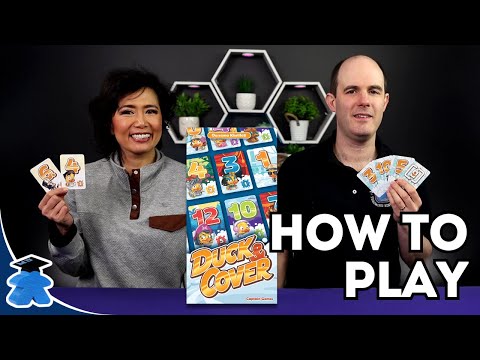
































Duck & Cover Deep Dive
What the Community Thinks About Duck & Cover
Duck & Cover has struck a chord with board game reviewers as an accessible, lighthearted experience that delivers genuine fun without demanding heavy strategic investment. The game's appeal lies in its simplicity: players understand the core mechanics within minutes, yet the experience remains engaging across its brisk 20-minute runtime. Reviewers across different channels consistently praise the game's ability to work as a casual family experience while still offering enough decision-making to reward thoughtful play.
Core Mechanics That Define Duck & Cover
Grid Manipulation and Card Movement
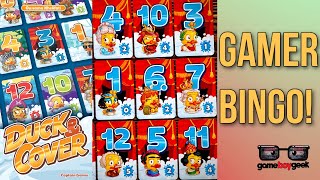
The foundation of Duck & Cover rests on a tactile grid system where each player arranges 12 numbered duck cards (1-12) in a random 4x3 layout. When the captain reveals a card from the shared deck, all players must decide what to do with their matching card. The movement options are straightforward: move the card to cover an adjacent card (the primary cleaning strategy), or duck the card by relocating it anywhere within the grid. If no matching card exists, players quack and pass. This grid-based decision-making creates the puzzle that defines each round. Players must balance immediately covering low-scoring splash values against maintaining flexibility for future draws.
Strategic Deck Depletion and Round Structure
The captain's deck of 26 cards (numbered 1-12 with two special cards: Repeat and Max) determines when rounds end. Each time all players quack a drawn card, it moves to the discard pile. Once the discard pile reaches a player-count threshold (calculated as 11 minus the number of players), the round concludes. Alternatively, a round ends immediately if any player consolidates their entire grid into a single stack, triggering negative scoring for that player. This dual end condition creates tension: players race either to consolidate efficiently or to force round-ending quacks, knowing which strategy suits their board state.
The Duck & Cover Experience
Lighthearted and Goofy Atmosphere
The quacking sound effect, duck-themed nomenclature, and the fundamental absurdity of moving rubber ducks around a bathtub grid set Duck & Cover apart as fundamentally comedic. Reviewers emphasize the game's goofy tone as part of its charm. The mechanics themselves encourage laughter: watching players scramble to avoid unfavorable moves, hearing simultaneous quacks when no one can play, and celebrating small victories like finally consolidating a problematic card. This tonal consistency means Duck & Cover works equally well as a game night closer or a casual gathering experience.
Relaxing Yet Engaging Puzzle
Despite its lightness, Duck & Cover delivers genuine cognitive engagement. The puzzle satisfies players seeking minimal rules overhead but maximum decision density. Each turn presents a concrete question: given the board state and knowledge of which cards have been drawn, is covering or ducking the better choice? Reviewers note the game avoids both extremes of being either trivially obvious or mentally exhausting. The 20-minute playtime means rounds end while tension remains high, leaving players eager to shuffle and play again.
What Makes Duck & Cover Stand Out
Accessibility Paired with Replayability
Duck & Cover's teaching time measures in seconds, yet each game feels distinct. The shuffle mechanism ensures no two grids are identical across games, and the captain's deck shuffling creates variable pacing. New players need only understand three actions (duck, cover, quack) before playing their first round. Simultaneously, experienced players develop card-counting strategies, positional planning, and risk assessment. This scalability across player skill levels explains its broad appeal.
Variable Victory Conditions and Scoring Incentives
The negative scoring for achieving a single stack rewards a specific, visually satisfying goal: consolidation. This creates a meaningful decision axis beyond simply covering the smallest numbers. Some rounds, a player might chase consolidation knowing they can reach it faster than others; other rounds, the strategy shifts to minimizing visible splash values across multiple stacks. Over three rounds, players accumulate points from both positive stacks and negative consolidation bonuses, rewarding adaptability. Tiebreaker rules (fewest visible cards in round three, then shared victory) prevent arbitrary resolution.
Potential Drawbacks
Limited Strategic Depth
While the game delivers satisfying decision-making, some reviewers note that meaningful decisions remain relatively constrained. Most rounds, covering low-value cards near your current position emerges as the dominant strategy. The randomness of card distribution in the initial shuffle and the captain's deck sequence can heavily influence outcomes, occasionally creating situations where optimal play is dictated by card luck rather than player choice. Players deeply invested in strategic control may find the outcome variance frustrating.
Randomness Dominance Over Mastery
The game's reliance on deck randomness means that multiple plays can feel samey for experienced players. Unlike games rewarding deep knowledge of deck composition, Duck & Cover offers limited replay-ability tied to personal skill improvement. A player's performance varies more with card luck than with increasingly sophisticated decision-making. For players accustomed to games with high mechanical complexity and limited randomness, Duck & Cover may feel shallow despite its engaging surface.
If You Enjoy Duck & Cover
Players who find Duck & Cover compelling typically gravitate toward light to medium-weight family games emphasizing quick teach-and-play experiences. Games like King Domino, Take Time, Hot Streak, and 5-Minute Dungeon share Duck & Cover's philosophy of minimal rules, maximum participation, and high replayability. Those specifically drawn to the grid-manipulation puzzle aspect should explore games with tile-based spatial reasoning, while fans of the comedic tone might seek out other deliberately whimsical designs. Duck & Cover fits perfectly in collections balancing competitive gateway titles with laugh-driven social experiences.
What Reviewers Are Saying
"Duck & Cover is a goofy little card game where you're trying to cover as many cards as you can to score the least amount of points."
— Banter and Boards
"I definitely enjoy it, it's one of those games where it's family weight but I have found that pretty much everyone enjoys it even though it's not the most thinky of games, it is excellent."
— Jamie, Tabletoptiktok
"This game offers a lot of randomness in the cards that come out. I think in general you want to cover up lesser, lower numbers and keep the highest number possible."
— The Board Gaming Doctor