/pic6616164.jpg)















Dungeons, Dice & Danger Deep Dive
What the Community Thinks About Dungeons, Dice & Danger
Dungeons, Dice & Danger arrived in 2022 with quiet confidence, earning recognition as one of the year's best solo experiences despite flying somewhat under the broader gaming radar. Designed by Richard Garfield and published by Ravensburger, it won over reviewers with the elegant push-your-luck tension of its roll-and-write dungeon crawl. Allies or Enemies ranked it among the best solo releases of the year, and Board Game Garden made its solo mode a personal highlight, while 3 Minute Board Games pushed back hard on its lack of creative depth. The game strikes different notes depending on expectations: those seeking intricate puzzle satisfaction find it rewarding, while some who want deeper interaction find the experience more utilitarian.
Core Mechanics That Define Dungeons, Dice & Danger
Dice Drafting Through Pair-Building
At the heart of Dungeons, Dice & Danger lies a deceptively elegant system: rolling dice and pairing them to create two numbers. The active player gains an advantage by using a black die alongside the white dice, while passive players must spend limited charges to access that same flexibility. This core loop forces constant small decisions about how to combine dice to carve pathways through the dungeon. Reviewers appreciate how the mechanic stays accessible on the surface while rewarding planning: you can instantly grasp what needs to happen, but finding the combination that advances your goals and respects the adjacency rules creates a satisfying constraint that turns randomness into problem-solving.
Damage and Monster Progression
Monsters serve as targets that both block and reward exploration. Each requires hitting specific numbers to defeat, and defeating one first earns a superior reward while later finishers earn a smaller consolation. Activating spaces beside a monster unlocks additional damage values, creating a tactical layer where players sometimes take inefficient paths to gain more ways to hurt a specific threat. Boss monsters add a wrinkle by inflicting damage on whoever defeats them first, trading immediate points for a cost. This transforms monster pursuit from a simple race into a negotiation: is beating this one worth the loss, or better left for an opponent in exchange for the smaller reward?
The Dungeons, Dice & Danger Experience
Tension and Rhythm in Solo Play
Solo mode fundamentally shifts the experience by treating the damage track as a countdown timer rather than a scoring penalty. Reviewers emphasize how this changes the feel: you cannot afford a passive turn, because every round that you fail to damage a monster, you mark off a space. The rhythm becomes constant, roll, assess, execute. Allies or Enemies describes a Sudoku-like satisfaction in rolling the dice, spotting which combinations work, and placing them, an almost meditative, puzzle-driven loop. The health bar creates escalating pressure as it empties, yet stays generous enough that games rarely end abruptly; instead, the weight of every wasted turn accumulates.
Multiple Dungeons, Distinct Personalities
The game ships with several maps, each layering unique spaces and challenges atop the core mechanics. An introductory map keeps the rules straightforward, while later ones add features like spaces requiring multiple hits or effects that strike every monster at once, escalating the complexity. Board Game Garden, having played only one of the maps, was eager to explore the rest, and reviewers generally found that each map creates a meaningfully different experience rather than feeling like a reskin, forcing adaptation rather than rote repetition of one optimal approach.
What Makes Dungeons, Dice & Danger Stand Out
Accessibility Meets Tactical Depth
The roll-and-write format means minimal setup and a game that runs entirely within its compact box, needing only dice, pencils, and sheets. That minimalism makes it forgiving to teach and instantly understandable. Yet beneath the simple surface sit real decisions: how to explore, which monsters to prioritize, and whether to take inefficient paths to unlock better damage options. The included maps provide genuine replayability without bloat, and laminating the sheets rewards players for diving back in repeatedly.
Solo Experience as the Defining Strength
Several reviewers independently single out the solo mode as the game's revelation. Allies or Enemies placed it near the top of a 2022 list specifically for its solo credentials, calling it potentially the best solo game released that year. The solo variant respects the multiplayer rules while recontextualizing the damage track as tension rather than a scoring reduction. Because the solo player must always attack, the mode naturally rewards efficiency and punishes indecision, and that structural elegance, flipping one rule from avoid-damage to always-engage, shows thoughtful design.
Potential Drawbacks
Minimal Interaction and Creative Expression
Not every reviewer embraced the game. 3 Minute Board Games, preferring roll-and-writes with deeper engagement, felt it leaned too hard into pure box-ticking. There is little player-to-player interaction, since everyone makes their own pairings and marks their own sheet, with no negotiation, take-that, or contested board state. And unlike roll-and-writes that invite drawing and creative flourishes, this one amounts to crossing off numbers and marking damage boxes. For players seeking those elements, the minimalism can read as emptiness rather than elegance.
Push-Your-Luck Driven by Randomness
The core loop's tension depends on favorable rolls and available combinations. Some turns yield several strong options; others leave you scrounging for any valid move. The game never feels entirely at the mercy of chance, since the pair-building and adjacency rules create levers to pull, but the upper bound of your options arrives with the dice. Players frustrated by dice-driven games will find little solace here, since dry spells where the numbers do not align with your dungeon state can stall progress.
If You Enjoy Dungeons, Dice & Danger
You might explore other modern roll-and-write titles that tackle the genre in different ways. Cartographers trades dungeon combat for territory mapping, offering a gentler, more strategic puzzle. Hadrian's Wall layers far more complexity and construction for players seeking intricate optimization. Welcome To... delivers the flip-and-write experience with a city-building bent and constant tough choices. And for roll-and-write variety in a single box, Rolling Realms, also by Richard Garfield's contemporaries, packages many quick puzzle types to chase in succession.
What Reviewers Are Saying
"It has a bit of a Sudoku feel, just that satisfaction of you roll your dice, see what combos you can make, and putting it in."
— Allies or Enemies
"This was so much fun to play, it is just so fun. There's four different maps, and we've only played one of them, and I'm excited to explore the other three maps."
— Board Game Garden
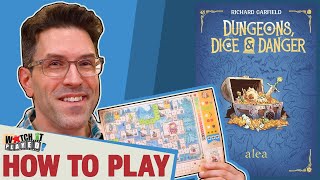
"This is a two to four player game, Dungeons, Dice and Danger, designed by Richard Garfield and published by Ravensburger."
— Watch It Played